
11 October 2026
A Broken Brake Pedal Exposed a Gap in China's Car Standards
Dongchedi tested three Zunjie V800 luxury MPVs in 100-0 km/h braking and reported the brake pedal bracket fracturing in all three, topping Weibo's trending list. The bracket is a glass-filled plastic part, and the dispute turns on a gap between China's quantitative industry standard and national standards that set no load or material requirement. Within 48 hours CATARC surveyed automakers, four ministries published a draft on design validation, and JAC's shares hit the limit down.
On 8 October, the Chinese testing platform 懂车帝 (Dongchedi) published a video in which three brand-new Zunjie V800s each performed a 100 km/h to 0 emergency stop. In all three, the brake pedal bracket fractured, and the vehicles lost braking ability, according to the video. The hashtag #尊界V800刹车踏板支架断裂# went to the top of Weibo's trending list.
The V800 is not an anonymous car. It is the first MPV from Zunjie (尊界), the luxury brand built by JAC under Huawei's HIMA partnership, launched on 5 August 2026 at 766,000 to 1,016,000 RMB, aimed at the executive market occupied by the Toyota Alphard. It claimed 3,500 firm orders in 24 hours and more than 10,000 during a 23-day pre-sale, and it is marketed on Huawei's 途灵龙行 platform with, in the company's phrase, eight-system full-link redundancy. By the close on 8 October, JAC Motors was limit-down at 24.72 RMB, down 10.01%, with a market capitalisation of about 55.7 billion RMB and more than 360,000 lots queued at the floor. The stock had risen more than 40% in the six sessions before, on reports of a possible Huawei–Stellantis tie-up.
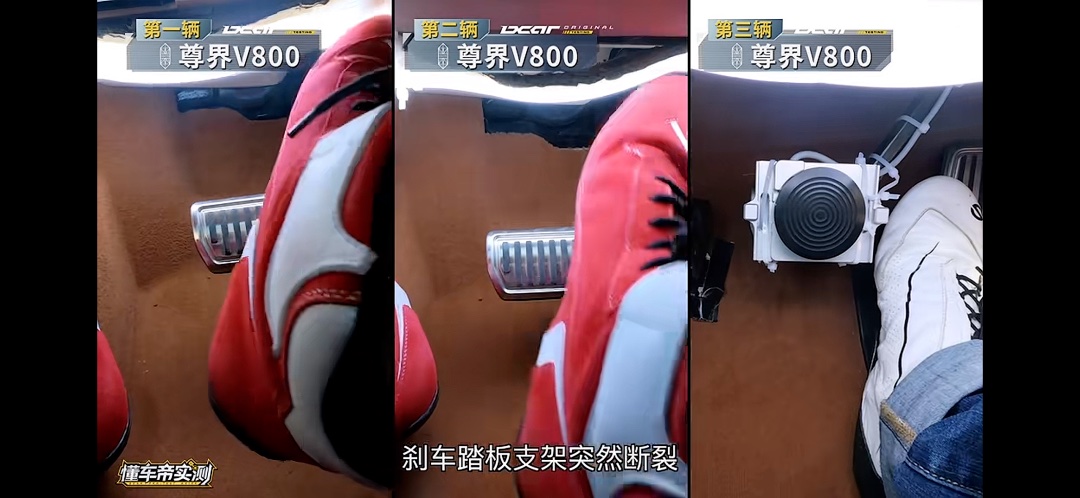
Three cars, three tests, one caption: "the brake pedal bracket suddenly fractured." Image: Dongchedi, via the People's Daily report of the case.
What is not in dispute
- The part that failed is the bracket base beneath the pedal, not the pedal arm itself.
- Dongchedi says the peak pedal force in its test was 1612 N, and that the widely circulated "4589 N" figure is an artefact: the high-speed camera and the test rig's display refresh at different rates, so the screen digits were captured mid-change and produced a ghosted number that was screenshotted and spread as fact.
- Dongchedi's position on the test: 100 km/h to 0 braking is "not an extreme condition" — one of the most basic real-world tests, and something drivers meet on a motorway. It adds that the part broke at the same location in three consecutive cars, which it treats as a possible safety hazard.
- Zunjie's own statement, published the same evening, says the braking system was developed and validated above the national standards (GB 21670-2025 and GB 7258-2026) and above the industry standard (QC/T 788-2018); that no such failure has occurred in customer use since first deliveries; that it will optimise the part and offer delivered owners a free upgrade; and that it will systematically review design validation, test boundaries and production quality management.
What the statement does not do is also notable. It describes the test as non-standard and extreme, it does not name a root cause, and — as Chinese commentators pointed out within hours — it does not contain the word "recall".
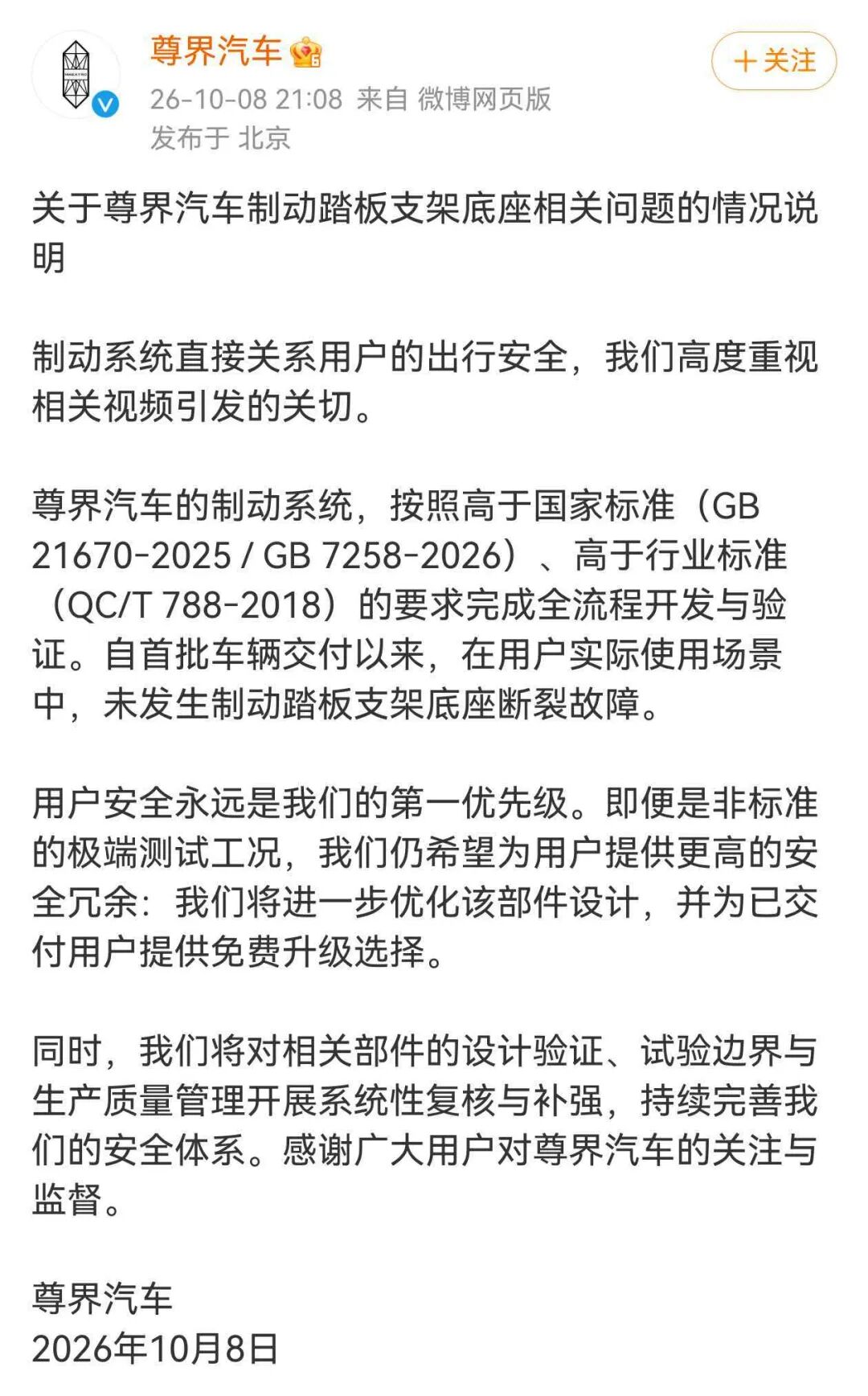
Zunjie's statement: above national and industry standards, no failures in customer use, a free upgrade for delivered cars. Image: Zunjie Motors on Weibo.
Update: a retrofit from November, and a registration the owner has to make
On the afternoon of 11 October, Zunjie customer service confirmed to reporters — including 长安街知事 and 哈尔滨日报 — the first concrete remediation timeline:
- the upgrade plan for the brake pedal bracket base is expected to be confirmed by the end of October;
- upgrades begin progressively from November;
- cars not yet shipped will be upgraded at the factory before delivery, with nothing required of the buyer;
- owners who have already taken delivery must register — at any of the brand's service centres nationwide, or through the store that sold them the car — after which the service centre contacts them.
The plan itself is not yet final, so no technical detail of the upgrade has been published.
Two things about that are worth noting. The company's language is still "free upgrade", not a recall — the same point commentators made about the original statement. And the retrofit puts the initiative on the owner: for a life-critical safety part, a process that depends on each owner seeing a notice and booking an appointment leaves an obvious question about the cars whose owners never do. That was the criticism made on Weibo by the account that carried the timeline, in blunter terms — that a brake pedal is not a promotional giveaway that customers should have to queue and register for.
The technical dispute is about a material and a gap
According to Dongchedi's teardown, the pedal assembly is a metal pedal arm with an engineering-plastic bracket marked PP-GF40 — polypropylene reinforced with 40% glass fibre. That material choice sits at the centre of the argument, and so does a gap between two sets of rules: the industry standard is quantitative, while the national standards are written as principles. We set the numbers out below.
So a plastic bracket is not unlawful. It is lawful if equivalent performance can be demonstrated — and the industry's numbers were, as one source put it, written around metal: high yield strength and elastic behaviour. A composite fails differently. A materials specialist quoted in the coverage put it bluntly: at equal cross-section, steel is stronger, more resistant to temperature extremes and ageing, and it bends before it breaks; PP is comparatively prone to brittle fracture when cold or aged. His conclusion: "the material itself is not the problem — the safety ceiling of a plastic bracket depends on how much margin the manufacturer leaves."
An industry figure close to JAC made the counter-point that matters for the whole market: many models already use non-metallic composite brackets, "not one brand or model" — it is a lightweighting decision that arrived with electrification. If that is true, the V800 is a symptom rather than an outlier, and the standard is the thing that is out of date.
How strong should a pedal be? The standards, and the margins
It is worth getting the standards question right, because it decides whether this is a defect story or a regulation story.
- QC/T 788-2018, the industry standard, is the quantitative one: hold the pedal under roughly 1,500 N for five seconds, five times, with no cracking and residual deformation no greater than 5 mm.
- GB 7258 — cited as the 2017 edition in the explainer, while Zunjie's statement refers to GB 7258-2026 — constrains the other end of the scale: a passenger car at maximum braking performance should require no more than 500 N of pedal force. So 500 N is the force a person can reasonably apply; 1,500 N is the force the part is required to survive.
- GB 21670-2025, the passenger-car braking standard, sets no specific load figure. It requires that the pedal and bracket not visibly deform in normal operation, and that their material performance carry the same safety characteristics as other critical parts such as steering connections — in the standard's framing, "a component not prone to failure".
Two further numbers give the 1,612 N fracture its context. According to 澎湃新闻's explainer, the same Dongchedi test ran eight other models, each completing six full-force stops at average pedal forces above 1,600 N without damage to pedal or bracket. And manufacturers' own design margins sit well above the regulatory minimum: Porsche's MSB platform sets the pedal fracture load at 3,000 N, and a 2007 General Motors engineering specification set it at 2,700 N.
There is also a design reason a pedal can be meant to give way. In a severe frontal crash the driver is usually braking hard, and the pedal can transmit impact force back into the right leg — which is why "anti-intrusion" pedals are designed to detach or collapse on impact, using crush grooves, crush rivets or plastic limit pins. That behaviour is triggered by crash loads and is a different mechanism from fracturing under sustained hard braking on a test pad; the two goals are met by different structures in the same car.
What the video analysis claims
Dongchedi's teardown segment makes specific structural allegations, which Zunjie has not answered publicly:
- the pedal's centre sits far from the pivot, and the pivot area is supported by a single vertical plate, where comparable models using the same supplier and the same material have two to three reinforcing plates;
- the fracture site shows a weld line, with wall thickness and ribbing judged too weak — potentially leaving the plastic part locally under-strength;
- the three cars, from different production batches, failed in the same mode within three days — on the second, third and fourth full-force applications respectively — which the tester treats as evidence this is not an isolated fault;
- with the pedal gone, foot braking was lost entirely, leaving only the P (park) emergency brake; the measured braking distance went from about 38 metres to about 140 metres, and the owner's manual itself warns that the P-park emergency function carries a risk of losing control.
Those are one tester's findings from its own test and teardown, not an independent engineering assessment. They are also, so far, unanswered.
The fallout went industry-wide in about 48 hours
- 9–10 October — CATARC opens a survey. The China Automotive Technology and Research Centre, a central state enterprise that carries out standards research for the Ministry of Industry and Information Technology, sent automakers a questionnaire on brake pedal assembly materials, focusing on non-metallic applications. Changan confirmed it received the questionnaire on 9 October. Industry sources read the survey as preparation for revising QC/T 788-2018.
- 10 October — four ministries publish a draft. MIIT, the Ministry of Public Security, the Ministry of Ecology and Environment and the State Administration for Market Regulation released a draft notice for comment on strengthening the management of automotive product innovation design and R&D test validation, with specific requirements around virtual controls, door handles, new HMI systems and large-angle seats. The timing is suggestive rather than proven — the drafting may well predate the incident — but Chinese commentary immediately framed it as an answer to the "rush-built car" (速成车) problem.
- 11 October — People's Daily weighs in. Its commentary, "Four departments join hands to say no to 'rush-built cars'", states the one thing it treats as beyond argument: "a car's brake pedal must never break while driving." It defines rush-built cars as models pushed to market by over-compressing development cycles and cutting real-vehicle validation, and quotes Li Fenggang, general manager of Beijing Hyundai, from the 2026 China Auto Forum: "some brands, to pursue launch speed, didn't do many of the tests they should have. Consumers became 'test drivers'."
- 11 October — the industry association follows. CAAM issued an initiative calling on the whole industry to take responsibility for product quality and safety, "strictly guard the safety bottom line, standardise innovative design, discard the irrational innovation model that values form over safety", and move safety assessment to the front of the innovation process.
- Executives started posting their own pedals. Voyah chairman Lu Fang posted a photograph of Voyah's pedal — "multi-layer high-strength steel main beam" — with the argument that "whether steel or plastic is not the point; what matters is the safety philosophy, the bottom line and the principles behind a design, and whether a company has a development and quality system that accumulates". GAC Honda's vice president did the same for the Accord, and Dongfeng Peugeot-Citroën and BYD's Yangwang joined in. It was a co-ordinated-looking demonstration of where everyone else stands.
The argument inside China did not split along brand lines
Hu Xijin, the former Global Times editor with a very large following, made the argument that cut through the partisanship: whatever the intent behind the test, "as long as Dongchedi's tester used a foot on the pedal rather than an external mechanical force, the V800's bracket breaking is unacceptable, and the problem is serious." He noted that Dongchedi also tested Luxeed and Aito braking systems without failures, and concluded that this points not to a systemic HIMA defect but to a problem in the V800's hardware design, procurement or quality control. Then he raised the question the whole episode turns on: if the car genuinely meets the standard and was still broken by a human foot, then the standard is what needs revisiting, with more margin built in.
The other camp argues the opposite: an ordinary emergency stop is around 500 N, a strong one perhaps 700 N, so how did a tester reach 1612 N, let alone the phantom 4589 N? One widely shared response answered in the opposite direction — that advising drivers to brake "moderately" or "at the right angle" in an emergency is dangerous, because the only correct technique is to press the pedal to the floor.
There is also a structural fact worth noting: Dongchedi says its braking test has now been run on more than 2,000 vehicles, and it built a dedicated page for the V800 result. A commercial review platform has become a de facto safety auditor, which is part of why the official response moved as fast as it did.
Why this reaches beyond one brand
Three things make this more than a bad week for one luxury MPV.
First, the standards gap is generic. If the national standards really do set no quantitative requirement for a load-bearing safety part that is migrating from metal to glass-filled plastic across the industry, then the question "how much margin is enough?" is currently answered by each manufacturer's internal process. That is precisely the kind of gap a regulator exists to close, and CATARC's questionnaire suggests it is being closed.
Second, launch cadence is now a regulated variable. The four-ministry draft and the People's Daily commentary connect product safety to development time and validation depth — the first time the speed of China's model cycle has been put in those terms at that level. Any brand that has been compressing validation to hit a launch window should expect to be asked about it.
Third, it matters for exports. Chinese brands selling into Europe, Australia and elsewhere face type approval that asks questions about safety-critical components in exactly this way, and a quantitative Chinese standard for non-metallic pedal assemblies would be an export credential rather than a barrier. The reverse is also true: a defect that becomes a national story travels with the brand.
Caveats
- The remediation is announced, not executed. The upgrade plan is not final until the end of October and no technical detail has been published; a November start is a stated intention, not a completed action.
- The retrofit places the burden on owners. Delivered cars require the owner to register at a service centre or their selling store; only unshipped cars are upgraded at the factory. What happens to cars whose owners never see the notice has not been addressed.
- The standards figures circulating are not fully consistent. A widely relayed report describes a national requirement of "2,000 N held for five seconds"; the detailed explainer we relied on states that GB 21670-2025 sets no specific load figure and that the 1,500 N figure belongs to QC/T 788-2018. We could not read the standards directly.
- The structural claims and the 38 m to 140 m braking figure come from Dongchedi's test and teardown, not from an independent assessor, and Zunjie has not responded to them.
- There is no authoritative conclusion yet. Zunjie and Dongchedi dispute the characterisation of the test, and no independent third-party assessment has been published.
- The 4589 N figure and its explanation are Dongchedi's. The camera-refresh artefact is plausible and specific, but we cannot verify it independently; the 1612 N peak is also Dongchedi's number.
- The PP-GF40 material comes from Dongchedi's teardown. Zunjie has not confirmed the material, and a pedal supplier asked about it said it was bound by a confidentiality agreement.
- The description of the standards gap comes from industry sources quoted in Chinese media. We have not read GB 21670-2025, GB 7258-2026 or QC/T 788-2018 directly, and the CATARC questionnaire is not public.
- Causality between the incident and the four-ministry draft is not established. The draft may have been in preparation for months; Chinese commentary links the two, and we report the timing rather than assert the connection.
- The share price move is a market reaction, not a finding of fault.
- No road-failure evidence has been published in either direction. Zunjie says there have been no failures in customer use; Weibo's chief executive made the reasonable point that the central question is whether there is any record of an accident caused by the brakes, and no such record has been produced.
- This article is built on Chinese-language sources — the company statement, Dongchedi's public response, the People's Daily and CAAM texts, CATARC reporting and social media. Where those sources disagree, we have said so rather than picking a side.
The bottom line
Strip away the tribal argument and this is a straightforward question with a testable answer: was the bracket under-designed, or was the standard it was measured against inadequate for the material it was made from? The industry has already answered the second question by starting to rewrite the standard. The first will be answered by the investigation — and, for the owners of the cars already on the road, by whether the "free upgrade" becomes a recall in all but name. The retrofit that begins in November is the first evidence either way, and a process that depends on owners registering themselves will be judged by how many of them do.
Source: Dongchedi's published test, response and teardown analysis; Zunjie Motors' statement of 8 October and its customer-service timeline of 11 October as reported by 长安街知事/哈尔滨日报 and 澎湃新闻; 澎湃新闻's explainer on the relevant standards; the People's Daily commentary of 11 October; CAAM's initiative; CATARC reporting via 新华财经/红星新闻; 证券时报's market coverage; and the Weibo discussion of #尊界V800刹车踏板支架断裂#, including 烟隐烟隐's post of 11 October on the upgrade process — translated & adapted for XPENGTech.
Updated 12 October 2026 with the November retrofit timeline, the customer-registration process, the standards and design-margin figures, and Dongchedi's teardown allegations.
Get the next one direct.
New articles, or a daily / weekly digest — the same list EVConduit keeps.