
23 October 2026
The 460,409 km XPeng X9 Tests at 91% Battery Health
The 460,409 km XPeng X9 has been through the used-car inspection: a service order records 91% battery health at 460,349 km, with normal cell voltage spread and about 423 km of range on a full charge claimed. The owner, a Shanghai cross-city operator, says he saved 300,000+ yuan in fuel and bought a second X9. The result set off a trending hashtag arguing 460,000 km is nothing special for Chinese ride-hail EVs, especially LFP packs - while the 91% is the part that is.
The XPeng X9 with 460,409 km on the odometer has been through the used-car inspection, and the number that decides its fate came back at 91%. A service order photographed during the inspection carries the line item "车辆电池健康度SOH91%" — vehicle battery health, state of health 91% — at an odometer reading of 460,349 km. The inspecting dealer says the pack's cell voltage spread is within a normal range, that no cells have failed, that the underbody hardware shows no problems, that charge and discharge capacity are unchanged, and that the car still runs about 423 km on a full charge — roughly 40 km less than when new.
On 30 October, XPeng Group vice-president 托马斯电火车 posted the result to Weibo: a 460,000 km X9 with battery health "as high as 91%", still holding its value in the second-hand market, and an owner who has re-bought an X9 and recommended five more. By 19:21 Beijing the post had 2 reposts, 28 comments and 131 likes. The dealer behind the inspection is 北瀚行阿力, who published the 230-second video on 27 October under the title "Can you still buy a 460,000 km XPeng X9?" The stills, the service order and the owner interview all come from that video.
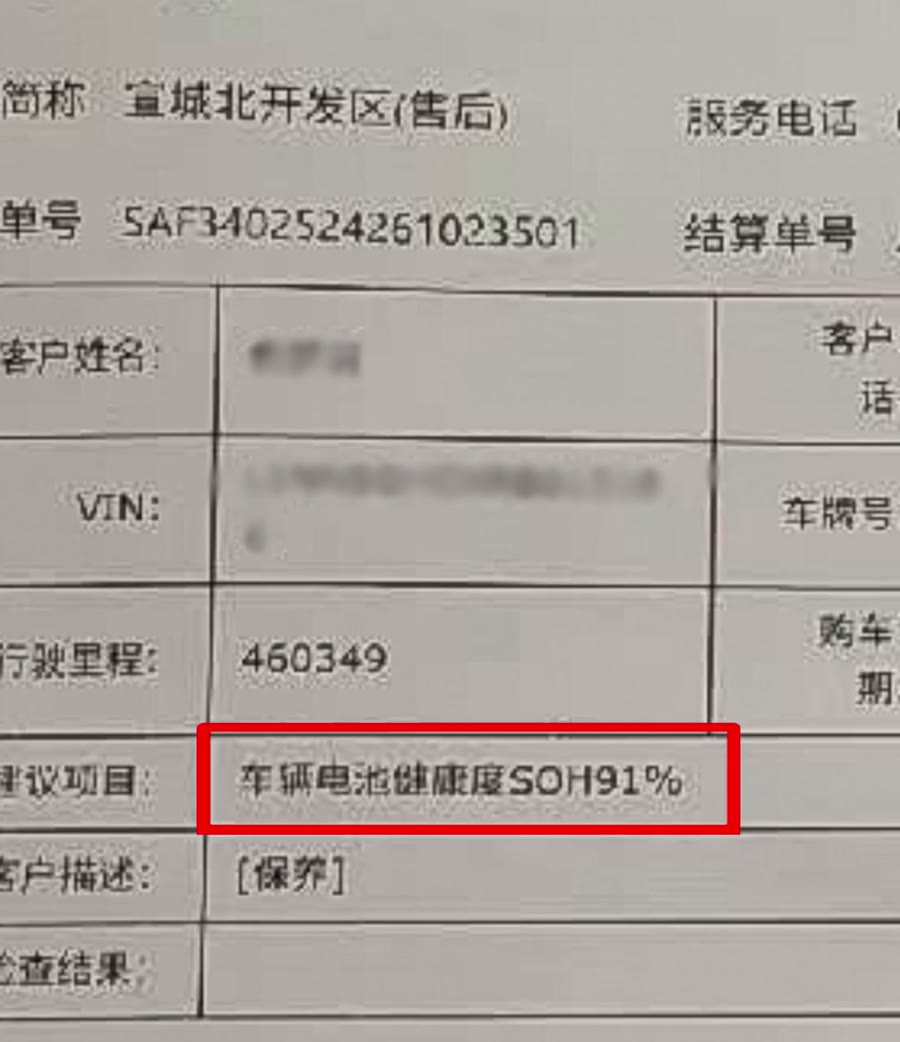
A service order photographed during the inspection: 460,349 km, and "vehicle battery health SOH 91%" in the red box. Image: 北瀚行阿力 on Weibo.
What the test found
| Item | Result |
|---|---|
| Battery state of health | 91% (service order) |
| Cell voltage spread | Within a normal range, per the dealer |
| Failed cells | None, per the dealer |
| Charge / discharge capacity | Unchanged, per the dealer |
| Full-charge range | ~423 km, about 40 km less than new |
| Odometer on the service order | 460,349 km |
| Odometer on the cluster (23 October) | 460,409 km |
The two odometer readings are 60 km apart, which is consistent with a car still being driven between the service visit and the inspection.
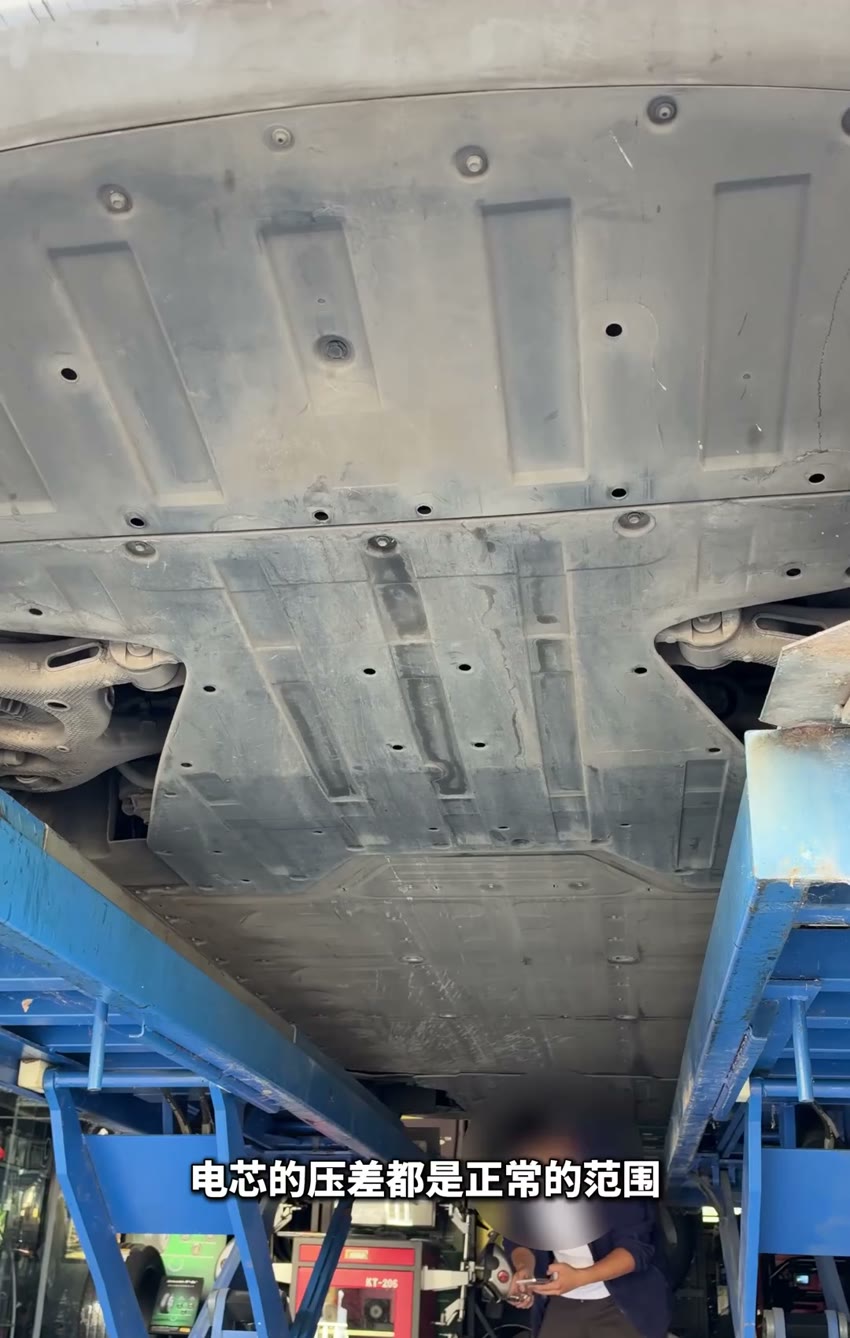
The pack from below, during the inspection. The dealer says the cell voltage spread is normal. Image: 北瀚行阿力 on Weibo.
The car and the odometer
The first report, on 23 October, was three photographs and a promise of test results. The car's own mileage screen is still the only place the bigger number appears:
| Reading | Value |
|---|---|
| Total distance (总里程) | 460,409 km |
| Trip meter A / B (里程小计) | 99,999.8 km each — both counters maxed |
| Distance since last charge | 0 km |
| Remaining range / state of charge | 426 km / 73% |
The 99,999.8 km trip meters are the detail that dates the car's use: each has run to the end of its five-digit-plus counter and stopped, which is what happens to a car doing this kind of distance rather than to a weekend vehicle.
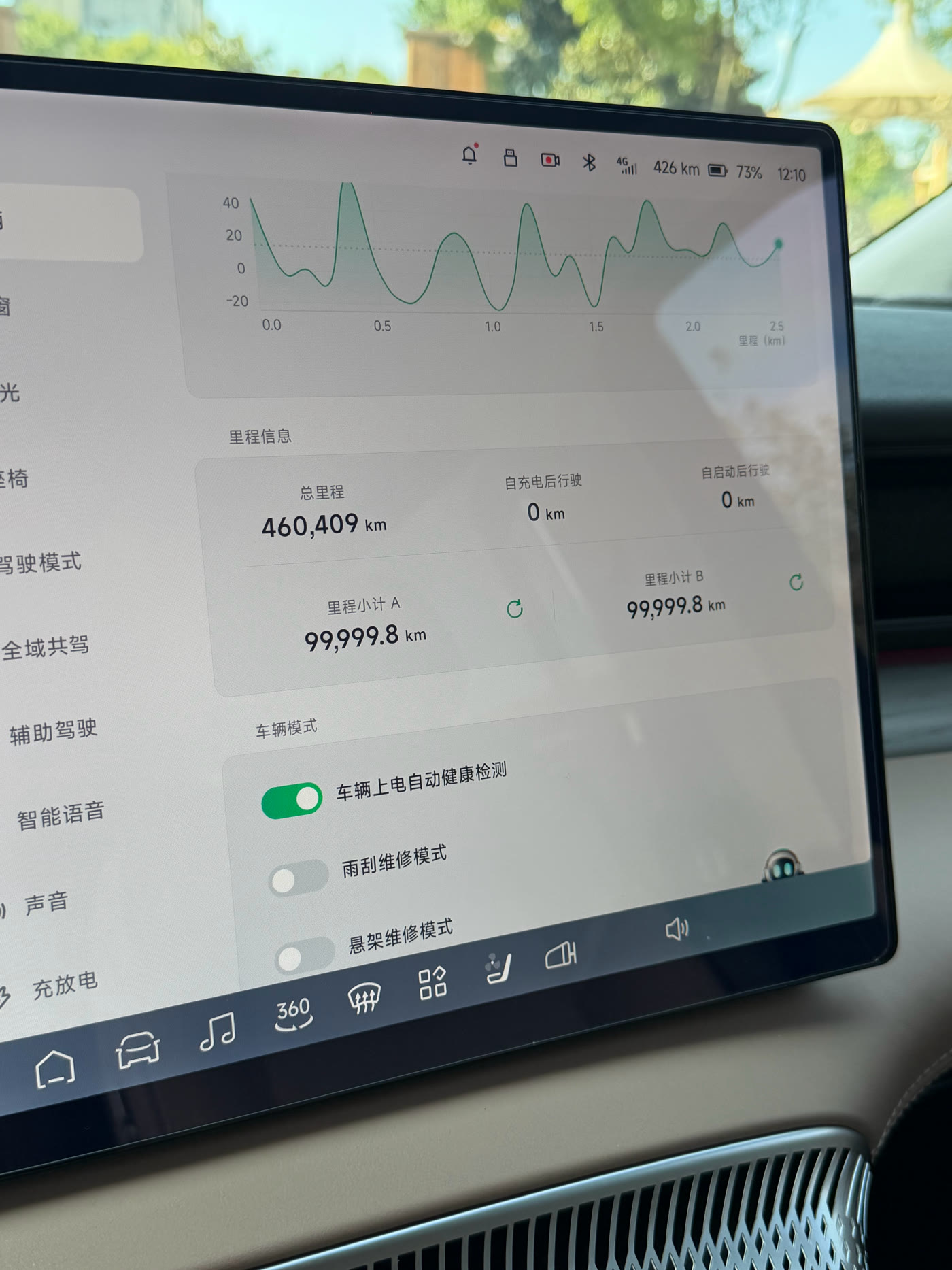
The car's mileage screen. Image: via 北瀚行阿力 on Weibo.
The X9 went on sale in January 2024 at 359,800 to 419,800 RMB, with 2,478 delivered in its first month. The car in question was bought new in 2024 for more than 370,000 yuan; two years of cross-city work later, it had covered 460,000 km — about 600 km a day, and not a private car's pattern.
The owner: two years, 600 km a day, 300,000 yuan of fuel
The owner is 洪先生, a Shanghai operator who previously ran a restaurant and now does cross-city passenger transport. He says he drives about 600 km a day; over roughly two years that is the 460,000 km on the clock. The arithmetic holds: 460,000 km over about 730 days is a little over 600 km every day, Sundays and holidays included.
He bought the X9 for more than 370,000 yuan, and says he has saved more than 300,000 yuan in fuel over the period. The supply-chain account 烟隐烟隐, which recapped the numbers, adds that the car has earned him 700,000–800,000 yuan — an estimate of the business, not an audited figure, and we have not independently verified it.
The strongest part of the story is what he did next: he bought a second X9, which has now covered 220,000 km, and says he recommended the model to friends. XPeng's post puts that at five referrals. An operator who has just run one X9 to 460,000 km choosing another is a stronger signal than any single test result — provided the first car's record is what the dealer says it is.
What 91% means — and what it does not
- It is a service-centre reading, not an independent test. The figure appears as a line item on a service order photographed in a video. We are not shown the tool, the state of charge or the temperature, and the dealer has a commercial interest in the car's condition.
- The company amplified it. The result was relayed by XPeng's own vice-president, which does not make it wrong, but it does mean the distribution is a manufacturer endorsement rather than independent reporting.
- A health percentage is an estimate of usable capacity. A car can read 91% and still lose more range than that if its thermal behaviour or charging curve has changed; the 423 km figure is the practical check, and it comes from the same dealer.
- No pack replacement is disclosed. If the pack had been swapped under warranty, 91% would say nothing about a 460,000 km pack. The video does not discuss service history.
- One car, chosen because it is remarkable. Other high-mileage EVs have not fared as well — see the P7 below — and a single 91% is an anecdote, not a fleet average.
The economics: 40,000–50,000 yuan off
The dealer's valuation is the part a buyer would actually use. A same-model X9 with normal mileage is being bought at around 210,000 yuan; this one was marked 40,000–50,000 yuan lower — roughly 160,000–170,000 yuan. For the owner, two years of fuel savings at 300,000+ yuan more than covers that discount. For the next buyer, the discount is the price of the odometer.
That is the trade the story describes: a car that has done 460,000 km is no longer worth much as an asset, but it has already paid for itself in operating savings. The 91% is what makes that trade legible.
Other XPengs that have gone the distance
Taken together, the documented high-mileage XPengs sketch what distance does and does not do to these cars.
A 410,000 km P7, still working as a taxi (July 2026). The reviewer 张抗抗KK hailed one in Shanghai and got the owner's account. It runs CATL's 811 cells in the 110 mm pack XPeng developed for the original P7. The driver's answer on degradation was "about 50" — and the follow-up question mattered, because he meant 50 km, not 50%: a full charge still displays 706 km and the car does "a bit over 500 km" in real use, about 50 km less than when new. The weak point was not the battery but the motor, replaced three times, the last with a different supplier's unit, after which it stopped failing. Window cables were replaced roughly annually because of how often the windows move in taxi service. The 820A-era infotainment was still responsive; the driver navigated by phone.
A 700,000 km car that the poster had to correct (August 2026). The account Mr圆周率 posted a dashboard showing 700,000 km and attributed it to an X9 — then corrected himself in the same post after other owners pointed out the cluster was not an X9's and was "probably an old P7". He kept the distance, dropped the model. The episode is a useful reminder of how easily a number acquires the wrong car.
XPeng's own durability line (October 2026). At the Paris motor show the company's European R&D head, Wu Meng, said the previous-generation G9's pack still showed about 90% health after 2,000 cycles, which he described as equivalent to one million kilometres. That is a manufacturer's claim about a test bench, not about a 460,000 km car in a compound, but it is the number XPeng is putting against the question.
Is 460,000 km actually a lot? The hashtag's answer
The inspection result became a trending topic on 30 October — #一台电车跑46万公里是什么水平# ("what level is 460,000 km for an electric car?") — and most of the replies argued the distance itself is not unusual in China; the 91% is the part worth arguing about.
- 刘道静ssr (30 October; 42 likes, 141 comments): EVs running hundreds of thousands of kilometres "are not rare at all, especially ride-hail cars, and especially with lithium-iron-phosphate batteries — there are a great many cases". His closing line: "LFP is a gift from God to the Chinese people."
- Nice科技匠 (30 October): Taiyuan swapped its entire taxi fleet to BYD EVs in 2016 — 8,600 cars — and at the end of their eight-year service life the longest had covered 1.4 million km, the shortest 900,000. On that benchmark, a 460,000 km private car is not near the top of Chinese EV mileage.
- 梁一鸣Max (30 October): "A normal EV does 200,000 km without trouble — ask any ride-hail driver. In Shenzhen I asked several: 200,000–300,000 km, no battery problems. This XPeng is going too far at 460,000 km." His punchline: the fuel saved "could buy a luxury car".
- 齐宇的车与家 (30 October, video): 460,000 km in two years at about 600 km a day, battery health still 91%, fuel savings above 300,000 yuan.
That is a useful counterweight to the headline. The milestone says less about whether an EV can last — Chinese ride-hail fleets settled that — and more about which pack got there and what the state-of-health reading actually means at that distance. It also explains XPeng's enthusiasm: on a taxi-fleet benchmark, a 460,000 km X9 with 91% health is ordinary in distance and unusually well documented in data.
The caveat is the obvious one: the taxi figures are social-media claims rather than a published fleet study, and a taxi's duty cycle — LFP packs, daily deep cycling, fleet maintenance — is not a private car's.
What it settles, and what it does not
- The pack. Answered, provisionally: 91% at a service visit near 460,000 km, with normal cell spread claimed. It is the first hard number on a car this far out.
- The motors. Not answered. The dealer says the hardware is in good condition, but the video gives no motor history — the 410,000 km P7's one real defect was three motor replacements, and this car's record is not disclosed.
- The warranty boundary. The car is far outside XPeng's five-year/120,000 km whole-vehicle cover and its eight-year high-voltage term, so any work from here is at the owner's or buyer's expense. A 91% reading at 460,000 km is out-of-warranty evidence — which is exactly what makes it useful.
Caveats
- The result was relayed by XPeng's vice-president and produced by a dealer with an interest in the car's value; the original service order is a still in a video, not a document published in full.
- "Normal range" for cell voltage spread is not quantified, and the service order's line reads as a recorded suggestion rather than an independent test report.
- The range figures are different readouts. The dealer's 423 km is quoted as a full-charge range (WLTC); the 23 October cluster photo showed 426 km remaining at 73%. They are not the same number and should not be combined.
- The odometer is a photograph of a screen, and the VIN is blurred on the service order; no VIN-linked service history has been shown.
- Anecdotes are not a sample. The 410,000 km P7, the 700,000 km car and this X9 are all selected because they are remarkable.
The bottom line
The number landed, and it is a good one: 91% at 460,000 km, with the cell spread and charge behaviour the dealer describes. The honest reading is narrower than the headline — one car, one service-centre reading, amplified by the company that built it — but it is the first real data point at this distance, and it lands on the side of the pack holding up. The more useful numbers for anyone buying one are the 40,000–50,000 yuan discount and the 423 km range, not the percentage.
Source: the Weibo posts by 北瀚行阿力 (23 and 27 October 2026), XPeng Group vice-president 托马斯电火车 (30 October 2026) and 烟隐烟隐's recap, with the dealer's inspection video and the service order it shows, plus the #一台电车跑46万公里是什么水平# discussion (30 October 2026) — translated and adapted for XPENGTech.
Get the next one direct.
New articles, or a daily / weekly digest — the same list EVConduit keeps.