
22 October 2026
He Xiaopeng: Skip L3, L4 in Late 2028, Three Metrics for the Second Half
He Xiaopeng used the WICV 2026 plenary panel to argue the industry should skip L3 and plan L2 and L4 together: L4 technology mature in late 2028, policy between 2028 and 2032, Robotaxi first because it demands a 100-fold safety factor. His three metrics for the second half are safe collision mileage, all-scenario coverage and the share of users willing to pay.
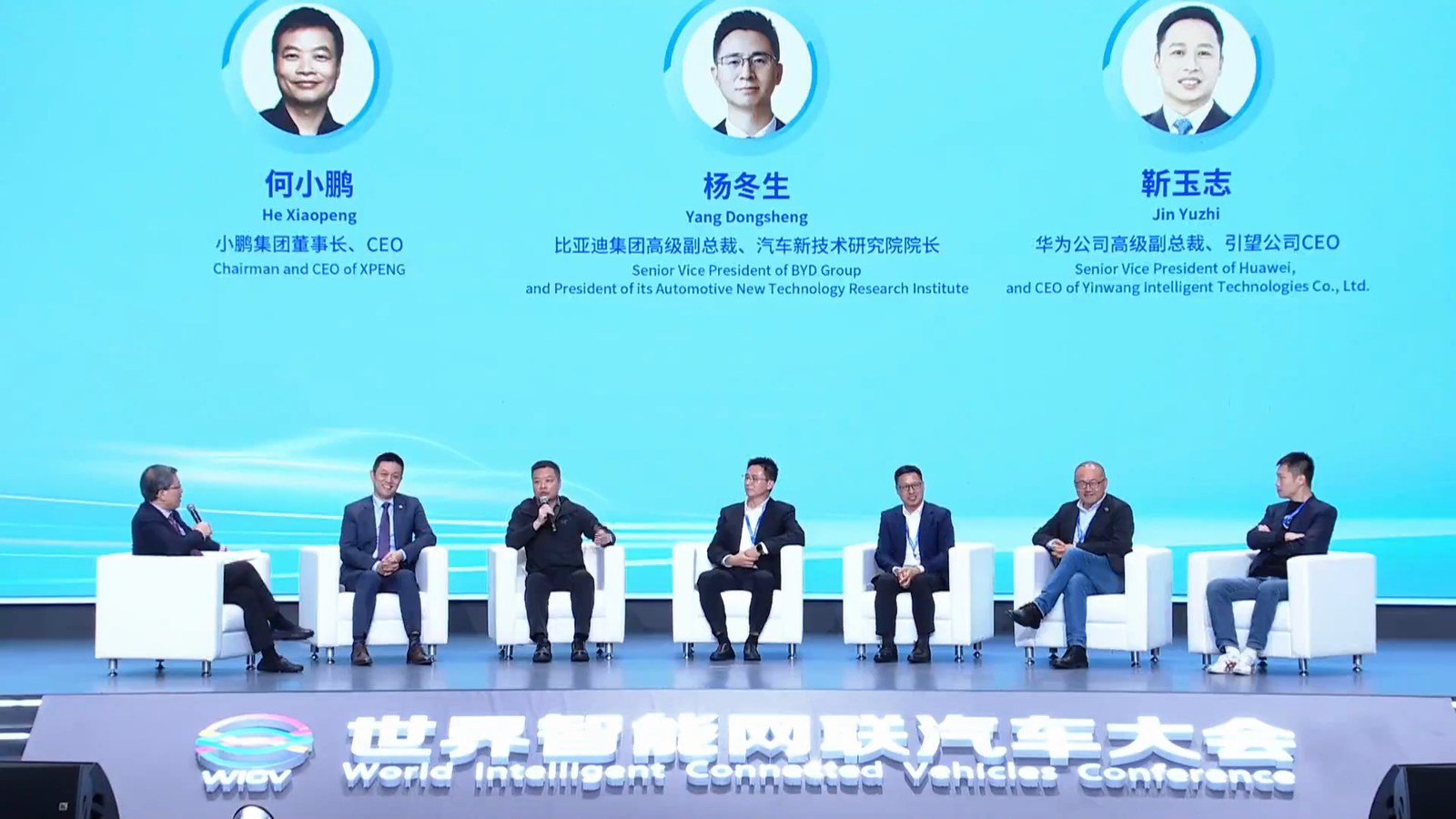
On the afternoon of 21 October, on the plenary stage of the 2026 World Intelligent Connected Vehicles Conference (WICV) in Beijing, XPeng chairman and CEO He Xiaopeng was handed the microphone and asked a blunt question: when can people buy your product?
What he gave back was not a product date. It was an argument that the industry has the ladder wrong.
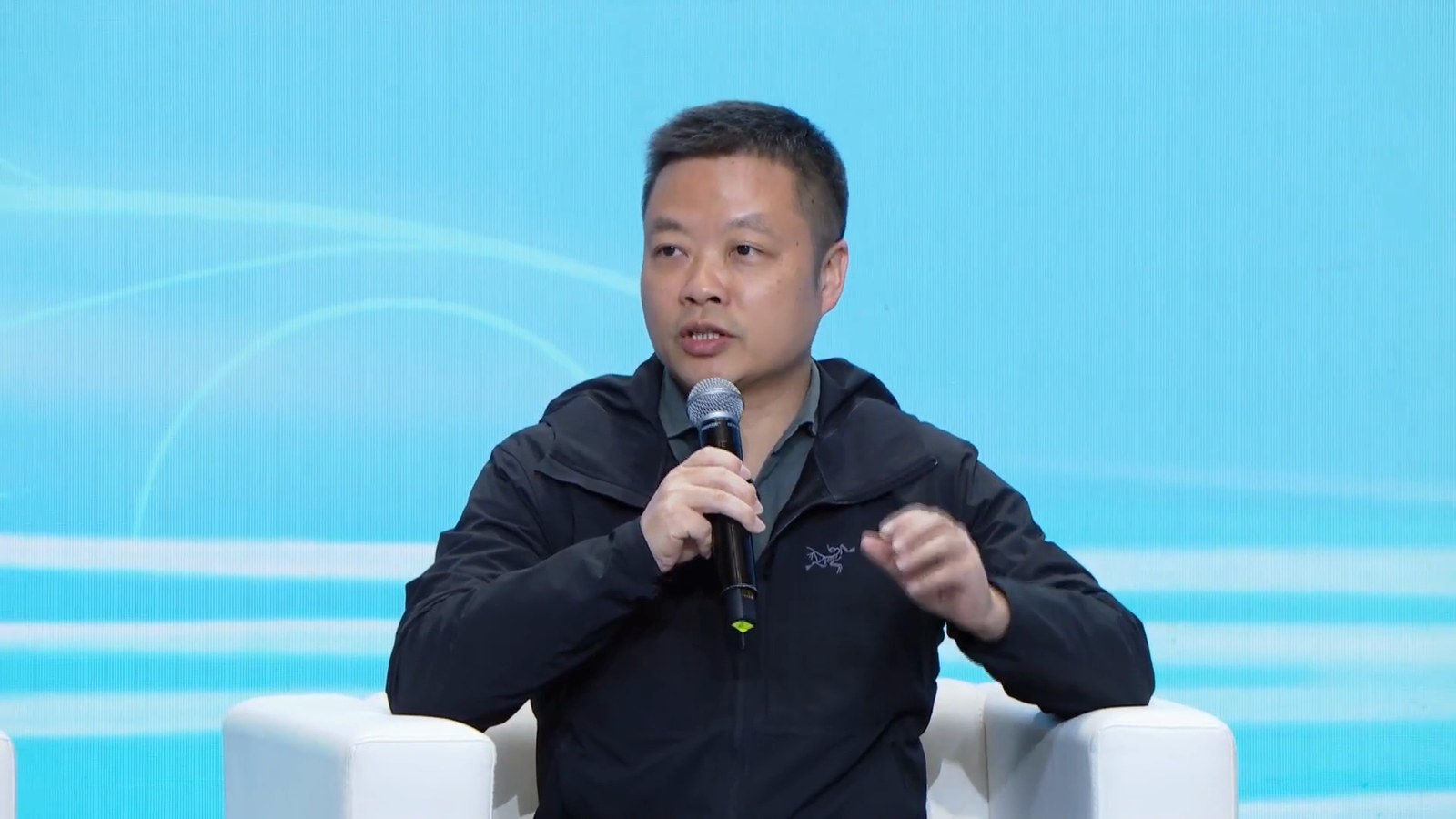
▶ Watch the eight-minute cut — the conference's own English interpretation, with English captions. The plenary ran 14:00–18:00; his two turns are at 1:43:46 and 2:07:09 of the full 4h41m replay.
Seated beside him: Li Bin of NIO, Yang Dongsheng of BYD, Jin Yuzhi of Huawei's Yinwang, Yu Kai of Horizon Robotics and Cao Xudong of Momenta, with Zhao Fuquan of Tsinghua moderating. Six companies that between them supply or build most of China's assisted driving, on one stage, for forty-five minutes.
"We skip L3"
The moderator asked him to be brief and answer two things: when does the technology land, and when can someone buy it. He answered neither directly.
"I treat L2 and L4 on the same level. We skip L3. Is L3 really safer? I put a question mark on it."
In Mandarin it was more pointed still — 是L3是不是更安全,我首先打一个问号 — "first of all, I put a question mark on whether L3 is safer."
His evidence was Audi's L3, which is legal on a limited set of European motorways. He says he had it for a day and drove "a few minutes" under it. "It hands the responsibility over to the system, but the experience is not optimised and safety is not improved. Most importantly, safety is not improved." L3, in his framing, is not a step up in capability but a step sideways in liability — and one that asks the customer to pay for it.
The Paris question, answered sideways
Zhao Fuquan then put the awkward one to him. Chinese motoring journalists had tested both a Tesla and an XPeng in Paris and expected Tesla to be better; they came back saying the two were "very close". Why?
He did not claim a win. He questioned the premise of the comparison: the interesting fact is not which stack is better in California, but why the same stack behaves differently from one city to the next — Tesla works well in Silicon Valley and less well in New York. Europe, he said, is narrow one-way streets where the hard part is not lane-keeping but how you courteously give way, and a crowded tourist roundabout with no lane markings at all.
"XPeng and Tesla are both able to drive in France. We have effectively brought L4 capabilities into a real vehicle: it can pull over, it can park itself, it can handle roads it has never seen and still comply with local law and local culture."
Then he put a ceiling on his own claim. If that is L4 capability, then a ten-fold improvement every year is hard to sustain — fusing chassis motion control with autonomous driving for snow, marsh and grass will not be finished "in one or two years". Everyone is working on it. Nobody, in his account, is there.
Three changes and three numbers
Earlier, asked what the "second half" actually means commercially, he gave three shifts and then three metrics.
The shifts:
- From software to AI models and data. The first half was software and algorithms doing L2 in limited areas; the second is models trained on data.
- From partial hardware to whole-vehicle coupling — chip, chassis, motion control, cockpit, ADAS and the complete vehicle engineered as a single system, because "this is very much like a robot".
- From national to global regulation. The first half was China and a few other countries writing assisted-driving rules. The second is the world legislating L2, L3 and L4, and then deciding which scenarios L4 and L5 are permitted in — urban Robotaxi first, freight and other uses after that.
The metrics, which he says did not exist in the first half:
| Metric | Chinese | What it measures |
|---|---|---|
| Safe collision mileage | 安全的碰撞里程 | how far between incidents, not how clever the demo |
| All-scenario coverage | 用户在全场景的覆盖率 | drive 10,000 km in any scenario — are 9,999 of them automated? |
| Willingness to pay | 用户愿意的付费率 | the share of owners who will actually pay for it |
"These three together are numeric indicators," he said. "They will guide the second half — not only better experience and better safety, but better returns."
Robotaxi first, and an L5 that can be regulated
For XPeng the route to real L4 runs through Robotaxi, not through a retail car that quietly accepts liability. "A Robotaxi has a 10- or 100-fold higher requirement for safety" and a much higher bar for kilometres between takeovers, he said — which makes it the right place to integrate L4 capability, and the place where the fusion of L2-grade cars and L4-grade machines becomes interesting.
He then proposed changing the definition of L5 itself:
"The definition of L5 originally came from a technical perspective. Now, for different states and different regulations, we need to embed those regulations into the definition of L5, to make L5 something that can be safely controlled."
That is a striking thing for a carmaker to ask for: not more capability headroom, but a legal definition of the top rung built around what can be supervised.
The timetable, such as it is
Pressed to sign off on a date, he gave three:
- L4 technology mature enough to launch: second half of 2028. It needs the whole hardware and software stack developed together, he said.
- Policy: between 2028 and 2032, varying by country, region and scenario — Robotaxi and fully driverless operation first, driverless operation with people aboard "a few more years" behind in some places.
- L3: skipped, with L3 treated as an augmentation of L2 rather than a rung of its own.
The room he was arguing with
The panel was billed as a discussion and behaved more like a fault line. Yang Dongsheng of BYD called L3 "a big threshold to cross", with safety requirements several hundred times higher, and put limited-scenario L3 in 2028 with unlimited-scenario L4 and L5 a year or two after that. Jin Yuzhi of Huawei's Yinwang noted L2-and-above penetration has reached 70% in China, that the mandatory L3 standard is published and takes effect after 1 July 2027, and that when responsibility moves from driver to system the safety bar rises with it. Yu Kai of Horizon argued the revolution has barely started and that each ten-fold jump crosses a "death valley". Cao Xudong of Momenta put the L3/L4 inflection at 2027–2028.
Li Bin of NIO refused the frame in a different way: technology and compliance are separate questions, he said, and L2 through L5 are technically the same stack — so the date is set by when a country permits it, not by when a supplier is ready.
Which is the honest summary of the afternoon. XPeng's "skip L3" is not a regulatory position — China is regulating L3 now — and it is not a product announcement. It is a bet that L3 will be remembered as an expensive detour, placed in front of the five companies most exposed if it turns out to be the main road.
The bottom line
Three things from the panel are checkable and worth holding onto: XPeng's stated intent to go L2 to L4 without an L3 product, the 2028 second-half and 2028–2032 dates attached to L4 technology and policy, and the three metrics he wants the industry judged on — one of which, willingness to pay, is the one no one on that stage can argue with. The rest is a chairman's opinion, delivered with unusual clarity — and the cars that have to prove it are still being engineered.
Source: He Xiaopeng's remarks in the plenary panel of the 2026 World Intelligent Connected Vehicles Conference, broadcast by 光明网 (Guangming Online) on 21 October 2026, with the conference's English interpretation audio — transcribed and adapted for XPENGTech.
Get the next one direct.
New articles, or a daily / weekly digest — the same list EVConduit keeps.