
21 October 2026
MONA L05: 587 km, Zero Takeovers, and a Pre-Sale Price of 169,800 RMB
XPeng has published a 5:40 video of a MONA L05 running Wenzhou to Shanghai on VLA 2.0 with zero takeovers - 587 km in three legs (73.8, 223.9, 289.3 km) through national roads, country lanes and night-time city traffic. It is the assisted-driving stage of Yiche's 8,000 km Golden Outer Ring relay. The same week brought the official pre-sale ladder: five trims, 169,800-191,800 RMB, launch 29 October - 16,000 RMB above the leaked slide.
XPeng's official account published a five-minute, forty-second video on 21 October of a MONA L05 driving from Wenzhou to Shanghai with the assisted-driving system engaged and, on the publisher's count, zero takeovers. The car identifies itself on screen as running VLA 2.0, software version 6.3.0, and the closing card gives the run as 587 km.
That number matters, because the far more common figure in the marketing around this car is 500 km. The 500 is the target; the phone-recorded trip log at the end of the clip adds up to 587, and the extra 87 km is the reason the second half of the video happens in the dark.
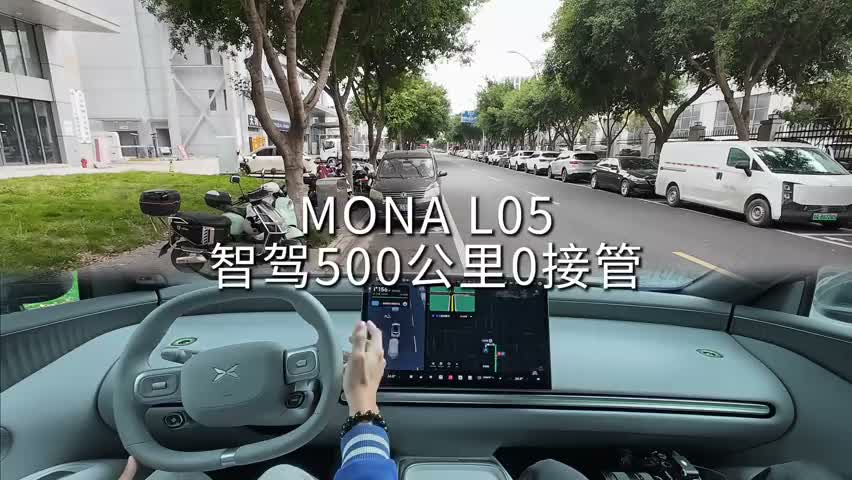
▶ Play the 5:40 run (Chinese captions; English subtitles on the YouTube version) — windshield and cabin cameras, and no narration after the first thirty seconds. The same cut is on YouTube, unlisted, with an English caption track: youtu.be/TQF7H6Xi9pU.
The three legs, as the car logged them
The video's final minute shows the car's own "trip diary" screens for each stage, and they are worth reading in full because they are the only quantitative claim in the piece:
| Leg | Distance | Takeovers |
|---|---|---|
| Wenzhou — Yongjia county | 73.8 km | 0 |
| Yongjia — Ningbo | 223.9 km | 0 |
| Ningbo — Shanghai Lingang | 289.3 km | 0 |
| Total | 587 km | 0 |
For the last and longest leg the diary shows assisted driving covering 100% of the distance, with 57 junctions passed, 190 lane changes, one U-turn, and 0.3 km of "roaming" — the car's term for the short stretches where it drove without an active route, which is also the only part of the 587 km not covered by navigation.
The video also shows the one thing a takeover-free run does not exclude: after roughly four hours on the road, an on-screen title card reads "开满4小时,休息一下" — four hours done, take a break. The driver stops. Nothing in the footage suggests a system limit was reached; it is a fatigue break, and the run continues afterwards, at night.
What the edit claims the car handled
The clip is a cut-down montage rather than continuous footage, and the producer's method is consistent: each scenario is captioned in Chinese and, a moment later, a green tick appears next to the caption. Around twenty scenarios are ticked in 5:40, which is the clearest reason to treat the sequence as an annotated highlight reel and not as an unbroken 587 km record.
The ticks, in order:
- Cut-in vehicle — hold the lane, ease off, yield smoothly rather than brake for the gap.
- Slow lorry ahead — open a gap and pass quickly.
- Multi-lane merge completed.
- U-turn across complex road markings, in an urban street with a no-entry sign cluster on the right.
- Left turn at an unmarked junction — a wide, painted-but-unlined intersection with trucks turning across the path.
- Oncoming vehicle on the wrong side, plus illegally parked trucks: slow early, steer round.
- Lorry stopped in the lane, passed without a stop.
- Roadworks with a changed layout — an unfinished dirt section between building sites, recognised and crossed.
- Container lorry in a narrow village lane — the caption is 厘米级控车, "centimetre-level control", threading past a 40-foot box with pedestrians standing in the remaining gap.
- Non-standard traffic lights recognised at a junction where a lorry partly occludes the signal head and the light is a horizontal bar rather than a conventional circular lamp.
- Leftmost-lane bias for progress, twice — once at a motorway junction where the queue is in the middle lanes, once behind a slow car on a two-lane road.
- Cyclist coming the wrong way at speed: slow early.
- Pedestrians: slow, read their heading, and pull away once the path is clear.
- Giving way to a car that had already crossed the line into the lane.
- Night, leftmost right-turn lane identified at a junction where the right-turn arrow sits in the left lane.
- Low-visibility U-turn and low-visibility junction recognition on unlit roads after dark.
None of these are unusual scenarios in Chinese driving. The interesting claim is not that any single one was handled but that the car did them in sequence, on roads it had not seen, without a disengagement — which is what the 587 km figure is meant to establish and what a montage cannot prove on its own.
This is one stage of an 8,000 km relay
The run is not a standalone stunt. It is the assisted-driving stage of a challenge called "中国黄金大外环" — the China Golden Outer Ring, organised by the car media outlet 易车 (Yiche), which has the L05 super-extended-range version driving from Guangzhou to Heihe, on the Russian border, a distance of more than 8,000 km across three climate zones with a temperature spread of more than 45 °C, relayed between staff and motoring personalities — 换人不换车, change the people, not the car.
Six tests are listed in the challenge's own promotion:
- Assisted driving, 500 km, zero takeovers — the Wenzhou-Shanghai stage shown above, on motorway, national road, urban arterial and urban expressway, plus a separate mountain-road segment.
- More than 1,150 km between refuelling stops on a single tank-and-charge, with a 90% real-world achievement target against the EREV's 1,310 km CLTC figure.
- 700 km for 200 RMB — Shanghai to Qingdao on a 200-yuan fuel budget, a cost claim of about 0.29 RMB/km.
- 24 hours living in the car — eating, sleeping, working and being entertained in it.
- Mountain roads — gradient, curvature and blocked sightlines, aimed at the "50,000-RMB-class" handling claim XPeng is making for this car.
- Cold-weather range in the north-east, the "can an EV cross Shanhaiguan" question.
The 587 km run is the first of those to be published with numbers. The rest of the programme is still being released.
XPeng's claims for VLA 2.0, and what the car is
XPeng's accompanying post makes the technical argument explicitly: VLA 2.0 links vision directly to action, dropping the intermediate language step, with latency pressed under 80 ms, and the company says the same stack — not a scenario-specific tune — took the Arc de Triomphe roundabout in Paris and the eighteen bends of the South Taihang mountain road at night. We covered the Paris demonstration separately, when it was a G9L doing the driving; the claim here is about the model, not about the L05's body.
The L05 is MONA's third model and its first mid-size, five-seat SUV: 4,870 mm long, 2,940 mm wheelbase, with a 702-litre boot, a 102-litre front trunk and an 87% "usable floor space" figure that XPeng leans on heavily. It is sold with two powertrains — a BEV with up to 635 km CLTC and an EREV with 310 km of electric range and 1,310 km combined — and two assistance tiers: Max, with one Turing chip at 750 TOPS running a distilled VLA-Lite, and Ultra SE, with two chips at 1,500 TOPS running the full model. XPeng's post does not say which of the two assistance tiers the run used, only that the top trim carries two Turing chips and 1,500 TOPS; the route bar across the foot of the frame carries all three legs of the run.
The pre-sale price, which is now public
The run's headline number is also the answer to a question this blog left open. On 15 October XPeng opened pre-sales at 169,800 to 191,800 RMB — 16.98万 to 19.18万 — across five trims:
| Trim | Powertrain | Range (CLTC) | Pre-sale price |
|---|---|---|---|
| 535 Max | BEV | 535 km | 169,800 RMB |
| 635 Max | BEV | 635 km | 179,800 RMB |
| 1310 Max | EREV | 1,310 km combined | 169,800 RMB |
| 635 Ultra SE | BEV | 635 km | 191,800 RMB |
| 1310 Ultra SE | EREV | 1,310 km combined | 181,800 RMB |
Full launch is 29 October, and XPeng has said the pre-sale prices are "very close" to the final ones. Booking incentives are a 1,000 RMB deposit against 3,000 RMB off the price, 20-inch wheels at 4,000 RMB, and the ROAM appearance and interior package cut from 9,999 to 6,999 RMB, stackable with launch-period offers.
That settles the leak we wrote about on 11 October. The slide that circulated then put the entry car at 153,800 RMB and topped out at 175,800; the real ladder starts 16,000 RMB higher and ends 16,000 RMB higher, and the range labels in it — 525 and 625 km, an EREV badged "1,330" — do not match the production car's 535, 635 and 1,310. The slide was wrong on every line. We have added a note to that article rather than quietly rewriting it.
Caveats
- The zero-takeover claim is the publisher's, not an independently logged figure. One car, one run, one route, on one day, with no third-party data logger and no disclosure of weather, traffic density or software configuration.
- 5:40 of footage for a 587 km drive means well over 99% of the distance is not shown. Nothing in the edit establishes that the omitted stretches were intervention-free; that rests on the trip-log screens, which are the car's own output.
- The green ticks are the producer's verdicts, added in the edit. There is no overlay of takeovers averted or of the system's own confidence, and no counter of how often the wheel was touched.
- "Roaming" mileage of 0.3 km is the one place the footage admits the route was not fully navigated; the rest of the run was on an active route.
- The 8,000 km relay is a media event, run with the manufacturer's cooperation and its cars. It is a demonstration, not a test protocol.
- Pre-sale prices are not final. XPeng has said they are close to launch pricing; the launch is 29 October, and trims, standard equipment and incentives can still move.
- The 1,310 km EREV figure is CLTC, the Chinese light-duty cycle, and the 90% real-world target in the challenge was announced before the result.
The bottom line
A 587 km run with no recorded takeover, through Chinese national roads and night-time urban traffic, is a meaningful data point for a car costing from 169,800 RMB — and it is still a marketing film, not an audit. The more durable news in the same week is the price: the L05 now has an official ladder from 169,800 to 191,800 RMB, five trims, and a launch date eight days out, which is what the leaked slide failed to predict and what buyers will actually be choosing between.
Source: XPeng's official Weibo post of 21 October 2026 (video and trip-log screens), XPeng's own community article on the zero-takeover stage, Yiche's "China Golden Outer Ring" challenge materials and the ZAKER summary of the six tests, and the pre-sale coverage by Sina Tech and Autohome's 车东西 on 15-16 October — translated and adapted for XPENGTech.
Get the next one direct.
New articles, or a daily / weekly digest — the same list EVConduit keeps.