
8 October 2026
MotorTaxi: A P7 Owner Tests the Single-Turing Distilled Build
MotorGogo's new MotorTaxi series puts the route in the guest's hands. Episode 1: an XPeng owner of nearly five years - a 2021 P7 and a P7+ - drives the XOS 6.3.0 single-Turing distilled build on a route he chose, and compares it with the dual-Orin car he drives daily. Better main/side road transitions, better judgement of illegally parked cars, much better overall feel; but clear hesitation on narrow roads and no ability to reverse out of an oncoming squeeze. With English subtitles.
A car owner, not a journalist, has given the clearest comparison yet of XPeng's single-Turing distilled assisted driving against the dual-Orin version — largely because he owns the second one.
MotorGogo has started a new series called MotorTaxi, in which the route is chosen by the guest rather than the host. Episode one's guest is 罗伯 (Robert), an XPeng owner of nearly five years with a 2021 P7 and a P7+, who has put roughly 100,000 km on the first car and more than 20,000 of them on LCC. The car he is testing is a MONA M03 running the XOS 6.3.0 single-Turing distilled version — the build XPeng began rolling out to Turing Max cars on 17 September.
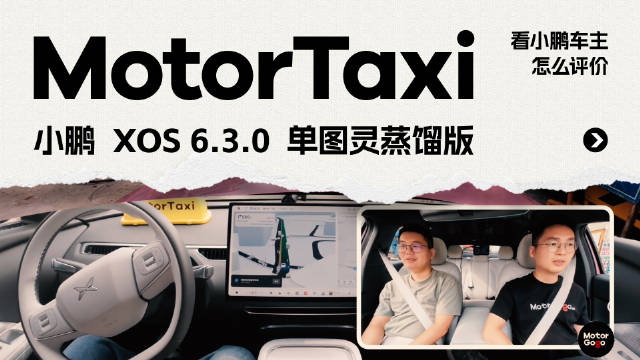
▶ Play the 10-minute episode with English subtitles burned in — our subtitles, over the show's own Chinese ones. The same file is on our YouTube channel: XPeng Single-Turing vs Dual-Orin Distilled Assisted Driving: An Owner's Verdict.
His verdict, in two lists
Three things better than his dual-Orin car:
- Main-road to side-road transitions. It no longer forces a hard speed reduction the way dual-Orin does. Earlier in the drive he puts numbers on it: dropping from around 70 km/h to about 30 used to happen suddenly and feel bad, and here "it clearly came down gradually."
- Illegally parked cars, especially on right turns. Its judgement is "more precise" — it no longer does what the old build did, which he describes bluntly: knowing there is a parked car ahead and still pulling over before changing lanes. "It won't be that stupid anymore."
- Overall driving quality — the biggest change. On big roads and small roads alike, the smoothness and the feel are "much better than dual-Orin."
Two things worse:
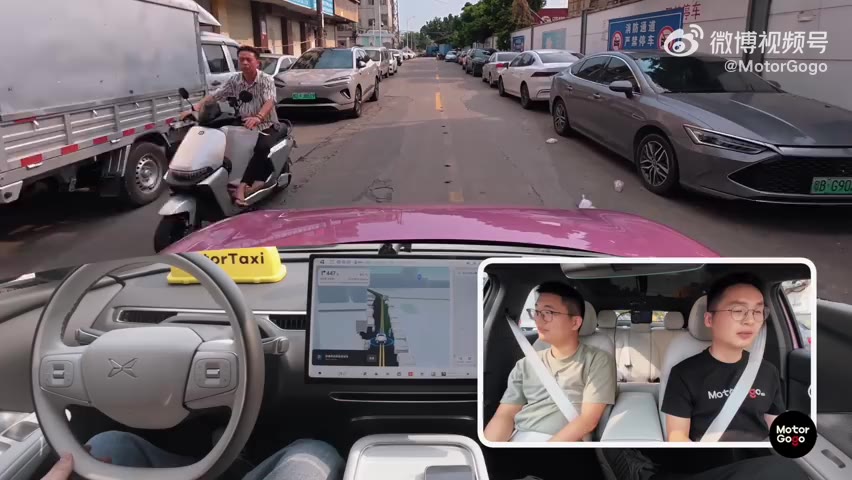
- Narrow roads. It "clearly hesitates" and will not push forward.
- Meeting oncoming traffic. It has no ability to extract itself. On a narrow road with a car coming the other way after it has already committed, a human driver would reverse; it cannot, so it simply cannot make progress.
His summary: narrow-road behaviour is not as good as dual-Turing — his explanation is that the compute is not enough, so the thinking is slower — but in control and route selection there is "basically no difference" from dual-Turing.
The moments that make the argument
The verdict is more convincing for being illustrated rather than asserted.
- A blocked lane. With one side of the road entirely taken, he expects to take over. He nudges the accelerator instead: with a little throttle the car judges the gap correctly, and when he releases it, it comes back on its own.
- A speed bump. He is not sure the single-Turing build still has bump detection — it does, and slows for it. "That's a nice surprise. It means the feature hasn't been cut."
- A truck reversing. With its hazards on, backing out of a driveway, the car sees it from a distance and waits. His comment is about the intent visible in the display: "you can see that far, you can see its intention."
- A car braking at the roadside. The stop is quick, responsive and — his word — linear.
- A route switch. The car pulls itself over to the roadside to stop, then moves off immediately when the route changes. He counts it as a second improvement.
What this adds
We have covered both sides of this build: the 17 September announcement that VLA 2.0 Lite was reaching single-Turing Max cars, and the separately distilled build for the older dual-Orin hardware. What has been missing is someone who drives one of those cars every day and can put the two side by side.
That is what this episode is, with an important qualification: it is one owner's recollection of his own car, not a back-to-back instrumented test. The narrow-road weakness he identifies is also exactly where the dual-Orin build has been criticised — which makes his "no difference elsewhere, worse here" reading a genuinely useful data point rather than a marketing line.
Caveats
- One owner, one car, one route. The route was chosen by the guest, so it skews towards the difficult — 40 minutes of driving to reach it and about 20 minutes on it, roughly an hour in total.
- The comparison is from memory. Robert is comparing this build with his own dual-Orin car, not with a dual-Orin car driven back to back on the same road on the same day.
- His explanation is an inference. "The compute isn't enough" is his reading of why narrow-road thinking is slower, not a measurement.
- The show's car, the show's edit. This is a produced programme from MotorGogo, and the segments are selected. The moments above are what the episode chose to show.
- No performance figures. There are no intervention counts, no distances, no timings — the evidence is behavioural, as in every owner review of this rollout so far.
- The subtitles are ours. We transcribed the Chinese dialogue and translated it; where the speech was ambiguous we kept the meaning rather than guessing at names or numbers.
The bottom line
The interesting result is not that the single-Turing distilled build is good on a hard route — it is that an owner of both hardware generations can describe the difference as a trade rather than a downgrade. Two behaviours got better, two got worse, and the one he calls the biggest change is not a feature at all: it is how the car feels while it is thinking. That is the sort of thing that only shows up on a road the owner chose himself.
Source: MotorGogo, "MotorTaxi" episode 1, on Weibo — translated and subtitled by XPENGTech.
Get the next one direct.
New articles, or a daily / weekly digest — the same list EVConduit keeps.