
7 November 2026
Promoters Are Only Half the Story in the 2026 EV Satisfaction Study
USCALE's press release publishes not just how many owners would recommend each brand but how many would talk a buyer out of one. Scored both ways, the 23-brand table re-orders: Genesis falls from 11th to 14th on a 30% detractor share, Fiat and Opel end up net-negative, and the eight brands above 50 net look like a different business from the five at the bottom. Also in the document: cars keep improving, and owners keep getting harder to please.
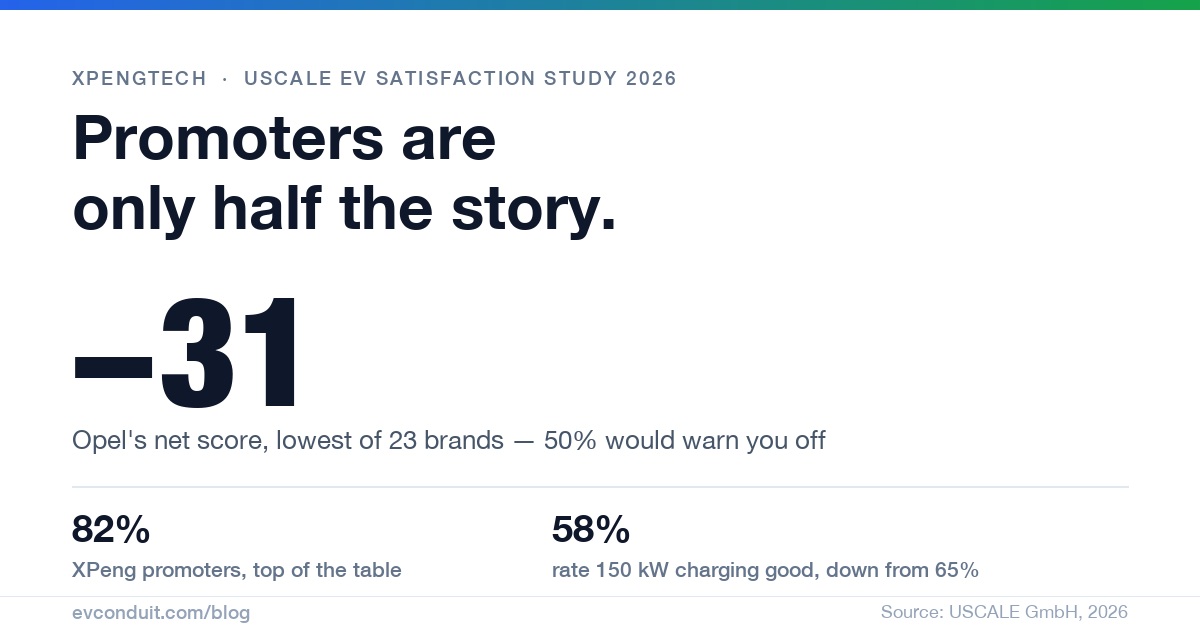
In October we wrote about the headline result of the USCALE EV Satisfaction Study 2026 — XPENG on top, Tesla back to second, satisfaction at a record — from the trade coverage that picked it up. This is the primary document, and it publishes something the write-ups, ours included, used only in passing: the detractor shares for every brand.
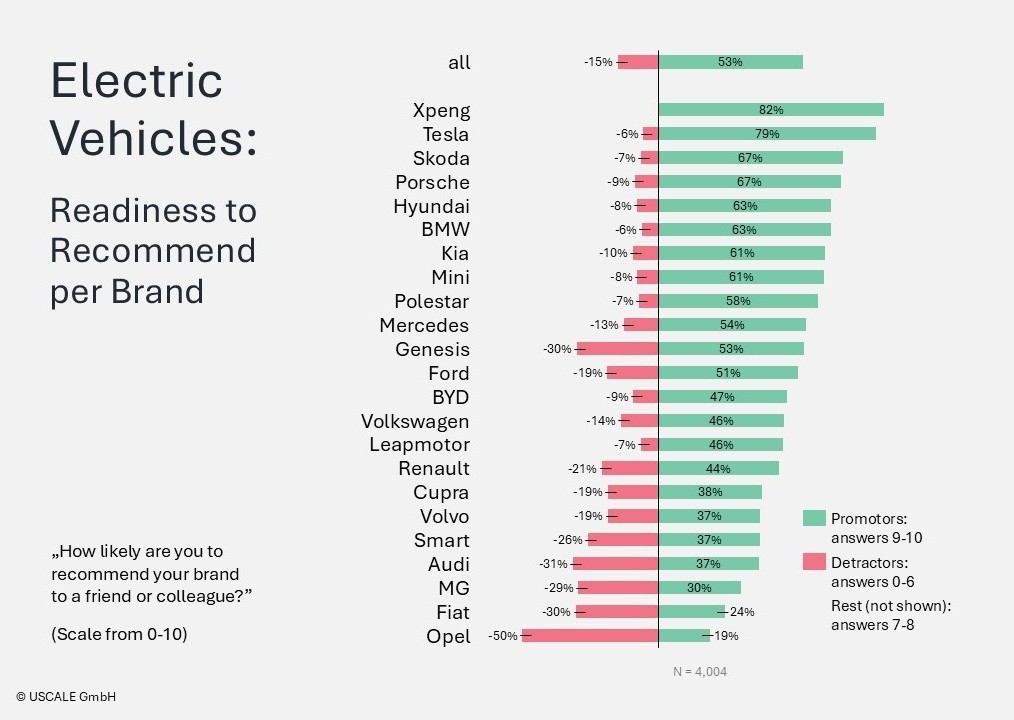
USCALE's published chart: green bars are the share of owners answering 9 or 10 — promoters; red bars the share answering 0 to 6 — detractors. 7s and 8s are not drawn. N = 4,004. Image: USCALE GmbH.
Once both bars are on the page, you can do the arithmetic USCALE does for the market as a whole — promoters minus detractors — for every brand individually. The overall figure validates the method: the study reports a net promoter score of 38, which is exactly 53% promoters minus 15% detractors. Applied brand by brand, the bottom half of the table looks worse than the published summary suggests.
The same data, sorted by net instead of by promoters
USCALE's chart and its ranking are ordered by promoter share. Here is the same study ordered by net score:
| Brand | Promoters | Detractors | Net |
|---|---|---|---|
| XPENG | 82% | not shown | — |
| Tesla | 79% | 6% | 73 |
| Skoda | 67% | 7% | 60 |
| Porsche | 67% | 9% | 58 |
| BMW | 63% | 6% | 57 |
| Hyundai | 63% | 8% | 55 |
| Mini | 61% | 8% | 53 |
| Kia | 61% | 10% | 51 |
| Polestar | 58% | 7% | 51 |
| Mercedes | 54% | 13% | 41 |
| Leapmotor | 46% | 7% | 39 |
| BYD | 47% | 9% | 38 |
| Ford | 51% | 19% | 32 |
| Volkswagen | 46% | 14% | 32 |
| Genesis | 53% | 30% | 23 |
| Renault | 44% | 21% | 23 |
| Cupra | 38% | 19% | 19 |
| Volvo | 37% | 19% | 18 |
| Smart | 37% | 26% | 11 |
| Audi | 37% | 31% | 6 |
| MG | 30% | 29% | 1 |
| Fiat | 24% | 30% | −6 |
| Opel | 19% | 50% | −31 |
| All brands | 53% | 15% | 38 |
The nets are ours, computed from USCALE's two published bars; the promoters and detractors are the study's. XPENG has no detractor bar drawn at all, which is a real gap and is dealt with below.
What the re-sort changes
The middle collapses. On promoters, Genesis is 11th of 23 with 53% — comfortably above average. On net it is 14th, because 30% of Genesis owners would actively steer someone away, the joint-second-worst detractor share in the study. BYD, with six fewer points of promoters, ends up ahead of it.
Two brands have more people warning buyers off than promoting them. Opel (19% promoters, 50% detractors, net −31) is the extreme, but Fiat is negative too: 24% against 30%, net −6. For those two, the average owner's advice is not neutral. It is "don't".
Equal promoters, different verdicts. Hyundai and BMW both sit on 63%, and BMW's net is two points better because fewer of its owners are hostile (6% to 8%). Kia and Mini both sit on 61%, and Mini edges ahead on net for the same reason. A ranking built only on enthusiasm hides the brands with a loyal core and a resentful remainder.
Leapmotor's debut is better than its position. The newcomer is 15th on promoters (46%) but 10th on net (39), just above BYD, because only 7% of its owners are detractors — a share matched only by Skoda and Polestar, both of which sit far higher up the table.
And the bottom is a cliff, not a slope. Nine brands net above 50 — XPENG certainly among them, no detractor bar notwithstanding. Nine more sit between 18 and 41. The last five — Audi 6, MG 1, Fiat −6, Opel −31, with Smart on 11 just ahead — are a different business from the top of the table, not a slightly worse version of it.
Mini and Genesis are missing from USCALE's own text. The press release carries a written paragraph for 21 brands; the chart contains 23. Mini (61% promoters, 8th) and Genesis are the two without a summary, which means the brand with the eighth-best promoter share gets no mention in the release that ranks it.
The finding that matters more than the ranking
Whether or not you like the re-sort, the study's own analysis points somewhere less comfortable: the cars keep getting better and the drivers keep getting harder to please.
- 59% of owners now report a real summer range above 400 km, up from 50% a year earlier. But only 75% still rate 400 km of summer range as good or very good, down from 79% — and only 15% call it very good, half the share of 2023.
- 77% of the cars can charge at 150 kW or more, up from 75%. But only 58% rate 150 kW as good or very good, down from 65%.
- 71% report problems with charging (2025: 73%), most often a session that will not start or delivers less power than expected. The in-car charging-station search is judged well implemented by just 43%.
- 48% report problems with their connect app (2025: 50%) — and the spread is absurd: 8% of Tesla drivers against 92% of Opel drivers.
- Asked what to fix, owners put software quality first (44%), ahead of charging power (42%), the connect app (39%), route planning (35%) and range (34%). Software is criticised more often than it was a year ago, which is the opposite of the trend for range and charging.
The founder's line is the correct summary: drivers have never been more satisfied, "but they are also becoming increasingly demanding. What was exciting yesterday is standard today."
There is a smaller finding in the same vein that is hard to dismiss as taste: about half of all respondents are annoyed by the car's warning and notification sounds. The brand spread makes the point — 29% of Mini drivers are bothered, against roughly 80% of Kia and Hyundai drivers — so this is a design choice, not a technical constraint. Warnings from the driver-assistance systems alone bother 30% of everyone.
The one number missing
XPENG's 82% is the highest promoter share in the study, and its detractor share appears nowhere in the published material — no bar, no label, no figure in the text. A net score cannot be computed without it.
Two explanations are plausible: the share rounds to zero, or the chart dropped it. USCALE does not say, and the difference between 0% and, say, 4% is the difference between a net of 82 and a net of 78. XPENG leads on the measure the study publishes — that part is not in doubt. But the single figure that would make its lead comparable to Tesla's 79% against 6% is the one the material does not give.
What the study is, and what it is not
- 4,004 drivers of battery-electric cars up to three years old, surveyed in June and July 2026 across Germany, Austria and Switzerland — the seventh edition.
- 23 brands, rated on a 0–10 recommendation scale; promoters are 9–10, detractors 0–6. 7s and 8s are neither and are not drawn.
- Recruited through social media. USCALE says so itself: the sample is "not representative of the average driver", and the people who answer look harder at a vehicle concept than the average buyer. That cuts both ways — they are quicker to praise a well-solved detail and quicker to punish a badly solved one.
- No per-brand sample sizes. With 23 brands and 4,004 respondents, some of these percentages will rest on a few dozen people. The chart's spreads are wide enough that the extreme ends survive that problem; the middle order does not.
- A young fleet in the newest brands. XPENG registered 393 cars in Germany in 2024 and 7,023 in the first nine months of 2026, so most of its surveyed owners had held the car for months, not years.
The bottom line
The ranking is the least useful thing in this study, and it is the only part most coverage repeated. The detractor bars say something the promoter bars cannot: that there is a cluster of brands in this market whose owners are actively negative, led by Opel at half its respondents, and that a handful of mid-table brands carry hidden hostility — Genesis at 30%, Smart at 26%, Audi at 31% — that their promoter shares conceal.
For XPENG specifically, the defensible claim is narrower than "best brand in the survey": it tops the promoter ranking, its own drivers single out charging power, charge management and real-world range, and route planning remains its worst category. Whether it has the best net endorsement in this field is unknown, because the study does not publish the number that would settle it.
Source: USCALE EV Satisfaction Study 2026, Stuttgart, 20 October 2026.
Get the next one direct.
New articles, or a daily / weekly digest — the same list EVConduit keeps.