
11 October 2026
Reviewers Tried XPeng's VLA 2.0 in Paris. Here's What They Said
The Paris Motor Show's Autonomous Lab, the public-road test-ride programme that only Tesla and XPeng joined, has produced its first reviewer verdicts. A Chinese XPeng-focused reviewer has compiled quotes from three overseas testers - Devin Olsen saying NGP 'easily rivals V14 and in some places is even better', plus reactions from Chubby and David Moss - alongside four behavioural notes from Paris footage. We set out what the quotes show and why the curation matters.
The Paris Motor Show's Autonomous Lab — the public-road test-ride programme that only Tesla and XPeng joined — has produced its first round of reviewer verdicts, and the strongest of them comes from a North American Tesla commentator.
They are circulating on Weibo in a compilation by the Chinese reviewer 肉肉爸比ev, republished the same evening by 托马斯电火车, the XPeng Group vice president who has been posting his own Paris footage. Three quotes are attributed:
"In North America we live in a bubble. FSD is excellent and it has no competitor, but once you leave North America the situation is different. From my brief use of NGP, it's impressive — it easily rivals V14, and in some places it is even better." — Devin Olsen
"First time experiencing XPeng's NGP on European roads — the drive was super smooth, even through construction and congestion. I'm surprised how well it does in Paris." — Chubby
"Overall beyond expectations — a smooth and trustworthy system. Watch the video; I'll share the comparison with V14." — David Moss
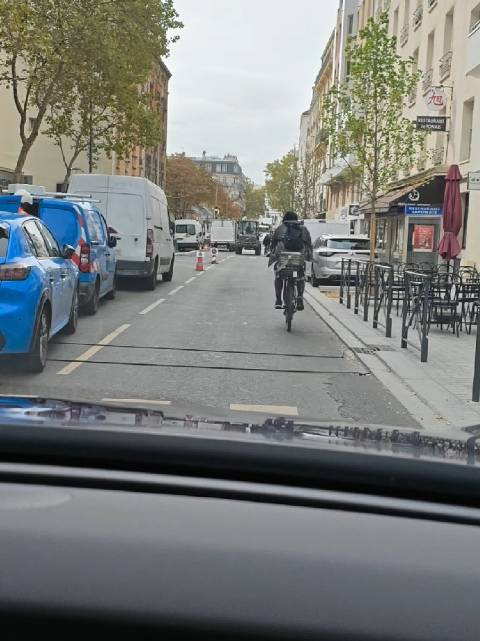
A frame from the Paris NGP footage posted by XPeng Group vice president 托马斯电火车. Image: via Weibo.
Read the provenance before the verdicts
The compilation was assembled by a Chinese XPeng-focused reviewer, republished by an XPeng executive, and rendered in Chinese. We have not seen the original English posts or videos, so the wording above is the wording as relayed. The route was about 25 minutes. XPeng-side coverage describes Olsen as a North American FSD and Cybercab commentator and a Tesla owner; we have not verified the individual quotes against their original sources.
None of that makes them false. But the selection is not neutral — and "smooth" is the same word XPeng uses in its own campaign copy for this generation, which the compilation itself points out.
What the drive looked like, in the compiler's reading
The same post walks through four moments from the Paris footage. They are the more interesting half of it, because they are specific:
- A pedestrian crossing. The car chose a complete stop and wait. In China, the poster says, the behaviour is usually to slow without stopping, creep, and accelerate once the pedestrian has passed; in Europe, where pedestrians have stronger priority, a full stop is often what the situation requires — but the car also cannot simply wait, and it moved off as the pedestrian cleared the front of the vehicle.
- An unmarked intersection, turning left. This was the failure point in Munich, where the model would throw its trajectory across the junction when there were no lane markings. In Paris it completed the turn steadily, to the left.
- Construction barriers at a signalised junction. It moved over early rather than swerving at the junction, then negotiated the offset junction.
- A right turn with cross traffic. A full standstill, with no creeping, followed by taking the gap.
These are observations from a video, not measurements, and the poster reads them in the most favourable light available. But the first is the kind of detail that matters: if the same model stack moves from creeping to full stops in Europe without being retrained, that is the generalisation claim in something close to its strongest form.
The claims attached to it
- The build running in the Netherlands was 6.3.0, and the poster believes Paris is the same — which would make the European behaviour generalisation rather than a Europe-specific retraining exercise.
- XPeng's European sequence now reads Germany → Netherlands → France, which he argues is faster than expected.
- The show's urban assisted-driving experiences were limited to two: XPeng and Tesla.
- His verdict on the local field: much of the European industry's urban NOA is "still PowerPoint".
What this does and does not show
We have been here before, in Amsterdam. There, a Xinhua-organised comparison — with an XPeng engineer driving both cars — produced a similar reading: two systems genuinely close on a hard European route, with the XPeng car stronger in construction zones and around bicycles, and the same structural caveat, that a test run by one side with an interest in the outcome cannot settle a comparison (our coverage of that test is here).
Paris improves on Amsterdam in one respect: the reviewers are third parties who use FSD daily, which is a better class of evidence than an in-house demonstration. It repeats Amsterdam in another: one side collected the quotes, translated them, published them, and the other side's executive pushed them out within the hour.
The measurement that would settle it still has not been made in Europe: the same route, the same day, both cars, an independent driver and published intervention counts. Until then, "rivals V14, and in some places better" is a reviewer's impression from a 25-minute ride — a useful signal, and not a result.
The company's own cut, five days later
On 24 October XPeng published its own four-and-a-quarter-minute compilation of the same event, with the voices of the people who took the rides rather than three hand-picked review posts. It carries bilingual captions burned in, and it is a different kind of evidence: instead of a reviewer's finished opinion, it is the raw reaction of someone stepping out of the car.
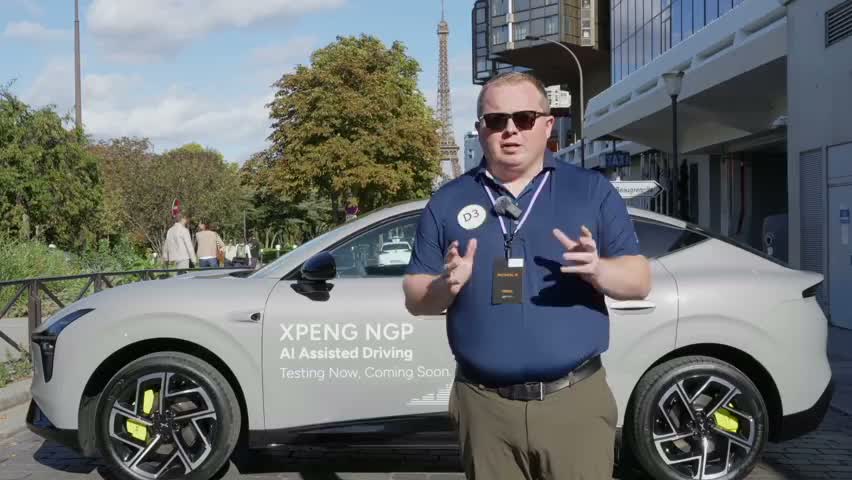
▶ Play the compilation — English SRT: download here. The spoken English is what the testers said; the burned-in English captions are XPeng's own, and they do not always match the audio word for word. The same cut is on YouTube, unlisted, with the English caption track: youtu.be/IbYt21DzA_8.
The three lines XPeng chose to quote in its post map straight onto the footage, and it is worth seeing them in full context rather than as pull-quotes:
| XPeng's Chinese quote | What was actually said, in English |
|---|---|
| 整个驾驶体验非常接近人驾,甚至做得更好 | "You have a very human-like driving experience, even better than a human driver." |
| 自始至终都没有犹豫过,表现非常稳定、扎实 | "There were people on the roads, bikes everywhere, and at no point did the car hesitate... it is just rock solid." |
| 面对各种不同的路况,都能处理得很好 | "The drive is very smooth, and it deals with different scenarios really well." |
Two of those are fair renderings. The middle one is the interesting edit: "at no point did the car hesitate" is a statement about one ride on one route, and XPeng's Chinese line turns it into 自始至终 — "from beginning to end" — which is a broader claim than the sentence supports.
What the unedited voices add
Watching the whole cut rather than the quotes changes the picture in three useful ways.
The comparison points are specific. Testers keep reaching for FSD rather than for vagueness: "this system from XPeng is definitely comparable to Tesla FSD Supervised"; "against Tesla Full Self-Driving, this stands out: it is just rock solid"; "in some particular moments it did better than what I think version 14 would have done". That is the same anchor the named reviewers used, from people who are not the same people.
The system's behaviour towards people gets the most attention. A tester describes a pedestrian crossing: "rather than going up to her and braking right up next to her, it saw her crossing, slowed down while she was crossing, and then as she finished crossing just went through." Another: "it knew whether they were stopping to load a vehicle or crossing the street." That is the Paris-specific claim, and it is being made by several unconnected voices rather than one.
The regulatory point is the one nobody at the show was making in September. One speaker argues XPeng's approach of building to UN DCAS — the UN regulation for driver-control assistance systems — means "it's going to potentially just work everywhere from the start". Whether or not that holds, it is a different argument from "it drove well in Paris": it says the Paris performance is a by-product of designing to a European rulebook, which would be a more durable claim than a good afternoon in the 16th arrondissement.
There is also an unguarded moment worth keeping. One tester says the pedestrian scenario was "almost as if the car knew what was going to go on" — a compliment that is also a description of why people will be nervous about the technology.
Caveats
- The quotes are relayed translations. We have not seen the original English posts or videos behind them, and the compilation was published by XPeng-focused accounts: the original poster is a Chinese reviewer; the account that republished it is an XPeng Group vice president.
- Comparisons with "V14" are impressions from a short drive, not tests. FSD's European availability is also still limited and market-by-market, which is the subtext of the "North American bubble" line.
- The four behaviour notes come from the compiler's video review, not from instrumented data.
- The 6.3.0 build claim is an inference — "should also be" — not a published technical detail.
- "Much of the European industry is still PowerPoint" is an XPeng-side claim. The checkable part is that no European automaker appears in the Autonomous Lab programme.
- We have the same limitation in our own earlier reporting: the Amsterdam comparison was also organised by one side.
- The compilation is a company edit. Every voice was recorded at an event XPeng attended, on a route XPeng chose, in cars XPeng prepared. Nobody has published how many testers rode, or what the unimpressed ones said.
- It drew little attention. The 24 October post had 43 likes, a fraction of what the L05 launch row got the same week — this material is aimed at readers who are already interested.
The bottom line
The value of these quotes is not that they settle XPeng against Tesla in Europe — they cannot, and they were not gathered to. It is that reviewers who use FSD every day found nothing to mock, in a market where XPeng's pitch depends on its driving stack working on roads it has never seen. That is a real data point. But the same names, the same cars and the same route run as a controlled comparison is still the missing piece — and it is a gap both companies have an interest in leaving open. XPeng's own compilation does not close it either, but it makes one thing harder to wave away: the FSD comparisons and the pedestrian-behaviour remarks keep arriving unprompted, in a dozen accents, from people who were not on the earlier list.
Source: the Weibo posts by 肉肉爸比ev and 托马斯电火车, and XPeng's 24 October compilation of Paris test-ride reactions, with our earlier coverage of the Paris Autonomous Lab and the Amsterdam Xinhua comparison — translated & adapted for XPENGTech.
Updated 24 October: added XPeng's own compilation of test-ride reactions from the Paris show, with an English transcript of what the testers actually said.
Get the next one direct.
New articles, or a daily / weekly digest — the same list EVConduit keeps.