
6 October 2026
Single-Turing G9L Max: A Reviewer Can't Tell It From the Dual-Chip Car
A reviewer spent several days in the single-Turing G9L Max on 6.3 - the distilled VLA 2.0 build for one chip - after driving the dual-Turing car, and could not tell them apart. He also explains why: assisted-driving models are small, and the binding constraint as they grow is memory, not compute. His prediction is that the gap opens by mid-to-late 2027, and his buying advice follows that date.
A Chinese reviewer has spent several days driving the single-Turing G9L Max on software 6.3 — the distilled VLA 2.0 build cut down to run on one chip — having already driven the dual-Turing version. His headline finding is that he could not tell them apart: "for the few days I've been driving it, there's no real difference from the dual-Turing car."
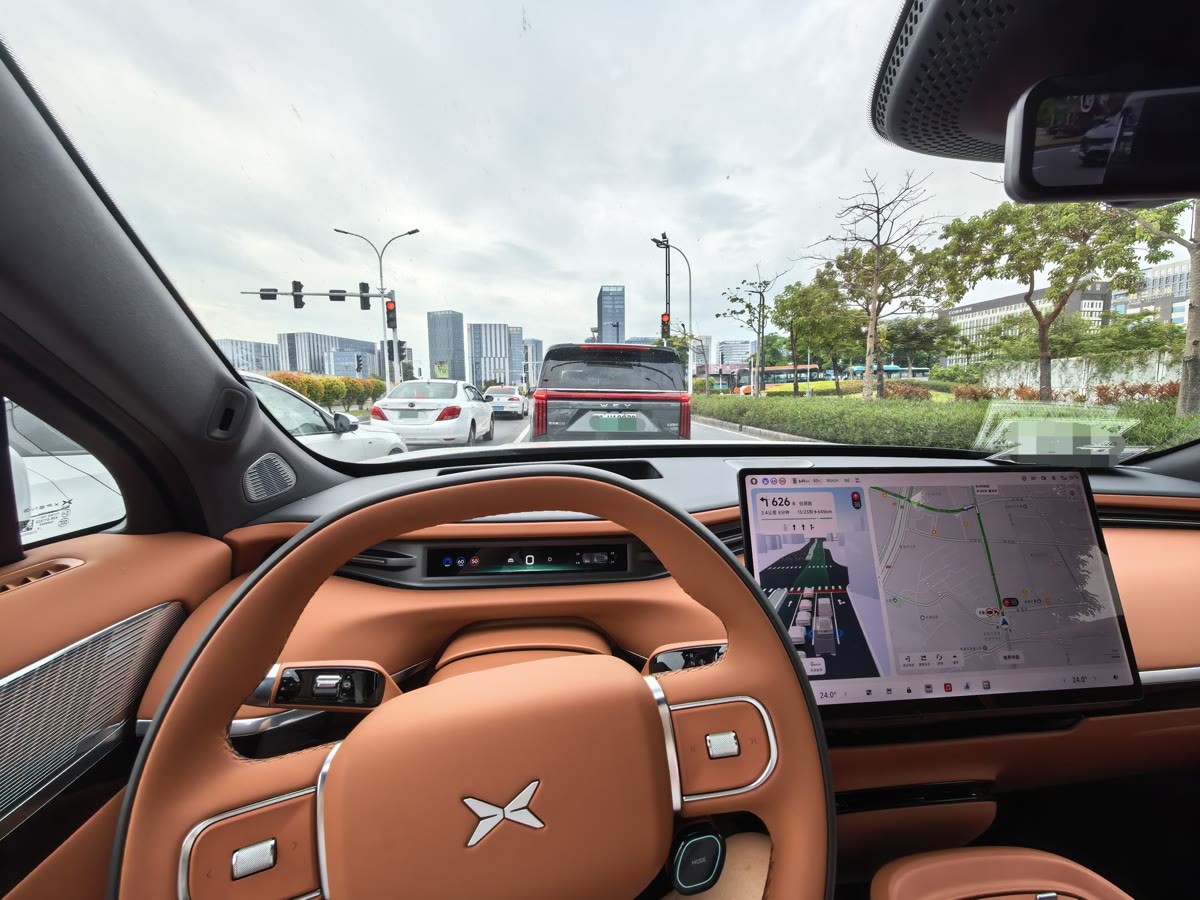
Photo: 旌旗超智能 (Weibo).
What he actually tested
旌旗超智能 puts the car through the situations that separate a working model from a good one — detours around construction, around a stalled vehicle, around the scene of an accident — and reports them handled well, with efficiency kept up. On safety he is more interesting than most reviewers: he says it is better than the overwhelming majority of lidar-equipped cars he has driven, has produced no scare moments, and — the detail worth keeping — does not gamble in congestion that the other car will yield.
On comfort he notes the tuning in both axes: longitudinal acceleration and braking, and lateral steering and lane changes, with brake nod specifically well controlled.
He found exactly two faults, and both are worth recording because they are specific: at one set of lights the road markings were obscured and the car queued in the wrong lane, going straight on from a left-turn lane; and once, after a turn, the car sat too far right and took about ten seconds to correct itself.
The part that matters: why one chip is not obviously worse
His argument is that assisted-driving models are small models. Five billion parameters is already impressive at this scale; he guesses XPeng may be above ten billion, and that a distilled build therefore lands somewhere around three to five billion. In ordinary city driving, a difference of that size in the parameter count does not show up as a difference in behaviour — which matches what he felt.
His stated conclusion is deliberately narrow: as long as the model itself does not change fundamentally, the gap between one and two chips will be very small in the short term. That is a claim with a time limit built into it, and he supplies the mechanism for why the limit exists. The binding constraint as models grow is not raw compute but memory bandwidth and capacity: at some point the compute still copes while the single chip's memory forces distillers to cut more parameters away.
He makes that concrete with the previous generation. Dual-Orin X cars cannot run the full VLA 2.0 because of memory bandwidth, and he goes further: with no FP8 support and the bandwidth it has, Orin X is effectively un-distillable, so if a dual-Orin X car receives a new city-navigation stack it has been rebuilt, not distilled. That is the real cost of the old silicon.
The prediction, and the buying advice
He puts a date on the divergence. XPeng's 6.1 to 6.3 run came out of Liu Xianming's rebuild — his own account of that work is here — and the reviewer, who describes a half-year reorganisation and a December internal build held back for more work, argues that a normal iteration cadence from here means two or three major versions a year. Extrapolate that, and by mid-to-late 2027 the single-chip cars should start to fall behind. His advice follows from that date rather than from the hardware:
- Buy the dual-chip car if you want the top experience and can absorb a 6–12 month horizon.
- Buy the single-chip car if you rarely use assisted driving and accept that the gap opens later and cannot be closed with a retrofit.
One clarification that matters for buyers
The reviewer also settles something that causes real annoyance among owners: XPeng's highest driving configuration is dual Turing. The third Turing chip is a cockpit chip. That is consistent with our own breakdown of the G9L line-up, where the third chip is what unlocks the Turing VLM-based in-car assistant and voice vehicle control — not more driving compute.
So the ladder that actually matters for assisted driving is one chip or two, and the "3-Turing" badge is not a third helping of it.
Caveats
- One reviewer, and he says himself that he had no controlled conditions. He cannot prove the two builds are equivalent; he can only report that they felt equivalent to him over several days.
- His parameter estimates are guesses, offered as such, and the 2027 divergence is a prediction, not a roadmap from anyone at XPeng.
- The Liu Xianming timeline — the mid-2025 handover, the half-year reorganisation, the December build — is the reviewer's account, not a company statement.
- Two faults in several days is not a safety record, and the review is a first look at a build still being iterated; the single-Turing cars started receiving VLA 2.0 Lite in September.
- His conclusion is about today's model. He is explicit that a fundamental change to the model would invalidate it — which is also the case for buying on it.
The bottom line
The distilled single-chip build is not the cut-down experience people expected, and for a buyer today the second chip is a bet on the model growing rather than a requirement for the software working now. What makes this review worth reading is that it takes the second half of that sentence seriously: it names the mechanism (memory, not TOPS), gives the precedent (Orin X), and puts a date on when the bet starts paying. Mid-to-late 2027 is a claim XPeng's release notes will settle for us.
Source: 旌旗超智能 (Weibo), with the chip configuration from our G9L launch coverage — translated & adapted for XPENGTech.
Get the next one direct.
New articles, or a daily / weekly digest — the same list EVConduit keeps.