
10 October 2026
The P7 Becomes the Asia Auto Gymkhana Championship's First Electric Car
XPeng's P7 will be the first all-electric production car used in the Asia Auto Gymkhana Championship, as the designated car for the Hong Kong round on 17-18 October at the Wan Chai waterfront - the series' first Hong Kong event, hosted by the Hong Kong Automobile Association with FIA support. The cars run in factory condition in a uniform-spec category, so the event is a durability and consistency test rather than a comparison with rivals.
XPeng's P7 will be the first all-electric production car used in the Asia Auto Gymkhana Championship. The company announced on 10 October that the P7 is the designated car for the championship's Hong Kong round — the series' first time in the city — which runs 17–18 October at the Wan Chai waterfront, and that the cars will run in factory condition.
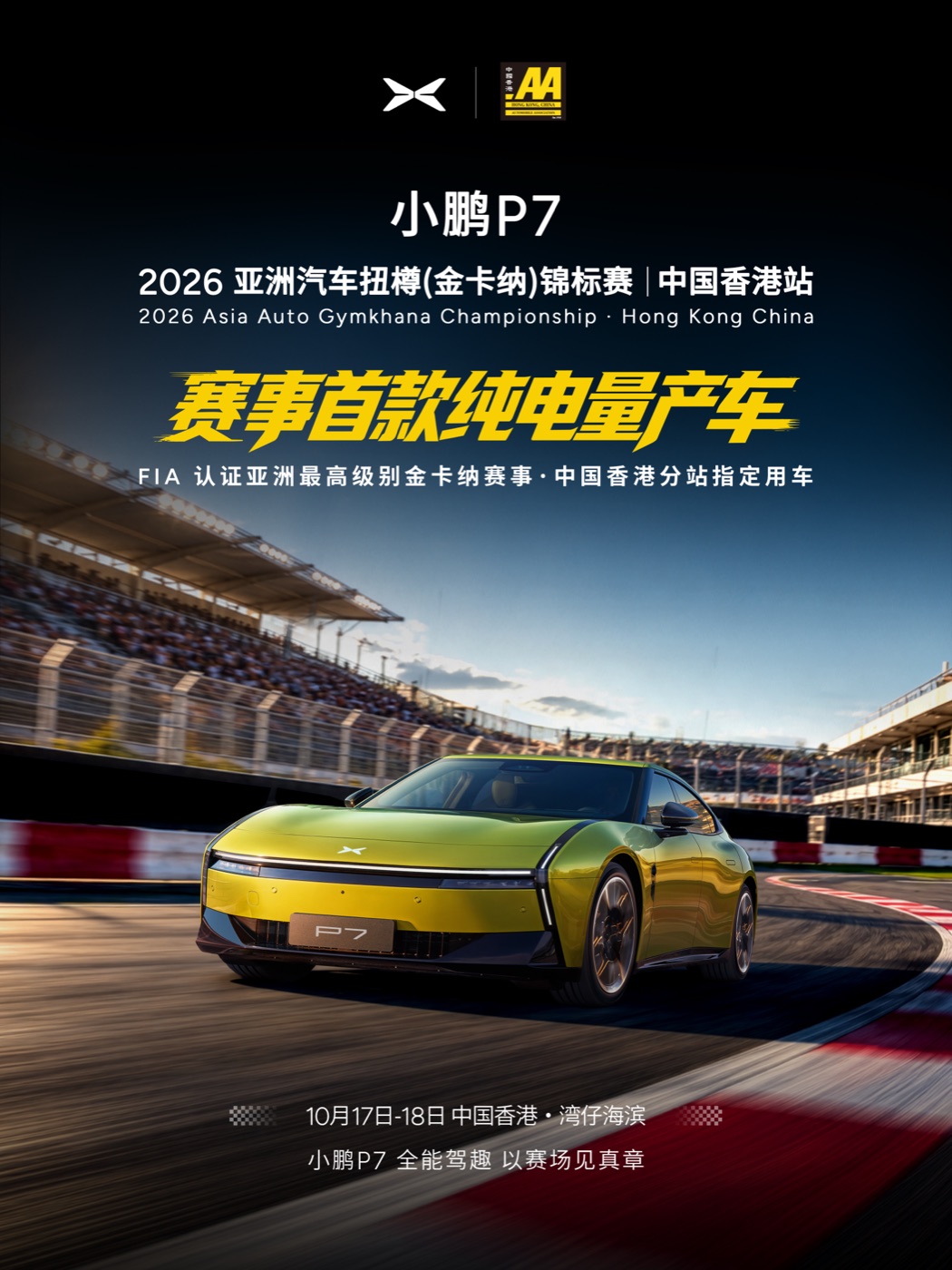
XPeng's announcement poster: "the championship's first all-electric production car", 17–18 October, Wan Chai waterfront. Image: XPeng, via He Xiaopeng's Weibo post.
What the event is
The championship is hosted by the Hong Kong Automobile Association with FIA support, and XPeng describes it as the FIA-certified highest-level gymkhana series in Asia, covering 12 countries across the region. The Hong Kong round is a first for the series.
Gymkhana — 金卡纳, or 扭樽 in Cantonese — is a timed obstacle discipline run in a closed venue. Each round lays out a course with cones inside a fixed-size area: S-bends, right-angle turns, U-turns. The route is usually published shortly before the event, which means drivers get little practice and have to memorise the layout, learn the car and plan their lines quickly. Results are decided on time, hitting a cone costs a penalty, and there are individual and team categories.
What that format measures is not top speed. It rewards body control through continuous weaving, suspension support, braking stability under repeated hard stops, steering precision in narrow gaps and response on corner exit — and the repeated high-intensity runs put the powertrain, brakes and overall durability under real load.
The part that matters: identical cars
The detail worth reading past the poster is that this is a uniform-spec category. The cars keep their factory condition and are identical between entrants, specifically so that differences between vehicles do not decide the results.
That cuts two ways, and XPeng's announcement leans on the favourable half.
- What it does say: XPeng is putting stock P7s through a competitive, repeated-load event in public. If the cars finish consistently and hold up, that is a durability and consistency claim backed by something a press release cannot fake.
- What it does not say: because every entrant is in the same car, the event cannot show that the P7 is quicker than a rival. This is a one-make test, not a comparison. XPeng's poster promises "all-round driving fun — prove it on the track", and the track in question is a cone course where everyone has the same car.
XPeng's own explanation of why the P7 suits the format is about the qualities gymkhana stresses: instant torque, stability systems that intervene quickly, and chassis tuning aimed at high-frequency steering inputs. All three are the kind of claim that is normally made in marketing copy; a two-day event with published results is a better place to test it.
Motorsport as a positioning tool
The P7 is the car XPeng markets on driving feel — the Chinese hashtag on the announcement translates as "all-round driving fun, street and track". The company has been putting it in front of competitive driving events: we covered its first hill climb at Beijing's Jinzhan Speed Festival, where it took 1:02.694 in the electric all-wheel-drive street-car class, fourth in class.
A FIA-supported Asian series with Hong Kong's automobile association behind it is a step up in institutional weight from a domestic festival — and a cheaper way to buy motorsport credibility than a racing programme of its own.
Caveats
- "FIA-certified, Asia's highest level" is XPeng's description of the event's status. The championship is hosted by the Hong Kong Automobile Association with FIA support; we have not seen an FIA document stating that ranking.
- There are no results yet. The round is on 17–18 October; nothing has been raced.
- A uniform-spec category is not a comparison test. The P7 being the series' first EV says nothing about how it performs against other electric cars.
- "Factory condition" is XPeng's statement, and the poster says the cars are identical between entrants to remove vehicle differences — it does not say what preparation, tyres or safety equipment the cars carry for competition.
- The 12-country figure and the car's suitability claims come from XPeng material relayed by Chinese coverage.
- The announcement is promotional, published by XPeng's official account and reposted by the chief executive; there is no entry list, no driver line-up and no timetable in it.
The bottom line
The interesting thing about this announcement is what it declines to claim. XPeng is not saying the P7 will beat anything — it is saying the same car, unmodified, will be handed to a field of drivers and run hard for two days in front of a sanctioning body. For a brand selling driving feel rather than lap times, that is the more honest kind of motorsport marketing, and it is the kind that can go wrong in public.
Source: XPeng's official Weibo post and He Xiaopeng's repost, with event detail from CNMO's report of XPeng's briefing — translated & adapted for XPENGTech.
Get the next one direct.
New articles, or a daily / weekly digest — the same list EVConduit keeps.