
19 October 2026
Two Flat Tyres at 160 km/h: XPeng's L05 Blowout Test, Uncut
XPeng's MONA product-line head and reviewer Wang Ziru rode through a 160 km/h blowout test in a MONA L05 with five people, nine ballasted suitcases and roughly 500 kg aboard - both tyres on one side, then into a corner, in one continuous take. We look at the conditions XPeng published, the M03 programme that preceded it, the claim that blowout stability is now standard from the L03 up, and the measurements the video still does not show.
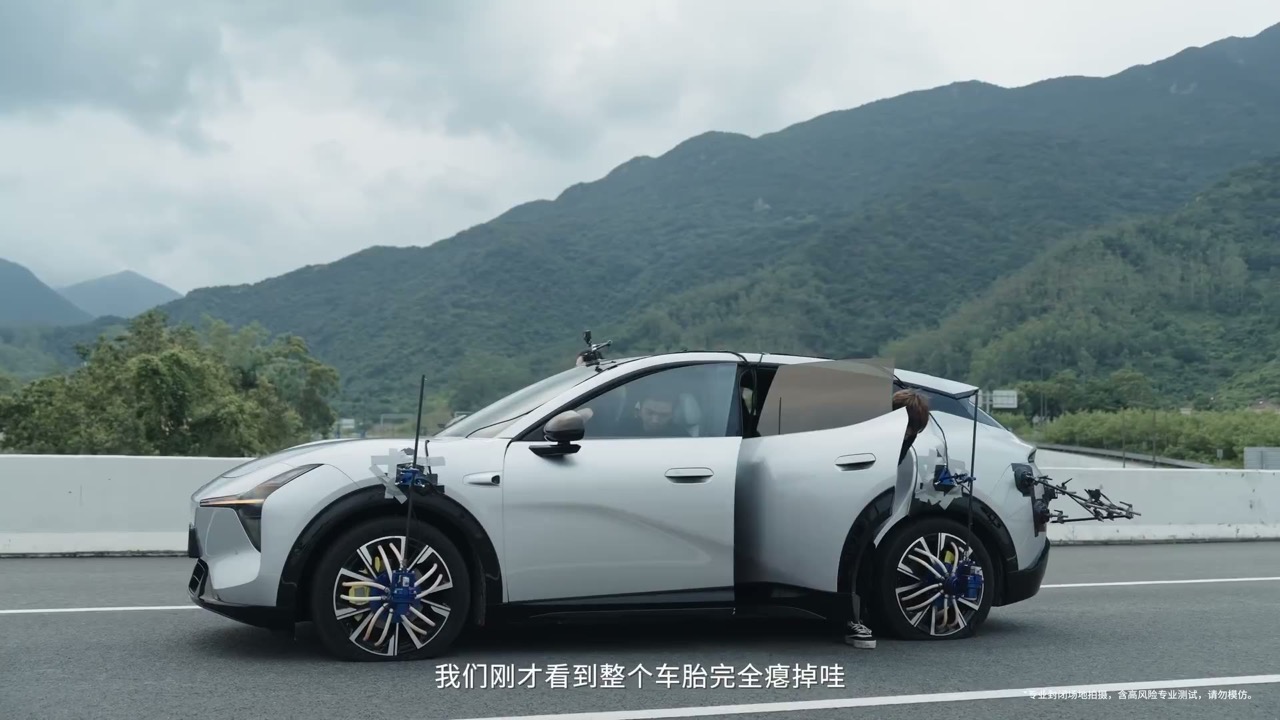
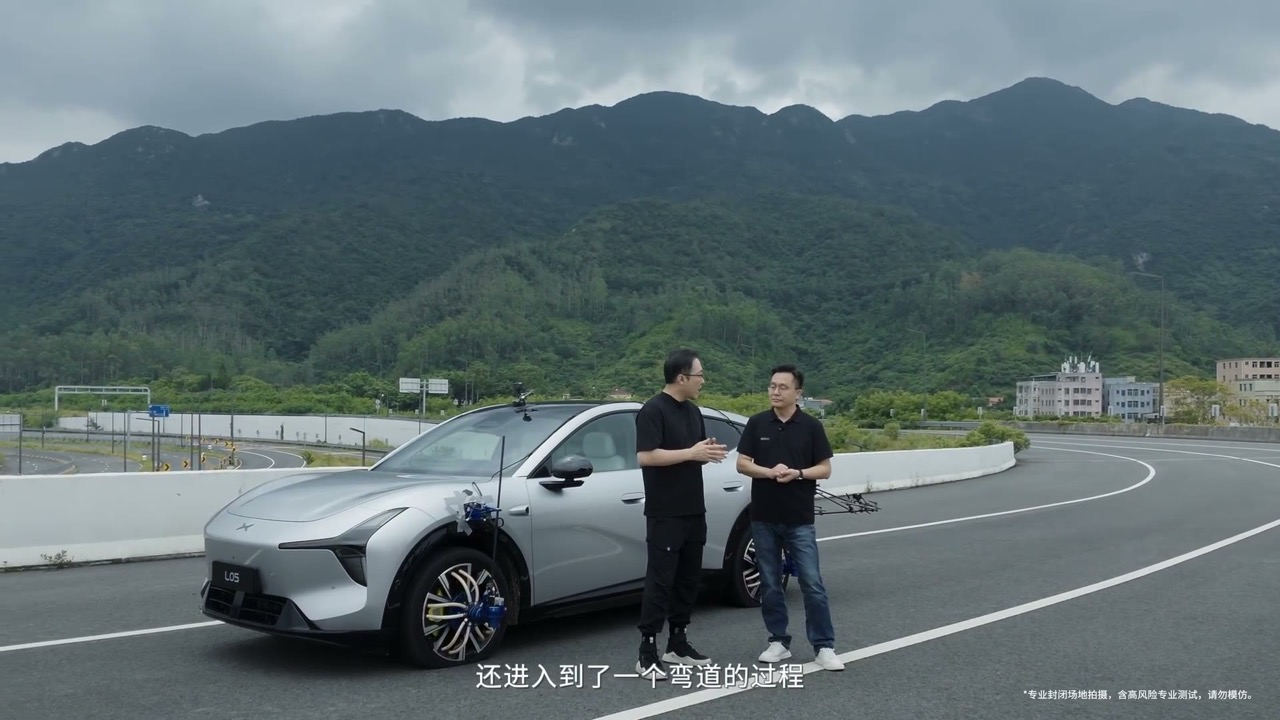
XPeng's MONA product line put its own boss in the passenger seat, a reviewer in the driver's seat, nine suitcases and four colleagues in the car, and then blew out both tyres on one side at about 160 km/h. The seven-minute video, published on 19 October, is one continuous take.
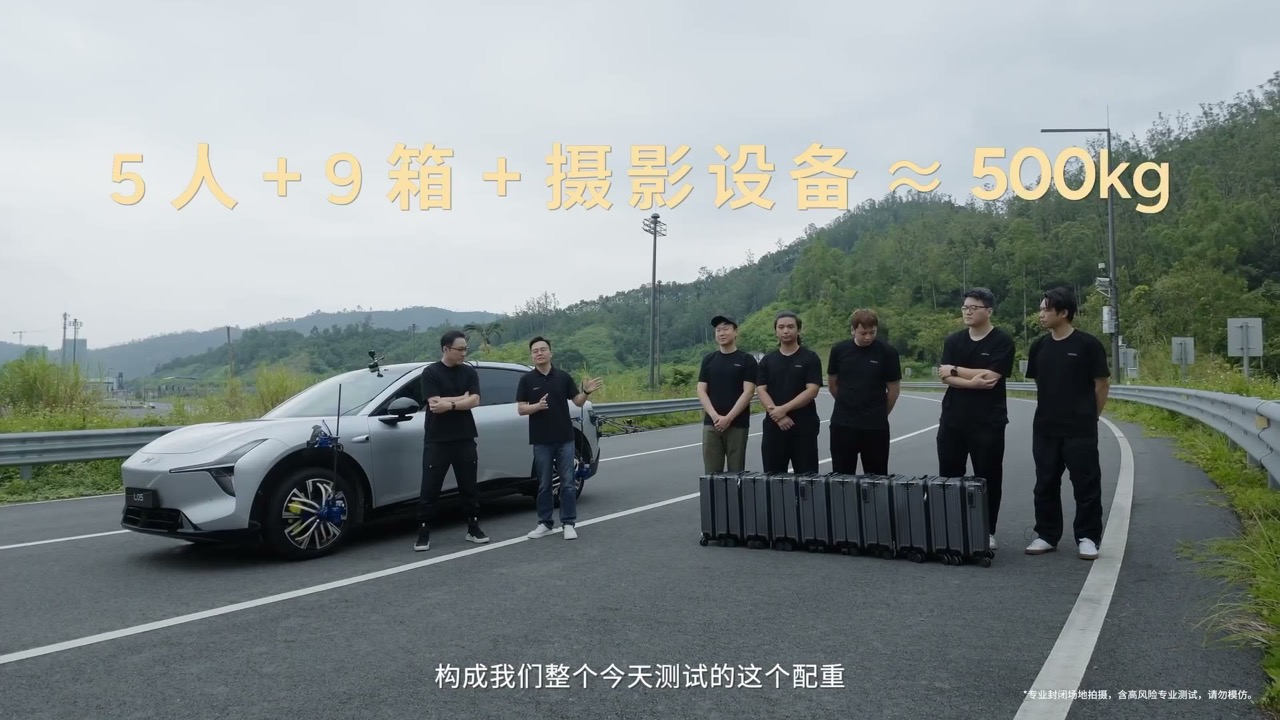
The conditions, stated on screen
This is the part that separates the demo from most blowout videos, because XPeng published the load:
- Five people: Jiang Wen (姜文), head of the MONA product line, the reviewer Wang Ziru (王自如, founder of ZEALER), and three colleagues from the product and engineering teams.
- Nine suitcases, each ballasted with a 10 kg sandbag — eight in the boot and one in the front trunk — plus the camera rig. The on-screen figure is ≈500 kg.
- Speeds stepped up through 40, 80, 100, 120 and beyond, with the blowout triggered at roughly 160 km/h — Wang Ziru says the readout went "past 160".
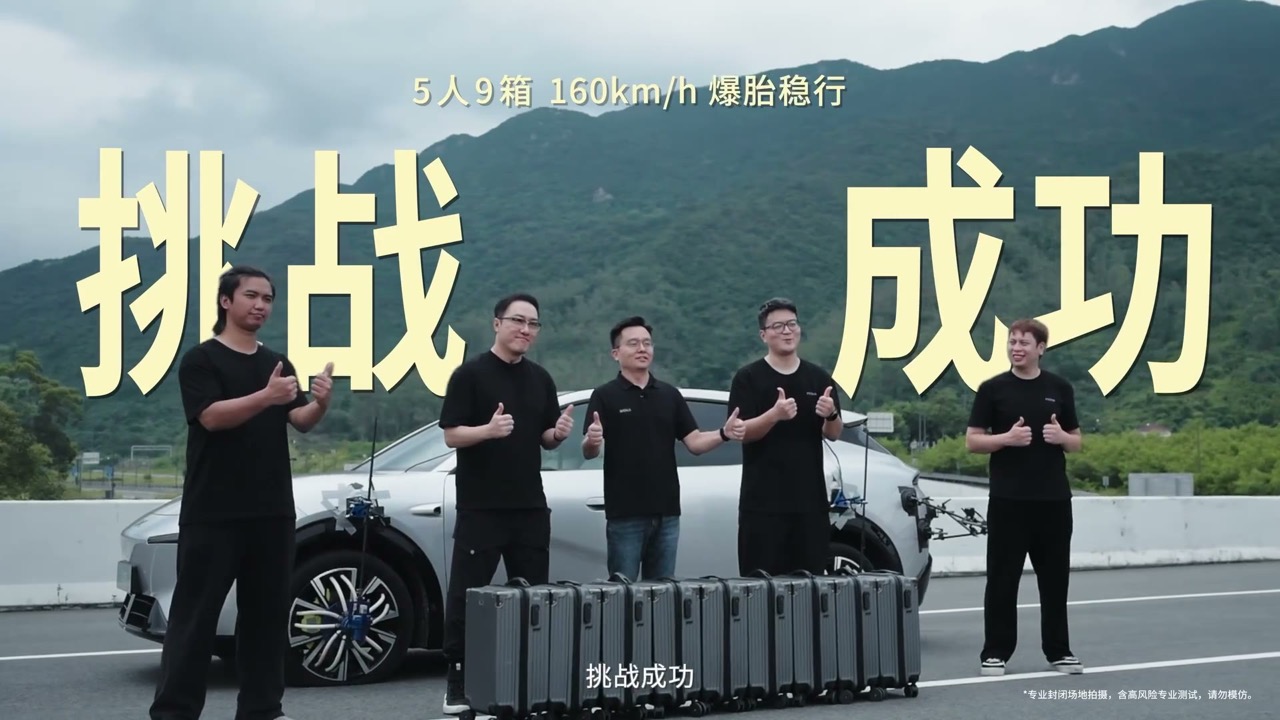
- Both wheels on the same side — front and rear — deflated at once.
- And the detail the pair make a point of afterwards: the car then went into a corner, with the two flat tyres on the outside of the bend.
A disclaimer in the corner of the frame states the obvious and necessary thing: professional closed course, high-risk test, do not attempt.
What it looked like from inside
The first run is Jiang Wen's. The second is Wang Ziru's, in the driver's seat, and his account is the most useful thing in the video because it is a description of the failure rather than of the system:
"I was already tense and my heart rate was high — I thought we'd stop at 120, and then the speed just kept climbing past 160. What surprised me is that when the tyres went, what we felt inside lasted only a brief moment. It stabilised almost immediately. That I completely did not expect. And then we got out and saw the tyres completely flat — only then did I understand what state the car had been in."
He goes on to say that in the combustion era this would not have been possible, and that the value of the technology is that the protection is nearly imperceptible: "it guards you without you feeling it, and when you need it, it acts instantly."
How it is claimed to work
Jiang Wen's explanation is deliberately non-specific: it is not one function but several systems working together, responding in milliseconds once the anomaly is detected, which is what holds the car in the first tenths of a second and lets it keep driving afterwards. He adds that XPeng has tested conditions considerably more complex than this one.
The architecture behind the claim is easier to see on the previous car. When the 2026 MONA M03 launched in April, XPeng published a five-scenario blowout programme: a single front tyre at 170 km/h, a cornering blowout at 70 km/h, a lane-change blowout at 120 km/h, a split-friction blowout at 100 km/h and a same-side double blowout at 150 km/h. The mechanism it credited there was adaptive dampers plus high-compute real-time torque distribution, adjusting the body's yaw the instant a tyre is lost.
The L05 test escalates on three axes at once — load, speed and geometry. The M03's double-blowout run was at 150 km/h; the L05's is at 160, with half a tonne aboard, and then turns.
The claim underneath the stunt
Two statements matter more than the footage.
The first is about price. Jiang Wen puts the outcome at the 150,000–200,000 RMB level, and reviewers covering the run framed it as "a safety capability other brands reserve for cars above 300,000 RMB, brought into the under-200,000 band." The L05's leaked pre-sale slide from 11 October listed 153,800–175,800 RMB — a figure XPeng still has not confirmed, but one that sits inside the band Jiang Wen names.
The second is about standardisation. Blowout stability, he says, will be standard from the L03 to the L05 — "all of our cars are global models" — which is a stronger commitment than fitting it to a hero trim.
What the demonstration does not establish
It is a good demo by the standards of the genre, because the load is published, the speed is stated, the tyres are shown flat afterwards and the take is unbroken. It is still a demo:
- No instrumentation is shown. No lateral deviation in metres, no speed loss over time, no steering angle, no yaw rate. Those numbers are what would turn "it stayed stable" into "it stayed within X of the intended line at Y m/s²".
- One run each, on a closed course, in a prepared car, by people who knew exactly when it was coming. Real blowouts arrive unannounced, on worn tyres, at whatever angle the road happens to be.
- The road surface and tyre condition are unstated. A blowout result is sensitive to both.
- No independent party is involved. The passenger is a guest of the company; the account of how it felt is genuine but not a measurement.
The honest reading is that the car did not spin, and that the people inside were impressed. For a safety system, that is a meaningful floor rather than a ceiling.
Why it matters here
The MONA L03 is on sale in Australia, which makes Jiang Wen's "standard from the L03 to the L05" line more than an abstraction for Australian buyers — if the Australian specification carries the same hardware and calibration, then the cheapest XPeng on the lot has the capability, not just the flagship. XPeng has confirmed the L05 for Australia in 2027 but not the local specification, so that caveat applies to the car in this test as well.
What is clear is the direction of travel: XPeng is now marketing crash-avoidance hardware — blowout stability, wading, crosswind control — the way it used to market range figures, and it is doing so at the bottom of its range rather than the top.
Source: XPeng's official Weibo post and video of 19 October 2026, with CNMO's report of the test, 第一电动网's coverage of the 2026 MONA M03 blowout programme and our earlier L05 coverage — translated & adapted for XPENGTech.
Get the next one direct.
New articles, or a daily / weekly digest — the same list EVConduit keeps.