
30 September 2026
What an Owner Saw in the Amsterdam NGP-vs-FSD Video, Scene by Scene
A Chinese owner who has driven both XPeng's test builds and an ordinary owner's production 6.3.0 car has published a scene-by-scene reading of Xinhua's Amsterdam footage: wider left turns since VLA 2.0, much smoother longitudinal control in 6.3.0, lateral prediction of a bicycle crossing from behind cover, and a detour NGP cleared in one pass where the Tesla needed a reverse. He also reports the smallest test-to-production gap he has seen from XPeng.
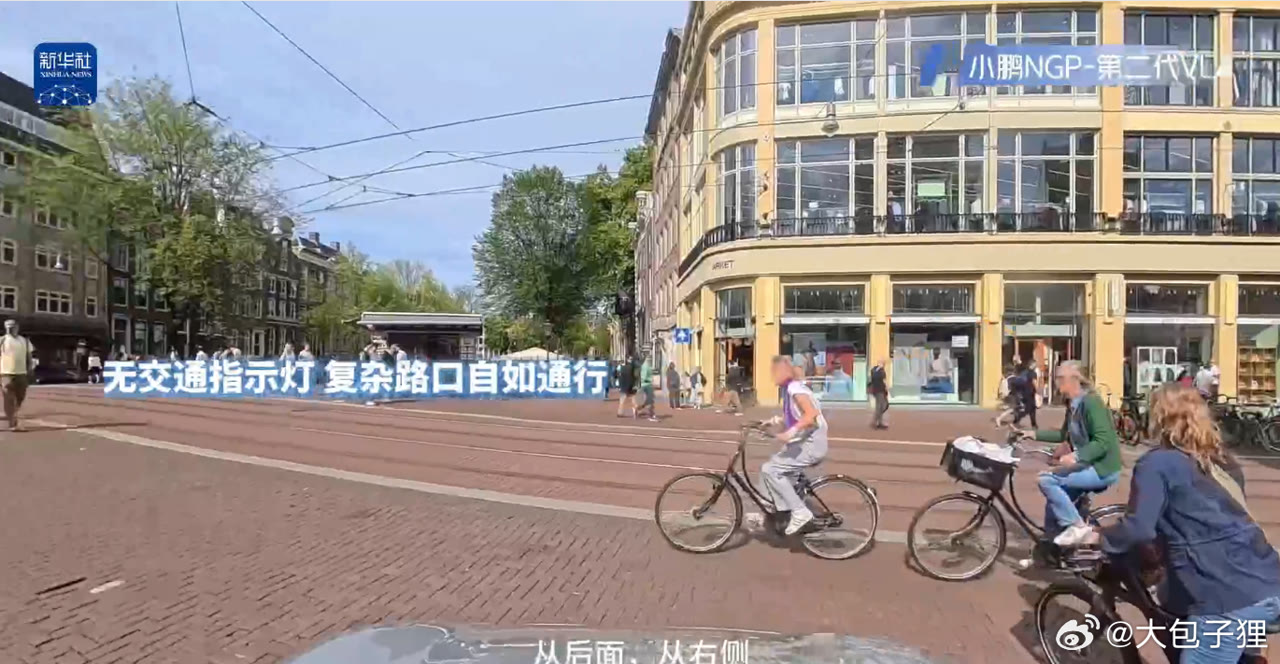
Xinhua's Amsterdam footage has produced a lot of takes, but this one is worth reading for a specific reason: the reviewer doing the scene-by-scene analysis owns the reference points. 大包子狸 has driven XPeng's test builds and — more importantly — borrowed an ordinary owner's production 6.3.0 car to compare against them.
He frames the whole exercise as settling a six-year-old argument. When XPeng launched NGP in November 2020, Elon Musk said on X that XPeng had "our old version software, not our latest neural network computer," and He Xiaopeng replied that rumours had never beaten a competitor, adding that from the following year Tesla should expect to be pushed hard in China — and that the two would eventually meet internationally (CnEVPost covered the exchange at the time).
The five scenes, as he reads them
1. Left turns got wider after VLA 2.0. He says the car now takes a wider arc through a left turn, and that this is a visible change from the 5.x generation, which tended to cut the corner. A tight turn puts the car into a negotiation with same-direction traffic as it enters the junction; the wider line behaves more like a person would.
2. Longitudinal speed control is where 6.3.0 shows up. On narrow roads he describes clear scene recognition and speed management — roughly 8–20 km/h where he puts the Tesla at 4–20. His argument for why this is not simply timidity: running slower preserves the window for lateral movement. Drive too quickly and the gap you needed to move into is already behind you.
3. Lateral prediction at a junction. He highlights a bicycle crossing from behind cover on the right front, which NGP predicted and avoided. He is even-handed about the Tesla, which also predicted pedestrians — but weights them more heavily, waiting until they clearly are not crossing, whereas XPeng commits sooner. He reads part of that as traffic culture rather than pure engineering: in much of China, waiting for a completely clear junction can mean never moving.
4. The fender-brush scenario, largely fixed. Long-time owners will recognise this one: an e-bike passing close to the front wing. Under 5.x it was the classic trigger for a phantom brake after the scooter had already gone. Under 6.3.0 he reports several encounters with no jerkiness — which he treats as evidence of both better lateral perception and much lower system latency.
5. The detour: one pass versus one reverse. NGP cleared the obstruction in a single trajectory; the Tesla, blocked by a truck, needed one reversing manoeuvre. His summary is fair rather than partisan: the XPeng output was smoother, the Tesla showed better ability to extricate itself.
The part that has nothing to do with Tesla
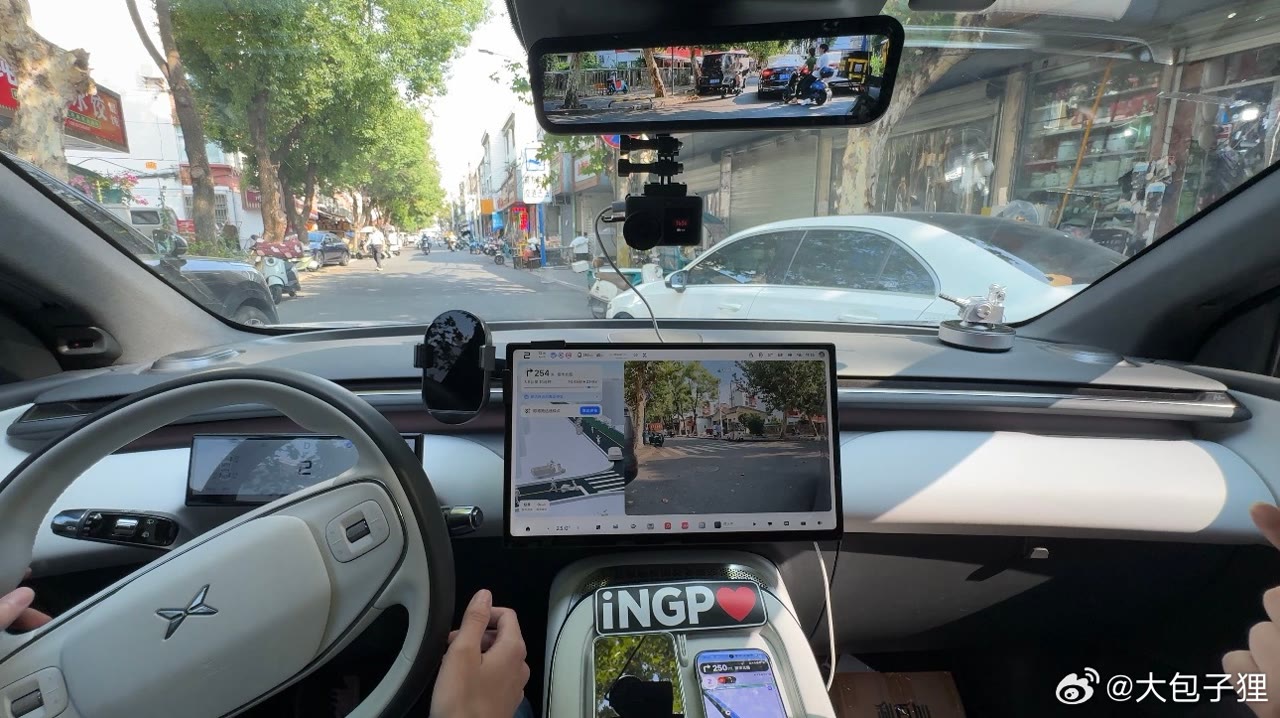
The most useful section is his production-car check. Over the Mid-Autumn holiday he borrowed a standard owner's G7 on production 6.3.0 — explicitly not a media or engineering car — and drove the same kind of tight alleys and lateral-heavy junctions. His conclusion: this is the smallest gap between a test build and a production build he has experienced across XPeng's releases.
He does note a difference. His test-version experience was on the GX and G9L; the production car was a G7, and he puts its advantage in longitudinal control and the smoothness of lateral movement — while conceding that a smaller car is simply easier in narrow streets.
What he concludes
Two claims, one of which is more interesting than the other. The first is that NGP now belongs in the global top tier, and that its assertiveness in negotiation matters more to Chinese buyers than a purely cautious system would. The second is about generalisation: the Dutch route can be dismissed as specially tuned, he says, but the roads he drives himself certainly were not — and "can drive anywhere" is the capability that travels.
Caveats
- This is one owner's reading of an edited video. Xinhua selected the moments; the scenes shown are a highlight reel, not a statistical sample, and nobody has published intervention data.
- The behavioural descriptions are judgements, not measurements — "more assertive", "smoother" and "better extrication" are impressions from clips.
- His 6.3.0 assessment compares different cars. Production G7 against test-build GX and G9L is not a like-for-like comparison, and he says so himself.
- The 2020 quotes are context, not evidence. They explain the framing of the post, not the performance of either system in 2026.
- The stills above are frames from Xinhua's footage with the reviewer's annotations, plus one of his own production-car photographs; the annotations are his, the footage is Xinhua's.
The bottom line
The interesting claim here is not that XPeng beat Tesla on a street in Amsterdam — the reviewer explicitly declines that framing. It is that a Chinese owner with production-car experience reads the footage as showing two systems converging on similar behaviour, with the remaining differences owed as much to local traffic culture as to code. That is a more awkward conclusion for a rivalry narrative, and it is the one the person who has actually driven the cars arrived at.
Source: 大包子狸 (Weibo), analysing Xinhua's Amsterdam footage — translated & adapted for XPENGTech.
Get the next one direct.
New articles, or a daily / weekly digest — the same list EVConduit keeps.