
13 October 2026
Why XPeng's Overseas Cars Run Google Maps Instead of Its Own
A Weibo walkthrough of the G9L's overseas car system says XPeng's Google Maps integration is the first in Asia-Pacific and required system-level work under strict data rules. Confirmed: the L03 is the first Asia-Pacific production model with Google Maps Auto SDK, keeping XPeng's own interface over Google's routing and data, outside China. The compliance detail is unconfirmed, and the world first was Rivian in July 2025. XPeng ties the map layer to NGP's overseas deployment.
A Weibo video walking through the G9L's overseas infotainment makes a specific claim: that XPeng's Google Maps integration is the first of its kind in Asia-Pacific, and that it is harder than it looks — not because of the map, but because the integration reaches down to the system layer, under strict data rules that separate the car's own perception data from Google's.
The first part of that checks out. So does most of the reasoning. The one thing worth adding is who did it first.
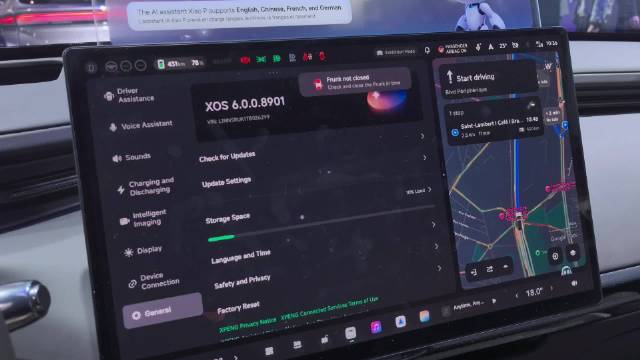
▶ Play the three-minute walkthrough — the overseas system in Paris, showing Google Maps, live traffic, restaurant search and the car's own map skin. Video: 飞机先生_ on Weibo.
What is confirmed
XPeng announced the integration at the L03's global launch in Munich in July, and its own newsroom carries the headline: "XPENG L03 Integrates Google Maps for Navigation and ADAS." The specifics, as reported by the Chinese tech press at the time:
- The L03 is the first production model from an Asia-Pacific brand with Google Maps Auto SDK built in.
- Auto SDK is not the Google Maps app embedded in a car, and not phone projection. It lets a manufacturer build its own navigation interface on top of Google's platform. The interface, rendering and interaction are XPeng's; Google supplies traffic-aware route planning, place search and EV energy and trip estimation underneath. The map runs natively in the car, with no app to download, and connects to voice control and the other screens.
- It rolls out across "most" of XPeng's overseas markets, starting with L03 buyers and then other models — and not in China, where XPeng keeps its own map system.
- Jörgen Behrends, Google's VP and GM for Maps in automotive, is quoted saying Google Maps has more than 2 billion monthly users and that XPeng completed the deployment in "less than a year."
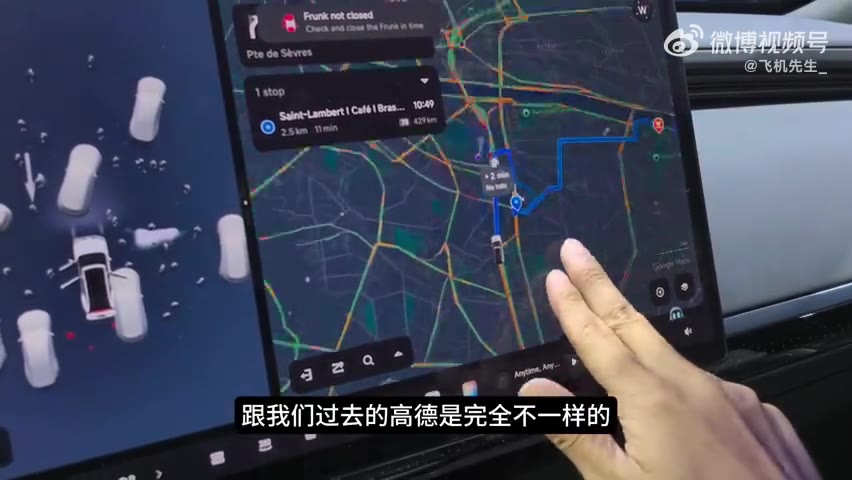
The map layer in the car: Google's data and routing, XPeng's interface. Image: 飞机先生_ on Weibo.
The correction: not the world's first
XPeng's own framing is careful — Asia-Pacific first — and the qualifier matters. The world first belongs to Rivian, which shipped a Google Maps Auto SDK-based navigation system in July 2025, a full year earlier, keeping its own interface and charging features while adopting Google's routing, ETA and place data. The pattern is identical.
Google says it is in talks with more manufacturers, which makes XPeng's move less a breakthrough than a marker of how quickly this arrangement is becoming the default. For a Chinese automaker entering Western markets, renting the map layer is faster than building one per country — and much cheaper than trying to match a decade of Google's data collection on roads you have only just arrived on.
Why the map is the story, not the map app
The part of the post that matters most is stated almost in passing: XPeng ties the Google Maps work directly to NGP.
Its own line, in the July announcement: "the future deployment of NGP (VLA 2.0) in overseas markets must rely on the support of map data and navigation instructions," and it calls the integration "a key upgrade paving the way for NGP's international growth."
That is the honest counterpart to the "two weeks per country" claim we covered this week. XPeng believes it can adapt its driving model to a new European country in a fortnight, using a ten-thousandth of the training data. What it cannot adapt that quickly is the map layer — and it has decided not to try. The model generalises; the map is rented.
It is also the pragmatic answer to the problem the same company is working on with regulators. Bringing assisted driving to dozens of countries means satisfying dozens of approval regimes; doing it on top of a map platform those markets already trust removes one class of argument before it starts.
The compliance detail, as the poster describes it
The post's own contribution is about the plumbing: that the integration required protocol handshakes reaching into the system layer rather than simply shipping an app; that personal data must be de-identified under strict rules; that vehicle perception data and Google Maps data cannot be mixed; and that Google is highly selective about which manufacturers it admits to the SDK — "not something you can buy your way into."
None of that is in XPeng's release, and we have not verified it. It is consistent with how Auto SDK is architected — a split between what Google provides and what the carmaker keeps — and with the fact that a Chinese manufacturer must satisfy European data rules to ship in Europe at all. Treat it as a credible account from someone who was in the car, not as a specification.
Caveats
- "First in Asia-Pacific" is XPeng's claim, repeated by Chinese coverage; the world first was Rivian in July 2025, and Google says other manufacturers are in talks.
- The compliance specifics — de-identification, data separation, system-layer protocol work, Google's admission criteria — are the poster's, not XPeng's, and are untested here.
- The walkthrough is the overseas system as seen in one car in one place. The Paris footage shows UK-style Google Maps data (English labels, local restaurants) and does not demonstrate anything about NGP itself.
- The China/overseas split is real: Chinese cars use XPeng's own maps, so the overseas experience is a different product, not a translation of it.
- None of this changes NGP's status as a Level 2 system wherever it launches, and map data does not substitute for regulatory approval.
- We have not used the system, and neither the post nor XPeng's release includes independent testing of the integration.
The bottom line
The interesting thing here is not the map app — every car will have one. It is that a company whose entire pitch is its own driving intelligence has concluded it cannot bring its own map layer to Europe, and has handed the foundation to Google. That dependency is what will decide how far and how fast NGP travels: the model may take two weeks per country, but the map, the data rules and the regulators are not on that schedule.
Source: XPeng's announcement of the L03's Google Maps Auto SDK integration as reported by 至顶网 and carried on XPeng's newsroom, with the Weibo walkthrough by 飞机先生_ — translated & adapted for XPENGTech.
Get the next one direct.
New articles, or a daily / weekly digest — the same list EVConduit keeps.