
16 September 2026
Will 5C Fast Charging Damage the Battery? XPeng's Powertrain Head Explains
XPeng VP and Powertrain Center head XP-Jacky answers the owner question behind every 5C claim: what does nine minutes of ultra-fast charging do to the pack? His answer is three layers of current control — an EIS safety chip doing real-time impedance 'ECG', BMS dynamic current regulation, and LFP cells with strong thermal management — plus a measured figure of about 1 percentage point of annual degradation difference, and the three charging behaviours actually worth avoiding.
An owner's question landed with XP-Jacky — XPeng's Vice President and head of the Powertrain Center — and his answer is one of the more useful pieces of battery explanation to come out of the G9L launch: will a high-power battery plus fast charging damage the battery?
The short version
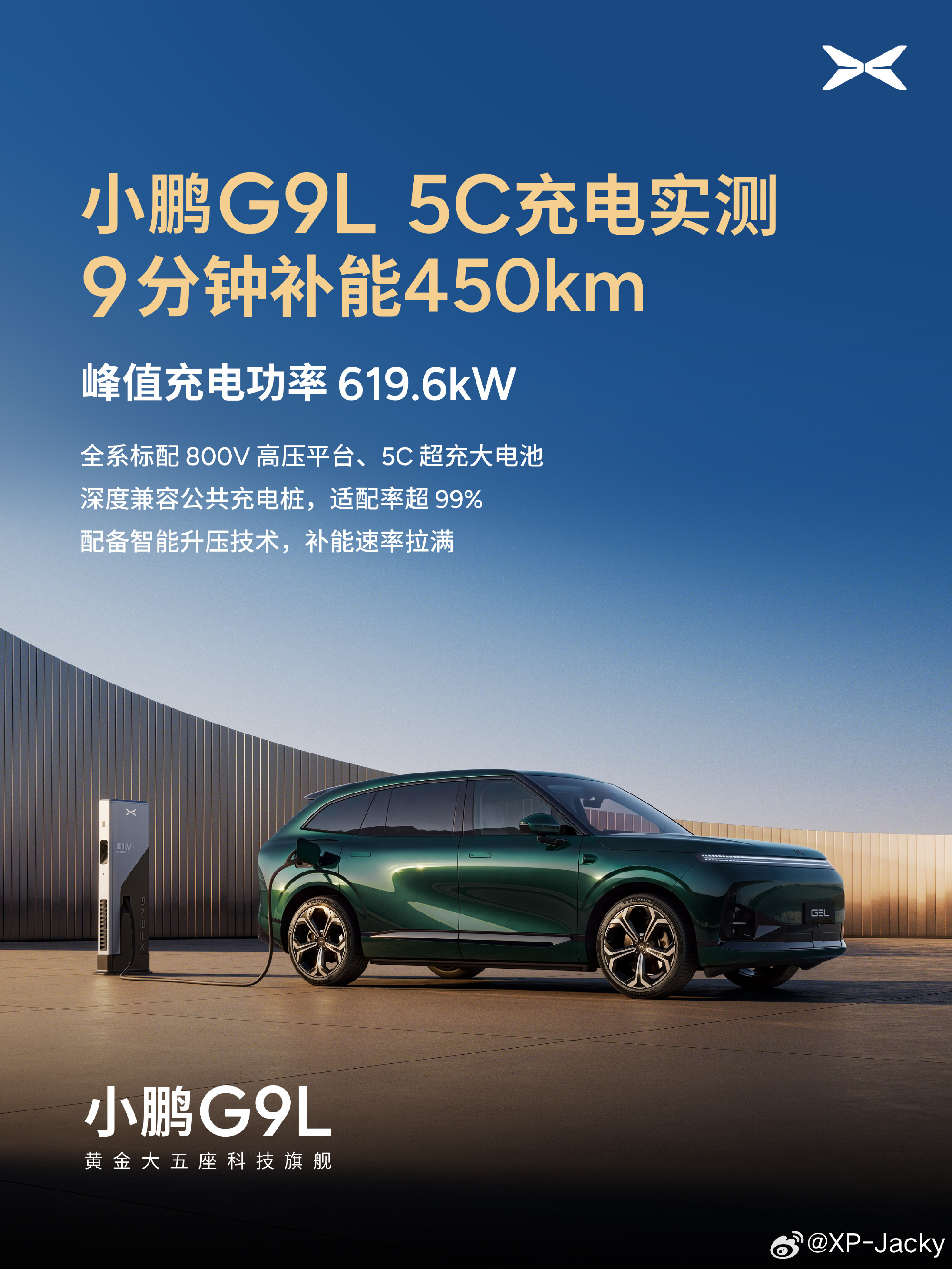
Using the G9L's 800V + 5C pack as the example — the one that adds 450 km of range in 9 minutes — his point is that during those nine minutes the current and power are not simply "full power"; they are continuously regulated by the BMS. What actually damages a battery, in his framing, is uncontrolled high current — not high current per se.
The three layers of current control
XPeng's answer describes three mechanisms working together:
1. An EIS battery safety chip — a "dynamic ECG" for the pack. EIS (electrochemical impedance spectroscopy) measures the battery's impedance in real time, which lets the system sense internal resistance and the precursors to lithium plating — the dendrite growth that is the classic long-term damage mechanism of aggressive fast charging. If charging behaves abnormally, the system reports it promptly rather than waiting for a fault.
2. BMS dynamic current regulation. If the battery management system sees abnormal temperature or impedance, it reduces power and depolarises the cells — that is, it backs off and lets the cell chemistry relax — regulating current in real time rather than following a fixed charge curve.
3. LFP cells plus strong thermal management. The pack uses lithium iron phosphate cells, and the thermal design reduces the risk of thermal runaway from both the material side and the cooling side.
Taken together, the argument is that multiple layers of control suppress most of the damage fast charging can do.
The degradation claim
The number worth remembering: XPeng says measured data shows the average annual degradation difference between long-term ultra-fast charging and slow charging is about 1 percentage point — much smaller than owners tend to expect.
That is a manufacturer figure rather than an independently verified study, and "average annual degradation difference" is doing a lot of work in one sentence — it says nothing about the worst cases, or about packs charged exclusively at 5C in hot climates. But it is a useful order of magnitude: the gap between fast and slow charging, when the fast charging is properly managed, is measured in fractions of a percent per year rather than in years of pack life.
It is also worth noting why an LFP pack can make this claim at all: LFP chemistry is inherently more tolerant of high states of charge and of heat than typical nickel-rich cells, which is part of why XPeng pairs the 5C claim with LFP rather than with a ternary pack.
What actually is worth avoiding
The most practical part of the post is the list of behaviours owners should avoid — all of them variations on the same theme of stressing a pack that is not ready for it:
- violent fast charging of a cold pack at low ambient temperature;
- ultra-fast charging immediately after heat soak — for example straight after the car has been sitting in strong sun;
- charging hard when the state of charge is already very low;
For those scenarios XPeng says it has developed smart charging functions such as battery smart insulation, which conditions the pack so it is not asked to accept high current while cold.
Why this matters for the 5C conversation
The 9-minute/450 km demonstration was impressive on video, but it invited exactly the question this post answers: what does that kind of charging do to the pack over years? The honest summary is that 5C is a system claim, not a cell claim — it depends on the chip doing impedance sensing, the BMS trimming current in real time, LFP chemistry, and thermal management. Remove any one of those and the same headline number becomes a much worse idea.
We covered the charging demonstration itself — 8% to 72%, +450 km in 9 minutes 17 seconds — in our earlier article on the G9L's 5C charging run.
Source: XP-Jacky (XPeng Vice President, Powertrain Center) on Weibo, 15 September 2026 — translated and adapted for XPENGTech. Technical claims, including the 1-percentage-point degradation figure, are XPeng's.
Get the next one direct.
New articles, or a daily / weekly digest — the same list EVConduit keeps.