
28 September 2026
Xinhua Puts XPeng NGP Against Tesla FSD in Amsterdam
A Xinhua-organised test in Amsterdam put XPeng's second-generation VLA driving stack and Tesla's FSD on the same streets on 11 September, with the results published on the 28th. Chinese coverage reports the two systems as closely matched, with XPeng clearing one construction section in a single pass where the Tesla needed two reversing adjustments. CleanTechnica's first-hand account adds the detail, and one caveat that matters: the same XPeng engineer drove both cars.
A Xinhua-organised test in Amsterdam has put XPeng's second-generation VLA driving stack and Tesla's Full Self-Driving onto the same streets — and both sides of the comparison are now on the record.
The test ran on 11 September 2026 and was embargoed until 28 September. The cars were a pre-production XPeng L03 running XNGP with VLA 2.0, and a Tesla Model 3 running FSD. The route was central Amsterdam: canal-side streets barely wider than one car, orbital tram tracks, roadworks, double-parked vehicles, tourists stepping into the road, and cyclists who have priority and do not wait. Intermittent rain made all of it worse.
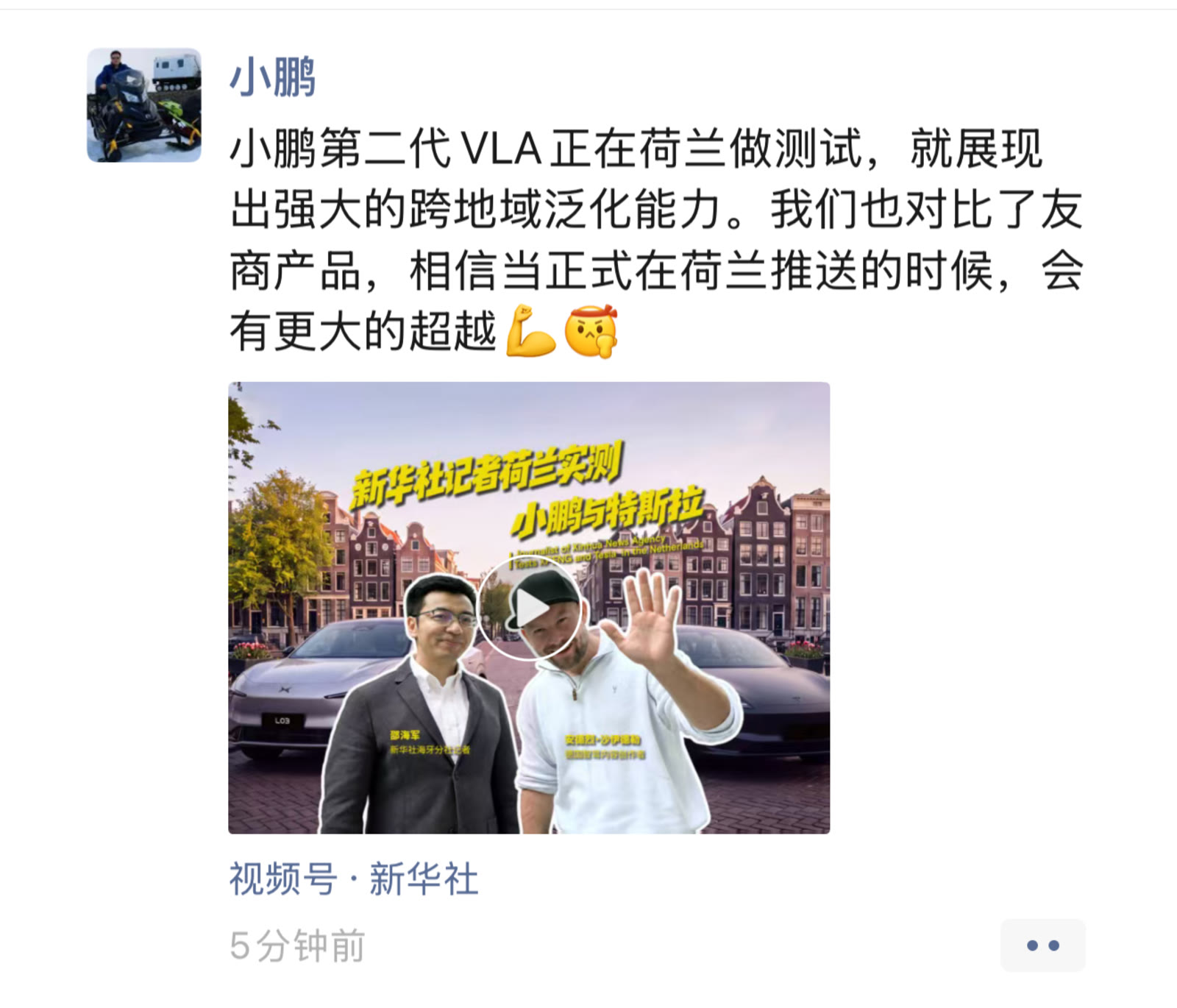
Chinese outlets describe it as the first time the two systems have been driven on the same route anywhere. The full programme is below; the shorter clips further down are the highlights 托马斯电火车 cut from it and reposted on Weibo, and 电动知士大雨, an auto-tech account that follows XPeng closely, quote-posted the same material the same afternoon.
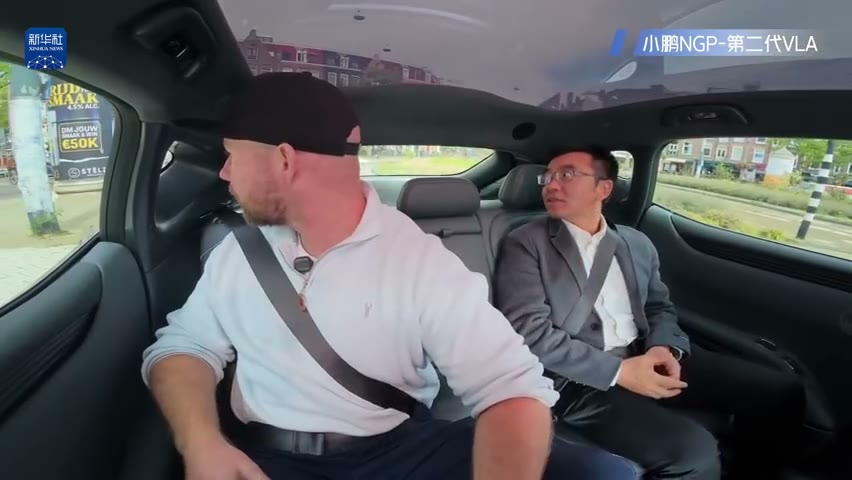
▶ Play the full programme (14 min 36 s) — the complete broadcast, in the L03 with Xinhua's correspondent and the German Tesla owner aboard, with English subtitles burned in. It is the video XPeng published on its own Weibo account.
About the footage: the programme carries Xinhua's watermark and reached us through XPeng's Weibo post. It is an edited broadcast, not a continuous log — the hours not shown are not accounted for, and no intervention or disengagement data for either car has been released.
What the Chinese coverage reports
- Xinhua's correspondent rode the XPeng and, by the outlet's own account, at one point found it difficult to tell whether a person or the software was driving — the framing being that the system's interventions were smooth enough to disappear.
- André Scheidler, a German Tesla owner and content creator who rode both systems back to back, gave the line the coverage has settled on: "Tesla is very comparable to the Xpeng."
- One section separated them. At a restricted construction area, XPeng judged the space and the safe distance and cleared it in a single pass; the Tesla needed two reversing adjustments before it got through.
- Xinhua's own social post added that the second-generation VLA "already shows strong cross-region generalisation" in the Netherlands, and that it expects a larger advantage once the system is officially rolled out there.
The other first-hand account
CleanTechnica's Larry Evans rode the L03 first and the Model 3 afterwards on the same roads, and his write-up is the most detailed account available. His description of VLA 2.0: it anticipates and then acts, and it was cautious and polite — arguably more than a local human driver — around construction and parking cars. He counted three moments where the person at the wheel took over: shifting into a lane that then had to be backed out of because of roadworks; going around a car stopped in the road with its brake lights on; and closing a gap to a construction vehicle so a car behind was not left blocking traffic.
What impressed him most was anticipation of the soft stuff: the car spotted bicycles before he did, judged their speed and distance and turned anyway, without needing a panic stop or forcing a cyclist to brake; it slowed for potholes and speed bumps, more for bigger ones; and it responded to driver inputs without disengaging, with co-driving controls on the wheel and a model that learns from what the driver does.
And the caveat that matters most for reading all of this: per his account, the same XPeng engineer drove both cars — the L03 and the Tesla. That single detail is why this is a demonstration rather than a head-to-head benchmark.
The highlights the blogger cut
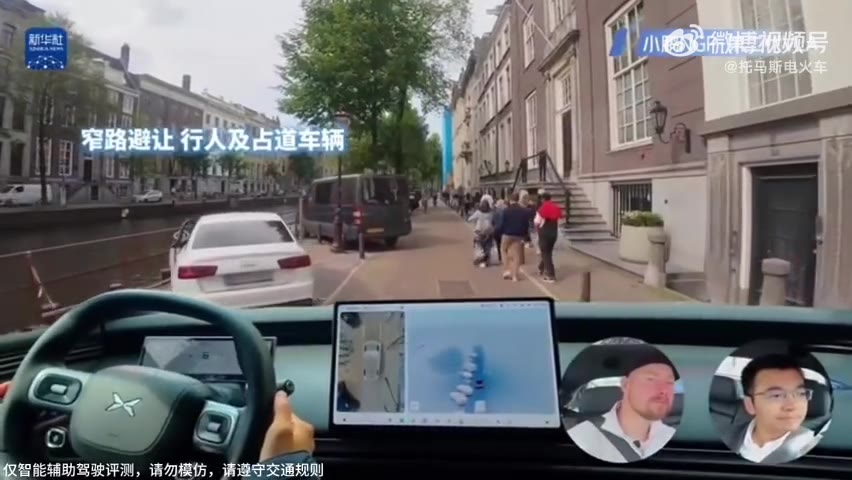
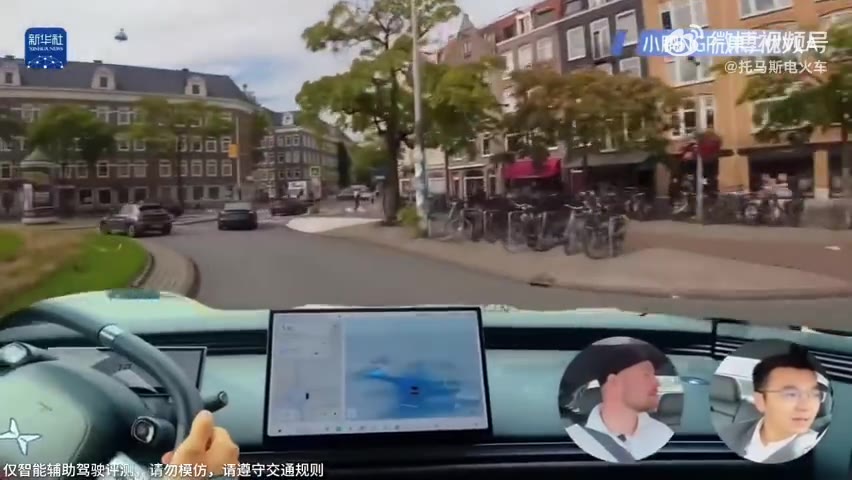
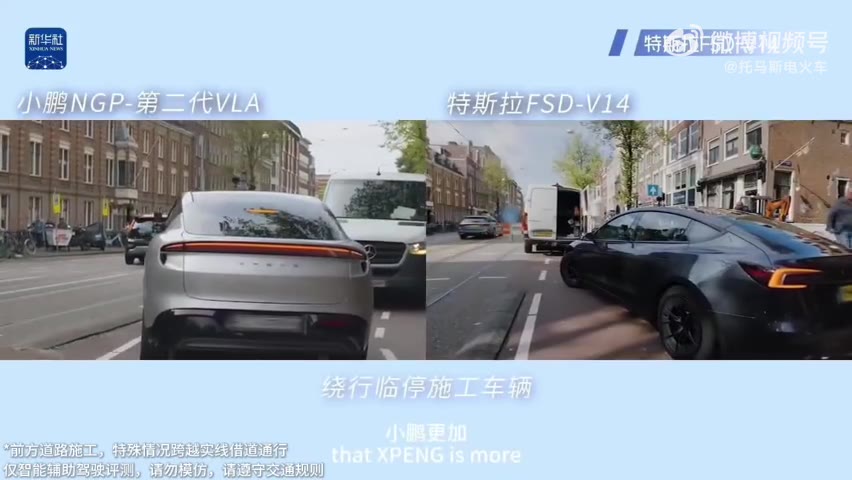
▶ Clip 2 (50 s) · Clip 3 (32 s) · Clip 4 (8 s)
The cars, on the day
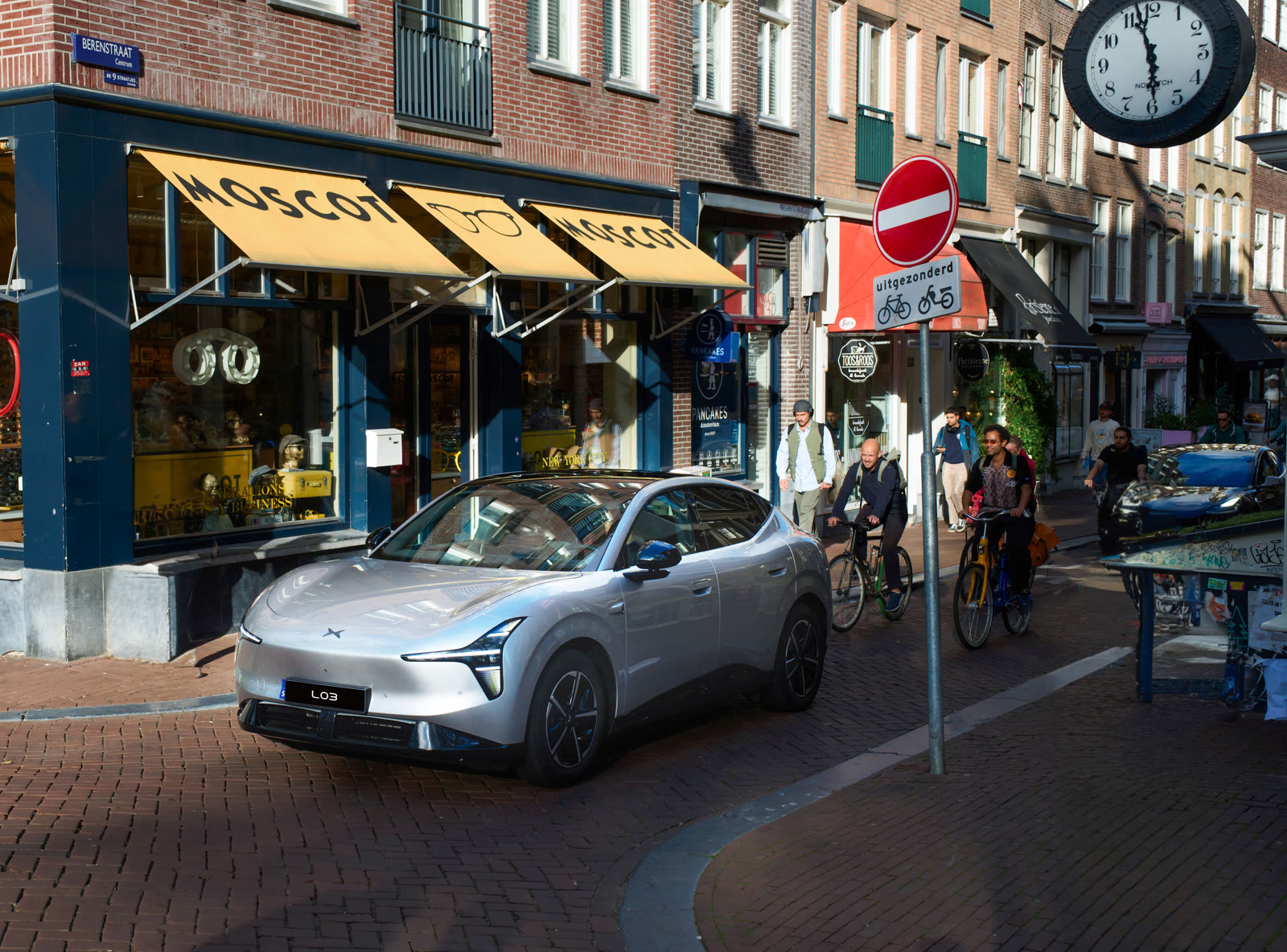
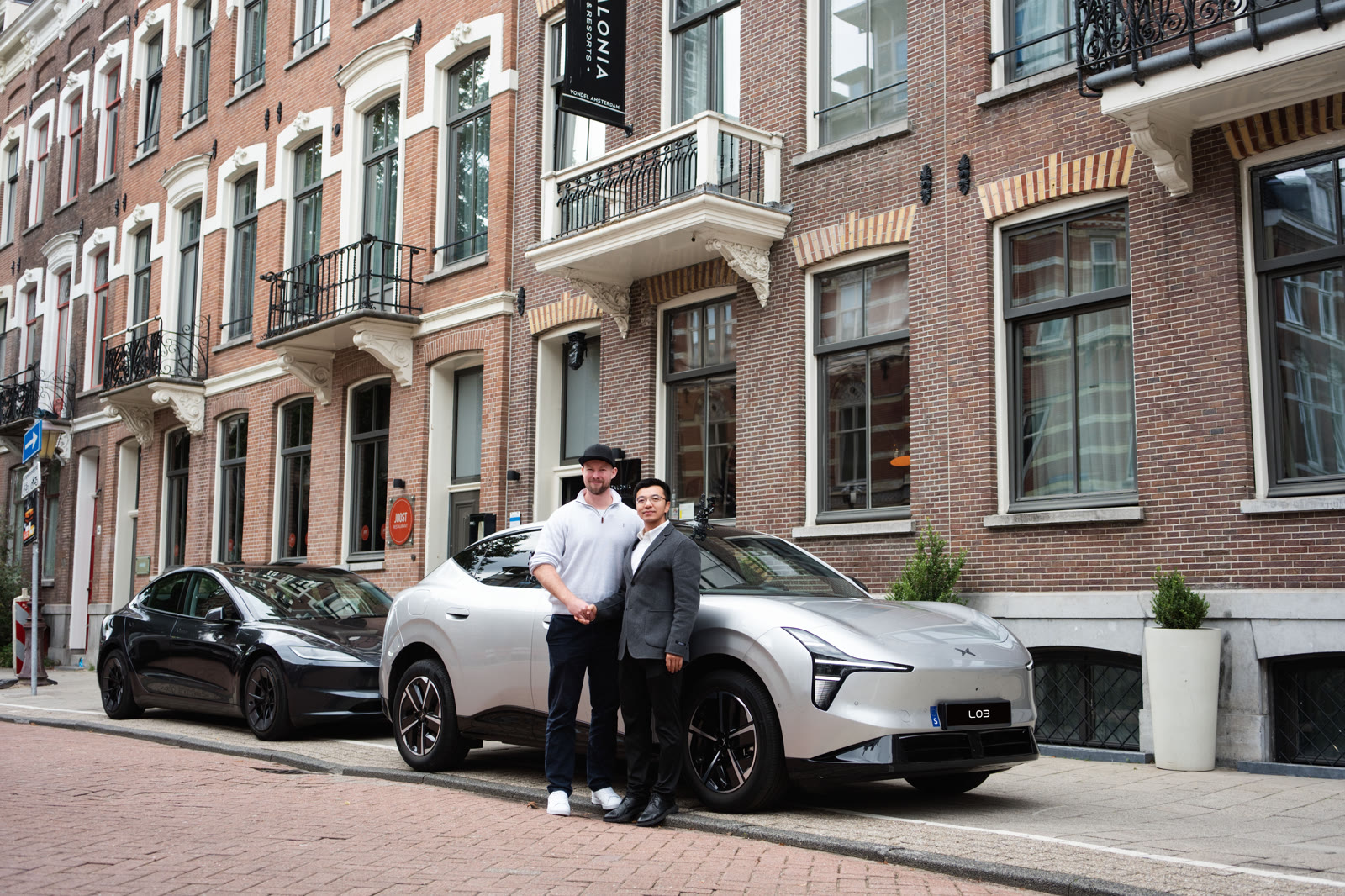
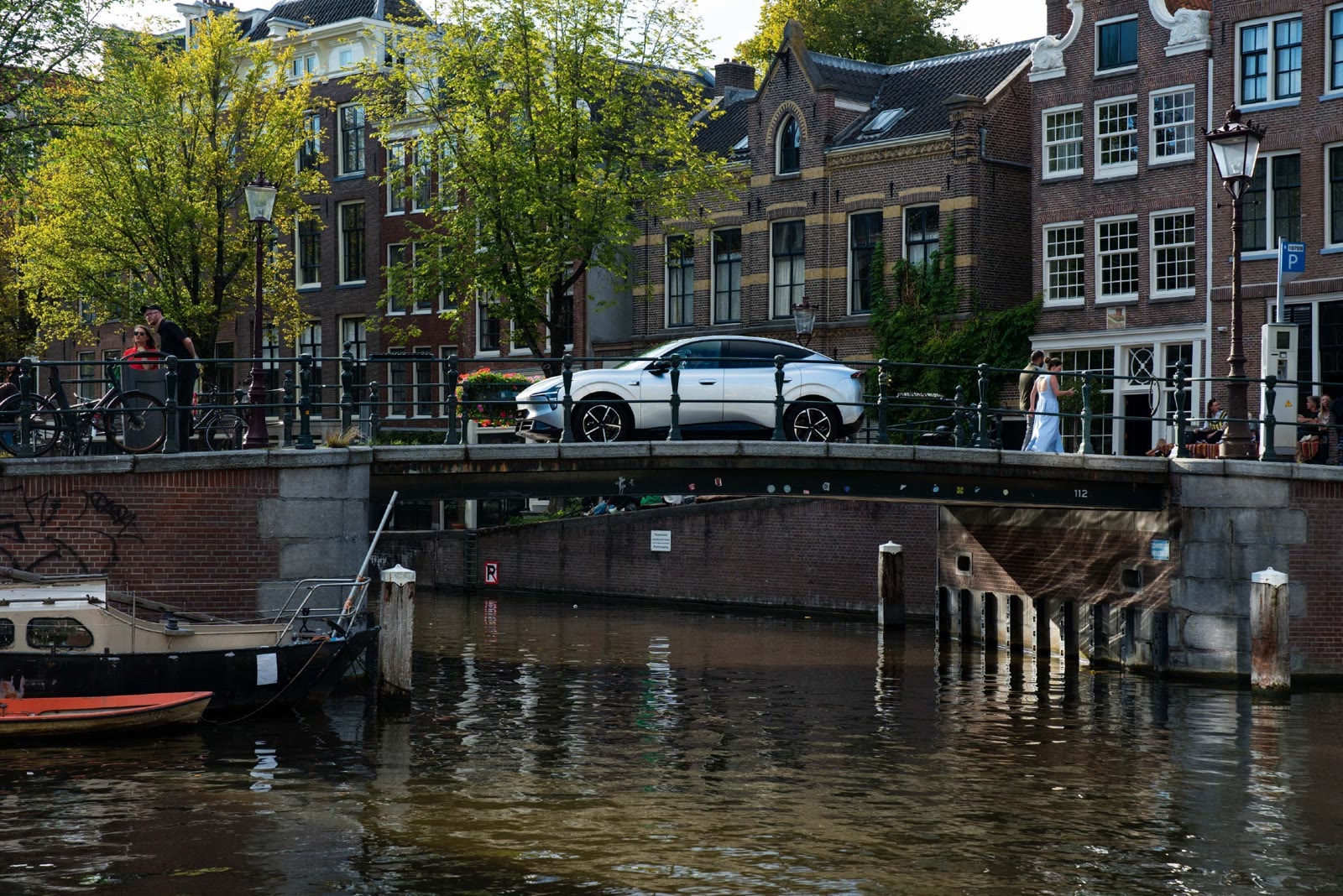
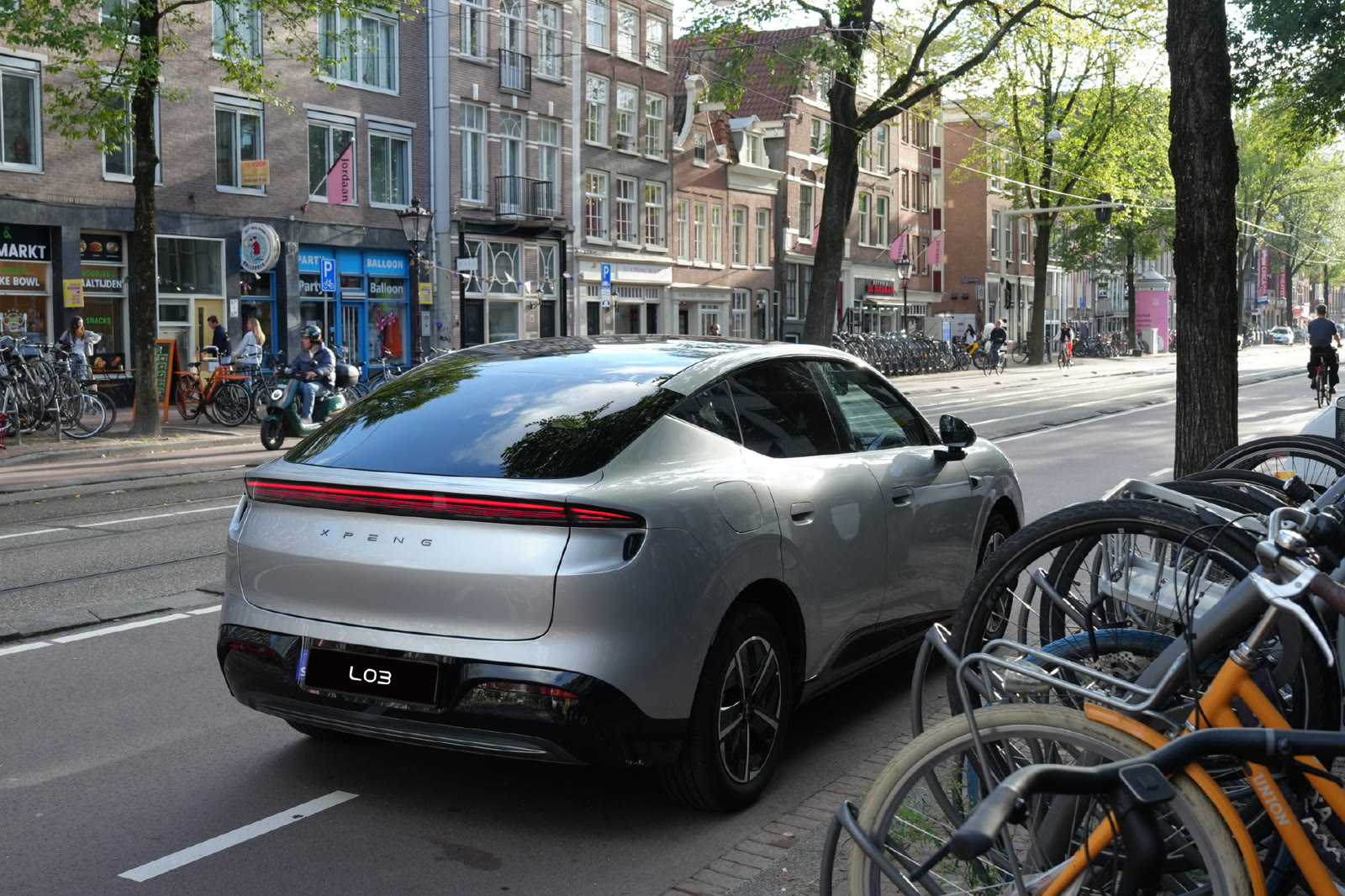
Where this sits
The Netherlands is the first country in Europe to allow FSD, which is what makes an Amsterdam comparison possible at all. XPeng was testing the L03 there ahead of its European release, which CleanTechnica puts at 2027 — so this is a pre-release car, on pre-release software, on roads the model has been learning for months rather than years.
What this test is — and is not
- It is not independent. XPeng supplied the L03 and, per the only detailed first-hand account, its own engineer drove both vehicles. Xinhua organised and filmed the comparison; the framing that comes out of it is not neutral.
- It is one city, one day, with no numbers. Nothing published so far gives interventions or disengagements per kilometre for either system. The construction anecdote — one pass versus two reversing adjustments — is a single data point, not a rate.
- Both systems are still Level 2. A driver monitored the car throughout in both cases; nobody is claiming otherwise, and both the Chinese coverage and CleanTechnica say so explicitly.
- A detail we could not corroborate. The Weibo post calls Scheidler the president of a German Tesla club. The coverage we found describes him as a long-time Tesla owner and content creator and gives no club title, so we have left the title out.
- Careful with the numbers that circulate with it. The "8:0 takeover" headline that resurfaces alongside this story belongs to a different, earlier test: a February 2025 Guangzhou comparison of FSD V13 against an XPeng P7+, run by a Chinese outlet. It has nothing to do with Amsterdam.
- The politics is the poster's, not the test's. The Weibo post pairs the drive with the MIIT-led "15th Five-Year Plan" for intelligent connected vehicles and its 2030 industrial goals. That is context the account added; the test itself measured nothing about industrial policy.
The bottom line
Two systems that are genuinely close on a hard European route, with the XPeng car showing better anticipation in construction and around bicycles, and the Tesla getting through the same route with more shuffling — as judged by a test run by one side's state media, with one side's engineer at the wheel of both cars. The interesting question is not who won Amsterdam. It is what the same comparison looks like with independent drivers, published intervention data, and the shipped software.
Source: 托马斯电火车 and 电动知士大雨 (Weibo) for the clip reel, which carries Xinhua's watermark; Xinhua's test as reported by CNMO and Sina; CleanTechnica's first-hand account — translated & adapted for XPENGTech.
Get the next one direct.
New articles, or a daily / weekly digest — the same list EVConduit keeps.