
7 November 2026
XPeng Filed an LFP All-Wheel-Drive P7. That's a Price Play, Not a Power Play.
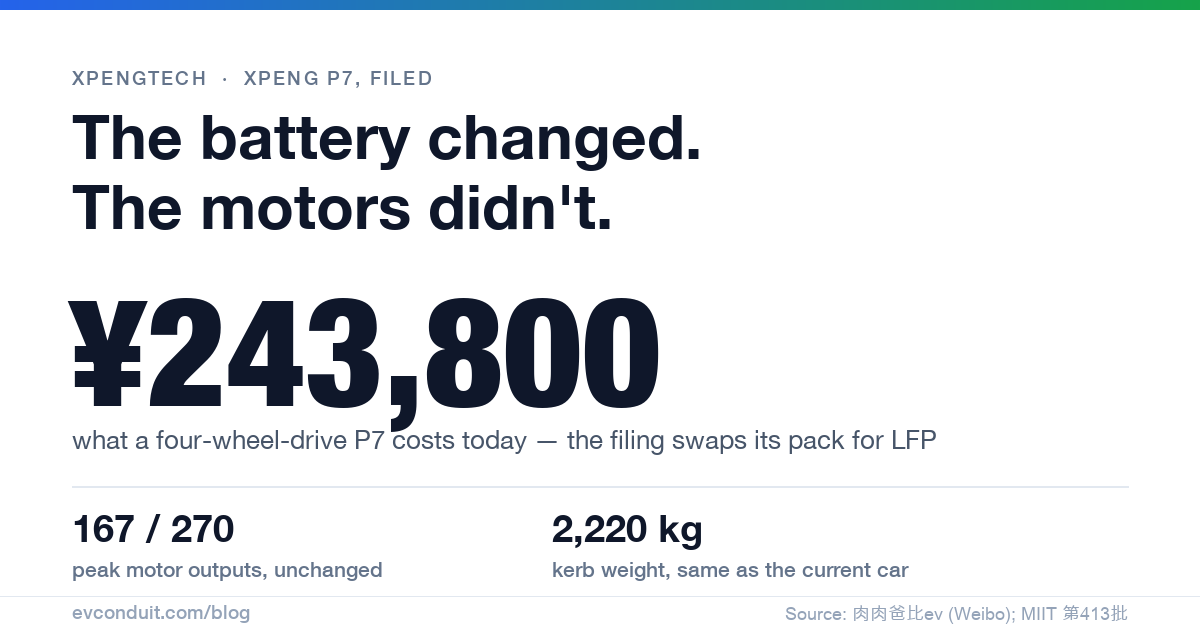
China's 413th vehicle-approval batch contains an XPeng P7 with the cheaper LFP chemistry under the fast drivetrain: an EVE Power pack, dual motors, the same 2,220 kg kerb weight. The motors are unchanged, the filing gives no range or price - but it is the clearest sign yet that XPeng intends to sell a four-wheel-drive P7 below today's 243,800 yuan.
China's type-approval system leaks cars months before their makers are ready to talk about them. The public notice for the 413th batch of vehicle approvals (公告第413批公示) went up on 4 November, and it contains an XPeng P7 variant that had not been announced. A Weibo automotive blogger found it the same morning.
The post is from 肉肉爸比ev (uid 3163705834, 435,000 followers, verified 汽车博主 / 微博原创视频博主), filed on 4 November at 09:26 with three photos: two studio-style shots of the car and one page of the filing's option catalogue. His reading: XPeng has homologated a P7 with an EVE Power (亿纬动力) battery and 160/270 kW motors, which he takes to be a new LFP, all-wheel-drive version. His conclusion is a price argument — the current four-wheel-drive P7 Max starts at ¥243,800, and "the LFP AWD should be able to come down a bit."
He is mostly right, and the detail worth adding is that the motors are not the part that changed.
What the filing actually contains
The vehicle is model code NHQ7002BEVED, according to a detailed Chinese write-up of the filing — a five-seat electric sedan with the same footprint as the current P7: 5,017 × 1,970 × 1,427 mm, 3,008 mm wheelbase. Kerb weight 2,220 kg, gross 2,670 kg, top speed 230 km/h. It carries two motors, and the storage device is listed as a lithium iron phosphate battery with cells and pack both made by Hubei EVE Power (湖北亿纬动力).
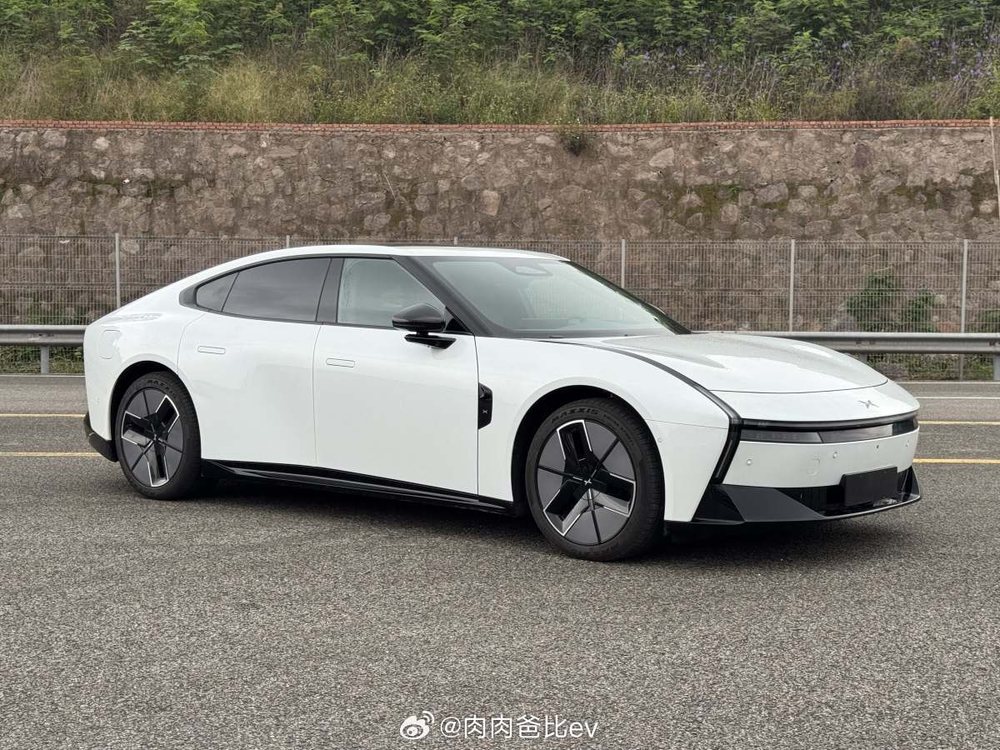
The car as photographed for the approval paperwork — the same body, a different pack underneath. Image: 肉肉爸比ev (Weibo).
That combination — LFP plus two driven axles — does not exist in the P7 range today, which is what makes it a story rather than a colour change.
One correction to the post, though. A detailed Chinese write-up of the same filing gives the motors' peak outputs as 167 kW and 270 kW, with rated outputs of 50 kW and 110 kW — a 437 kW peak total, exactly the figure XPeng publishes for today's four-wheel-drive P7. The post's "160 kW" looks like a rounding slip; on either reading the drivetrain is within a couple of percent of the car already on sale, so nothing about the filing's performance is new. What is new is the battery supplier and the chemistry underneath it.
The P7 range as it stands
From XPeng's own configurator, which is the cleanest way to see why a filing like this matters:
| Trim | Price | Drive | Battery chemistry | CLTC | 0–100 km/h |
|---|---|---|---|---|---|
| 702 Max | ¥203,800 | RWD, 270 kW | LFP | 702 km | 5.8 s |
| 820 Max | ¥223,800 | RWD, 270 kW | NMC | 820 km | 5.4 s |
| 750 四驱 Max | ¥243,800 | AWD, 437 kW | NMC | 750 km | 3.7 s |
| 750 四驱鹏翼 Ultra | ¥301,800 | AWD, 437 kW | NMC | 750 km | 3.7 s |
Look at the first row and the third. XPeng already sells an LFP P7 — it is the cheapest one, and it is rear-drive only. It already sells a four-wheel-drive P7 — it is the expensive one, and it is NMC. The filing joins the two columns: the cheap chemistry with both axles driven.
That is a well-understood move in the Chinese market and not a small one for XPeng specifically, because LFP is the lower-cost chemistry and the battery is the single largest line item in an electric car's bill of materials. Putting LFP under the fast version is how you offer a quicker car at a lower price without discounting the car you already sell.
The number that argues against a range penalty
LFP packs are usually heavier for the same energy, which is why carmakers often trade range when they trade down to LFP. The filing has one data point on this: 2,220 kg kerb weight, which is the same figure quoted for the current NMC four-wheel-drive car.
Either XPeng has found the weight back somewhere, or the LFP pack is not carrying the same number of kilowatt-hours as the 92.2 kWh NMC unit in the 750. The filing does not say which, because it does not publish battery capacity or range — those appear in later documents, and usually only at launch.
For what it is worth, the current 750 loses 70 km when you take the 21-inch wheels instead of the 20s (750 km down to 680 km). Whatever the LFP car's headline range turns out to be, expect the option sheet to move it.
Why now: the price bracket got violent
The four-wheel-drive P7 Max at ¥243,800 is not obviously cheap for what it does in 2026. On the spring 2026 price sheets, the refreshed Zeekr 007 offered 585 kW and a 2.73-second 0–100 in its four-wheel-drive Ultra trim for ¥233,900, with a limited-time entry price under ¥194,000 for the single-motor car. Xiaomi's SU7 Pro was ¥249,900 and the SU7 Max ¥303,900. Tesla's Model 3 started at ¥235,500, with the long-range rear-drive at ¥259,500.
XPeng's car has 437 kW, 3.7 seconds, a 92.2 kWh NMC pack and a 750 km claim, plus the 800V architecture and dual-chamber air suspension that are standard across the range. It is a good car being sold into a bracket where a rival offers 148 kW more for ¥10,000 less. An LFP version is the cheapest way to move the price without touching the specification sheet that the NMC car is defended by.
Where it lands is speculation, but the arithmetic gives a narrow window: above the ¥223,800 rear-drive 820 Max, below the ¥243,800 AWD Max. Somewhere in that ¥20,000 band is a four-wheel-drive P7 with a smaller price tag and a different chemical recipe. Nothing in the filing commits XPeng to it.
The supply chain is the quieter story
The current four-wheel-drive P7's pack is CALB (中创新航) NMC, 92.2 kWh, according to spec sheets. The filing swaps that for EVE Power LFP.
This is consistent with where XPeng's battery sourcing has been heading. We wrote in September about how the company's 2026 line-up runs on CALB, EVE and FinDreams with essentially no CATL in the GX — a deliberate diversification that also improves purchasing leverage. EVE was already supplying large volumes for the MONA cars and the P7+, in both LFP and ternary chemistries. A P7 pack is the next step up the range.
Two other details in the filing are worth noting for what they say about XPeng's supplier map: the two drive motors are listed as coming from XPeng's own Wuhan manufacturing arm and from Luxshare-ICT's Changshu plant (立讯智造科技), and the braking system is a Bosch IPB unit made in Suzhou. The applying entity is Zhaoqing XPeng New Energy Investment; the production address is Guangzhou Huangpu.
What the filing cannot tell you
- No capacity, no range, no price, no date. None of those appear in what was published. The notice came with a single attachment — the vehicle-and-vessel tax exemption catalogue (第九十二批) — and that list does not include this model, so there is not even a secondary range figure to check against.
- The 5C claim is unverified for this pack. XPeng's current line-up advertises a "5C ultra-fast AI battery" even on the LFP 702 Max, with a claimed 10–80% DC time of 12 minutes; the NMC cars quote 11.3. Whether the new LFP pack keeps that is not in the filing.
- The "Chinese tax-incentive catalogue" attachment we could open does not list this car, so there is no third-party range figure to check against yet.
- The Weibo post is not the primary document. Its author is reading the same filing everyone else is, and his 160 kW figure is already off by 7 kW against a fuller reading.
- It is a filing, not a launch. XPeng has homologated cars before and released them months later, or changed them before launch.
The comment section is its own data point
The post drew 25 comments, and they split in a way that is informative about the car's audience. One asked whether the price could reach the ¥150,000–200,000 band. Another pushed back hard: "why should it get cheaper — XPeng's totem needs its own position." And a third dismissed the pack as coming from a "second-tier no-name battery maker," drawing a reply pointing out that CALB and EVE are two of the largest cell makers in China.
That last exchange is the same argument we made in the battery-supply piece, from the other side: for a large part of the buying public, a battery brand is a credibility signal, and CALB or EVE do not carry the recognition that CATL does — even though XPeng's flagship GX has no CATL cells in it at all. An LFP AWD P7 will have to sell on the number, not the badge.
The bottom line
XPeng has filed a P7 that puts the cheaper battery under the faster drivetrain. Nothing about the motors is new, the filing says nothing about the price, and the only figure that hints at the trade-off — kerb weight — is identical to the car on sale. But the direction is unambiguous: the company is preparing a four-wheel-drive P7 that costs less than ¥243,800, and the LFP pack is what makes that possible.
Three things to watch at launch: the pack size, whether the 5C charging survives, and whether the price lands closer to the rear-drive 820 Max than to the car it is meant to undercut.
Source: 肉肉爸比ev (Weibo) — translated & adapted for XPENGTech.
Get the next one direct.
New articles, or a daily / weekly digest — the same list EVConduit keeps.