
20 September 2026
XPeng G9L's 1,200 km Zero-Refuelling Run, Analysed
Nine media outlets drove a G9L from Beijing to Shanghai — 1,200 km with zero refuelling, finishing with 81 km showing. 张抗抗KK's analysis of the logged data shows the three phases: electric first to 279.4 km at a 77.6% range achievement rate, then fuel burning while the battery climbed from 43 to 267 km, then the remarkable final stretch where the fuel display read zero while the battery gained charge — the 'hidden fuel' buffer, and why it is cheaper than an equivalent battery reserve.
XPeng's G9L has completed a 1,200 km Beijing-to-Shanghai run with zero refuelling — nine media outlets, one tank and one charge, finishing with 81 km still showing. 张抗抗KK then took the raw data from 小王同学_DrEV and worked out how the car actually used its fuel and its battery along the way, and the shape of it is more interesting than the headline.
Reading the chart
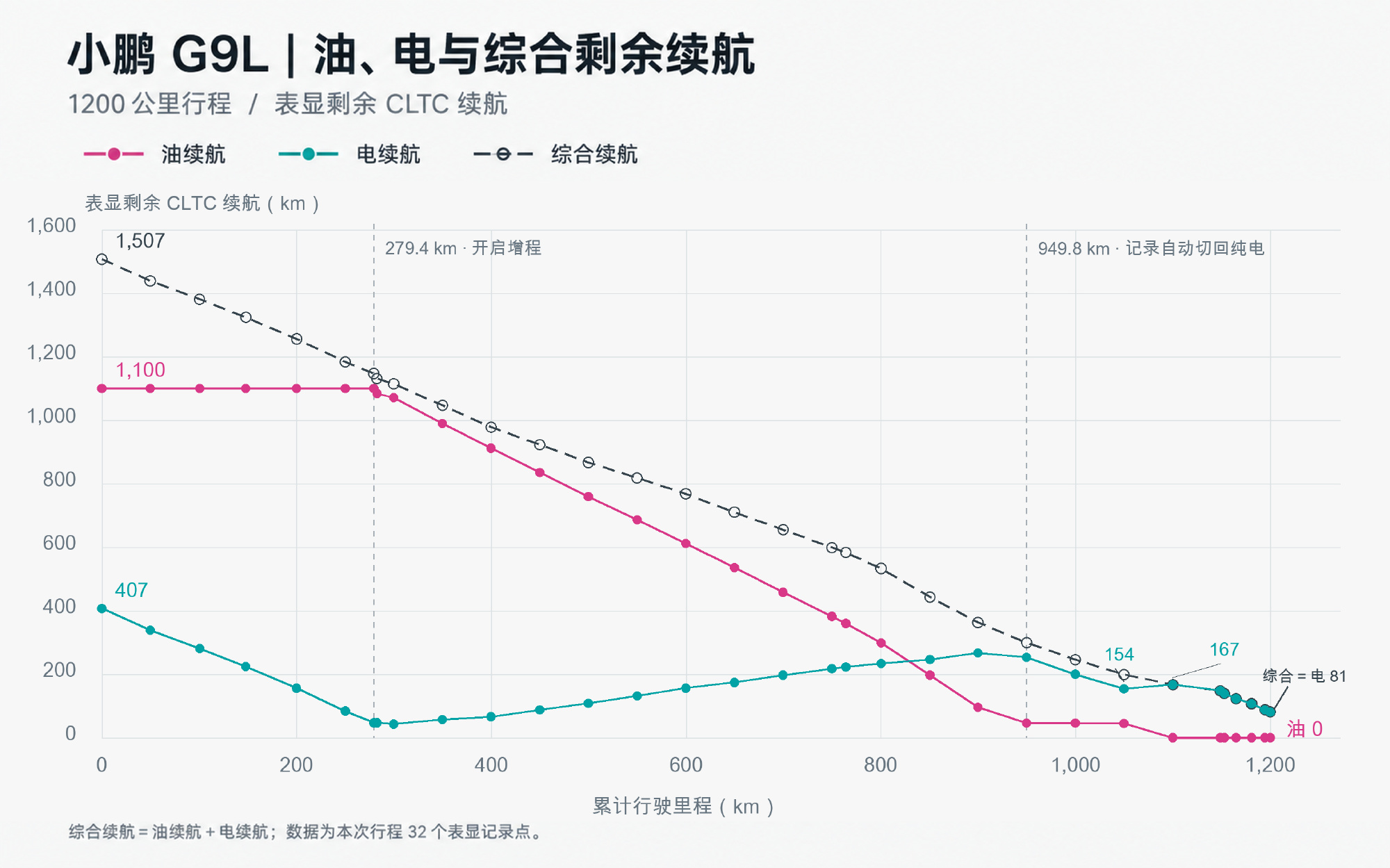
The graph plots three curves across the trip: remaining fuel range, remaining electric range, and combined range (fuel + electric) as shown on the car's display, taken from 32 records logged during the run. Two annotations matter: at 279.4 km the range extender was switched on, and at 949.8 km the log shows an automatic switch back to pure electric.
From there the trip falls into three phases.
Phase 1 — electric first, to 279.4 km
The car ran on battery alone until 279.4 km, when the range extender was engaged. Displayed electric range fell from 407 km to 47 km — 360 km of indicated range consumed — while the car actually travelled 279.4 km. That works out to an electric range achievement rate of 77.6% against the displayed CLTC figure, which is a useful reminder of how CLTC numbers relate to real motorway running.
Phase 2 — burning fuel, and the battery climbing
From roughly 300 km to 900 km, remaining fuel range fell steadily while remaining electric range rose from 43 km to 267 km. Nothing was plugged in: the range extender was putting energy back into the battery.
That is the strategy in one sentence: run the engine at a good efficiency point, send part of the output to the motor and part into the pack. On a long trip the battery becomes a buffer rather than a fixed reserve.
Phase 3 — fuel low, then the interesting part
By 949.8 km the fuel range was down to 46 km and the log recorded "fuel insufficient, automatically switched back to pure electric". Over the next 100 km the fuel figure barely moved (46 → 45) while electric range fell from 253 km to 154 km.
Then the pattern inverts. From 1,049.8 km to 1,100 km — 50.2 km of travel — fuel range went from 45 km to 0, but electric range rose from 154 km to 167 km. The car was still generating. And over the following 48.8 km, with fuel range pinned at zero, electric range fell only from 167 km to 148 km — just 19 km used for 48.8 km driven.
The "hidden fuel" explanation
The only consistent reading is that the car was still burning fuel to make electricity after the fuel range display hit zero — the phenomenon Chinese owners call 藏油, "hidden fuel". A displayed zero does not mean an empty tank: manufacturers hold a buffer below the point the gauge is willing to represent.
张抗抗KK's follow-on argument is about why this asymmetry exists. Battery-electric cars also keep a buffer, but the arithmetic is unforgiving: at roughly 20 kWh per 100 km, buying an extra 100 km of genuine reserve means roughly 20 kWh of battery — cost, volume and weight. A fuel tank has its own packaging and safety constraints, but adding a few litres is a far cheaper reserve. His phrasing: making the tank bigger is basically a slap more sheet metal.
What the run does and does not prove
- It is one trip, in one direction, by media drivers — not a standardised consumption test, and weather, traffic and driving style all moved with it.
- The 77.6% figure is the poster's own calculation from displayed CLTC values versus actual distance, not an official number.
- The conclusion that fuel was still being burned during the final zero-range segment is an inference from the data pattern — a well-supported one, since the battery charge rose while the fuel display read zero, but an inference rather than a logged event.
- And as the author notes, the run finished with range still showing: nobody knows how far it would have gone to a genuine stop.


Source: 张抗抗KK on Weibo, 19 September 2026 — translated and adapted for XPENGTech, with data from 小王同学_DrEV and the challenge summarised by XPeng's community post. Displayed ranges are CLTC-based; the achievement-rate and hidden-fuel conclusions are the author's analysis.
Get the next one direct.
New articles, or a daily / weekly digest — the same list EVConduit keeps.