
30 September 2026
XPeng G9L vs Porsche Cayenne: 4.7 s, 36 m and a Wet Moose Test
A Chinese reviewer ran an XPeng G9L and a Porsche Cayenne back to back: 4.7 s to 100 km/h, 36.0 m braking, a 5.4 m turning radius against the Cayenne's 5.7 m, and a wet moose test at 66.3 km/h against 62.5 km/h. The Cayenne won the high-speed lane change 124.1 to 123.4. The revealing part is not the margins but how differently the two cars behave at the limit.
A Chinese reviewer has taken an XPeng G9L and a Porsche Cayenne to a test track and run them back to back — acceleration, braking, a high-speed double lane change, a turning circle, and a wet-surface moose test. The results are more interesting for where the two cars diverge than for who won.
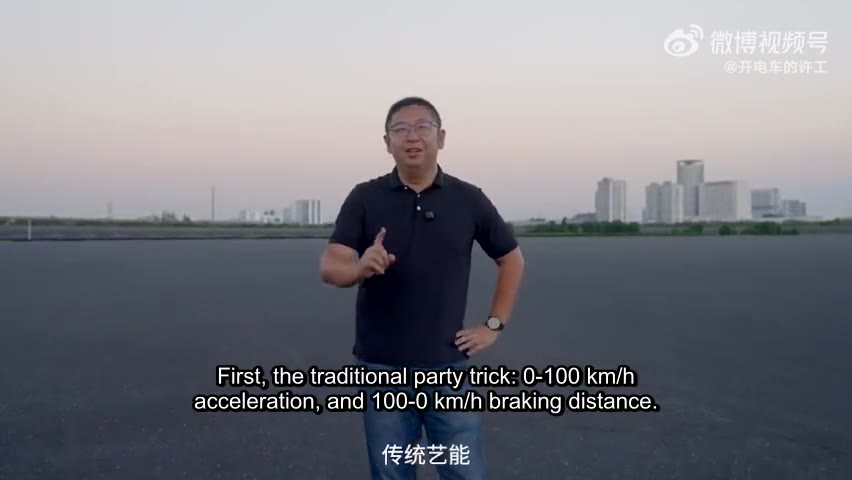
▶ Play the 6-minute 50-second test (English subtitles added) — the reviewer is 开电车的许工; the subtitles are ours, the testing is his.
The numbers
| Test | XPeng G9L | Porsche Cayenne |
|---|---|---|
| 0–100 km/h | 4.7 s (every run, per the reviewer) | not published in the video |
| 100–0 km/h braking | 36.0 m | not published in the video |
| Turning radius | 5.4 m | 5.7 m |
| High-speed double lane change | 123.4 km/h | 124.1 km/h |
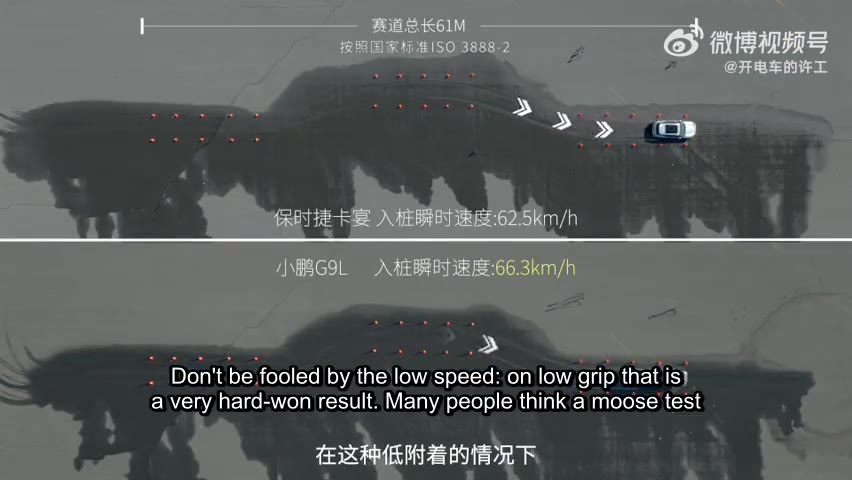
| Wet moose test | 66.3 km/h | 62.5 km/h |
Where each car was actually better
The G9L won the two tests that measure hardware more than tuning: it stops in 36 metres, and it turns in a 5.4-metre radius despite being a longer car — its wheelbase is about 20 cm longer than the Cayenne's. Rear-wheel steering is doing the work there, and as we noted when the G9L launched, that hardware — steer-by-wire rear steering up to 15°, dual-chamber air suspension and adaptive dampers — is standard across the range from ¥231,800 (the limited-time launch price; list is ¥241,800). There is no options list to work through.
The Cayenne won the test that measures composure at speed, narrowly: 124.1 km/h through the high-speed lane change against 123.4 km/h.
And the wet moose test — where the G9L was faster at 66.3 km/h against 62.5 km/h — is the one the reviewer treats as the most revealing, for a reason that has nothing to do with the stopwatch. His point is that the two cars get through it in completely different ways: the Cayenne's rear is livelier and needs a driver with some skill to keep it tidy, especially on a low-grip surface, while the G9L leans a little more, runs slightly wide, and simply refuses to make a drama of it. For a big, heavy, comfort-oriented electric family SUV, that is the achievement — not the extra 3.8 km/h.
The reviewer's own verdict
He is careful not to overclaim. His summary is that the Cayenne remains the sporty, entertaining SUV and is the one for a driver who wants that; the G9L is the comfortable, tech-forward, solidly luxurious one whose chassis is not inferior to the traditional luxury brands — and that for a family SUV it was a genuine surprise. He also notes that the two cars were filmed across two days of testing, and that both behaved consistently in the acceleration and braking runs.
Caveats
- One reviewer, one test day, one car of each. These are his numbers, not independently witnessed or repeated, and the video does not state the Cayenne's variant, tyres or the ambient conditions.
- The Cayenne comparison is a marketing frame as well as a test. The original post carries the hashtag "G9L's handling matches the Cayenne at a fraction of the price," and a 4.7-second, 36-metre SUV is being benchmarked against a car in a different price class deliberately.
- Two cells in the table above are blank because the video reports the G9L's acceleration and braking figures (its own headline results) without giving the Cayenne's.
- The moose test result is the stopwatch, not the whole story — the reviewer's more useful observation is about how each car behaves, which is a judgement from the passenger seat rather than a measurement.
- Our subtitles are a translation. The narration is Chinese; we translated it for this clip, and any nuance in the reviewer's wording is ours to answer for.
The bottom line
A ¥231,800 Chinese SUV was put through a wet moose test against a Porsche Cayenne, and the interesting result is not that it was 3.8 km/h quicker. It is that the car was easier — the same chassis hardware that gives it a tighter turning circle than a smaller Porsche is what lets it absorb an emergency avoidance manoeuvre without asking the driver to be a hero. That is a deliberate engineering choice, and it is the one a family SUV should be making.
Source: 开电车的许工 (Weibo) for the video; launch specifications from our earlier G9L coverage — translated & adapted for XPENGTech.
Get the next one direct.
New articles, or a daily / weekly digest — the same list EVConduit keeps.