
11 October 2026
XPeng Is the First Automaker Mass-Producing ADI's Battery 'ECG'
Analog Devices' own case study names XPeng as the world's first automotive OEM to put ADI's EIS technology into mass production - the 'battery ECG' that measures impedance across many frequencies rather than reporting one resistance number. A Chinese commentator has paired ADI's claim with the company's public CN0510 reference design showing how the measurement is made. We explain what the spectrum reveals, what the bench hardware does not prove, and what has never been published.
A Chinese battery commentator has dug out the supplier's side of a story we had only heard from XPeng. 张抗抗KK has found Analog Devices' own case study, which states plainly that XPeng is the world's first automotive OEM to adopt ADI's EIS technology for mass production.
EIS — electrochemical impedance spectroscopy — is the technology XPeng's powertrain chief described in September as a "dynamic ECG" for the pack. ADI's write-up is dated 15 June 2026 in English and was published in Chinese on 23 June 2026.
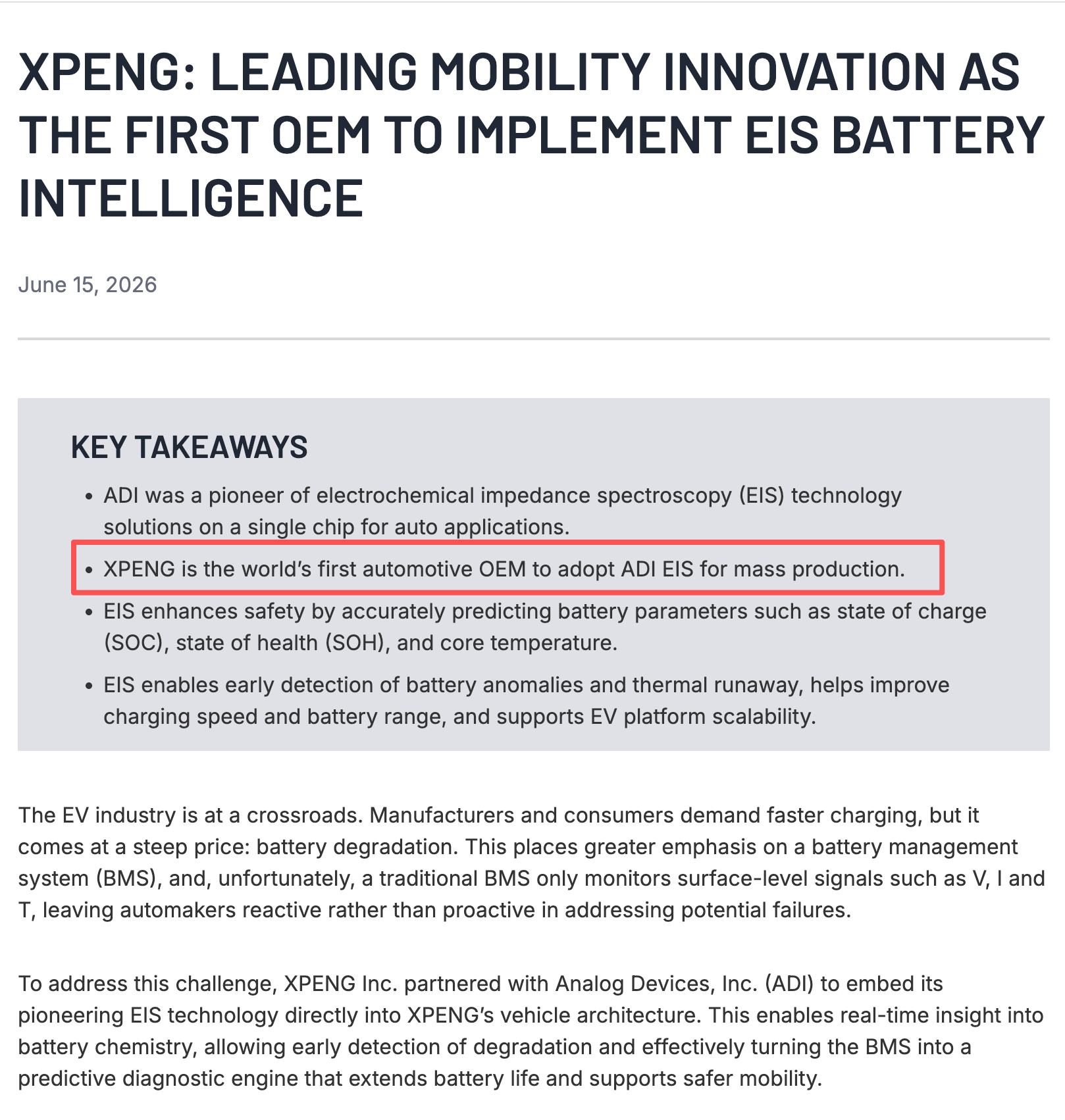
ADI's own page, as reproduced in the post. The highlighted line is the claim: the world's first automotive OEM to adopt ADI EIS for mass production. Image: Analog Devices, via 张抗抗KK on Weibo.
What EIS actually measures
A conventional battery management system watches voltage, current and temperature — three surface-level signals. From those you can infer that something is wrong, but not what.
EIS does something different: it applies small signals at many frequencies and measures the battery's impedance at each of them, producing a curve rather than a single number. The commentator's framing is a good one — it is the difference between "the pack's resistance is 20 milliohms" and a spectrum you can read:
- high frequency reflects the ohmic path — connections, conductors, the parts of the cell the current has to pass through;
- mid frequency reflects interfaces, including the SEI layer and charge-transfer behaviour;
- low frequency reflects diffusion — how easily lithium moves inside the material.
That is why a spectrum is diagnostic and a single resistance value is not. A pack whose overall resistance has risen tells you it is ageing; a spectrum that has moved in one band rather than another tells you where it is ageing, which is the difference between a warning light and a maintenance decision.
Why doing it in a car is the hard part
Impedance measurement is routine in a laboratory with precision instruments and a calm electrical environment. A car is neither: it is a high-voltage, noisy, cost-constrained product that has to do the measurement continuously, on every pack, for years.
That is the engineering ADI claims to have done — integrating the complete measurement chain onto a single chip for automotive use, across its ADBMS6842, ADBMS2970 and ADBMS6822 battery management devices, with multi-frequency analysis and its BLISS system software. ADI says it also worked directly with XPeng on the algorithms, producing a unified BMS architecture now covering XPeng's electric line-up, and it placed support engineers near XPeng's operations base for frequent face-to-face work.
The reference design the post is built around
The post's fifteen images are mostly from ADI's public CN0510 reference design — one of the company's "Circuits from the Lab" bench circuits for battery impedance measurement. They show schematics, the evaluation board and its wiring, and, in the last figure, an actually measured impedance spectrum of a lithium-ion cell.
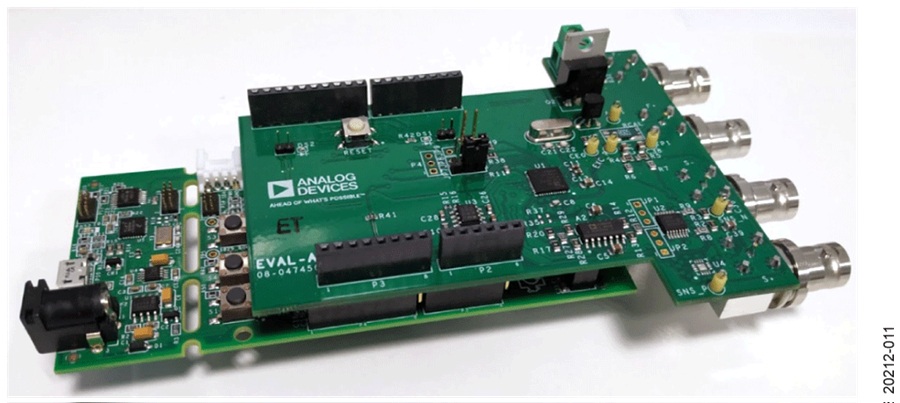
ADI's CN0510 evaluation board, from the reference design the post draws on. Image: Analog Devices.
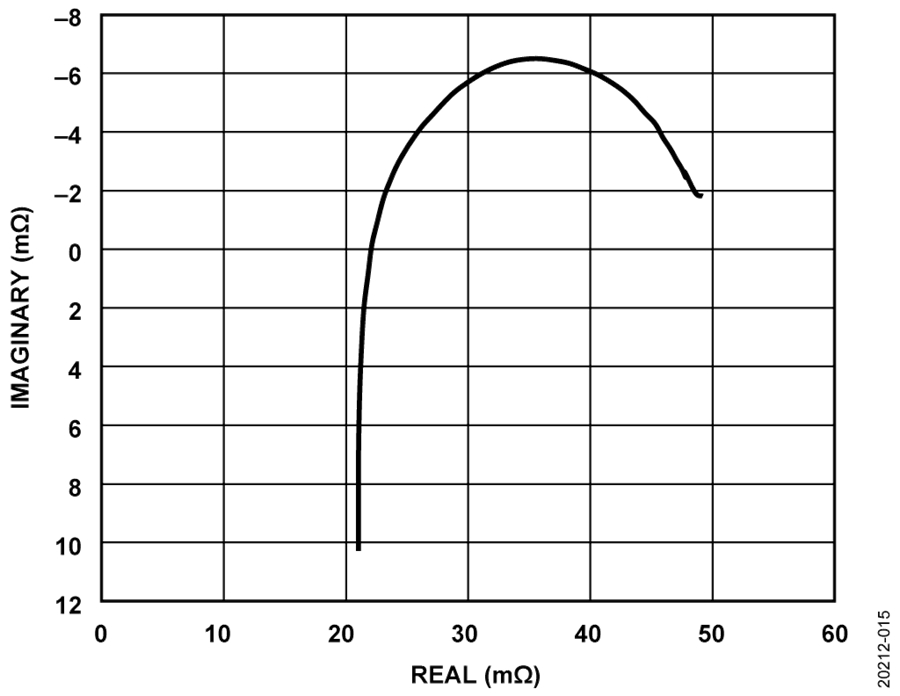
A measured impedance spectrum from the reference-design documentation. Note the date stamp on the plot: this is 2021 bench data, not vehicle data. Image: Analog Devices.
That distinction is worth keeping: the reference design demonstrates how the measurement is made, not how XPeng's production system performs. The plot is bench hardware talking to a single cell on a lab bench, and it predates the automotive programme by years. The production implementation is the ADBMS silicon, not the evaluation board.
Where this fits what we know
We have covered the other half of this already. XPeng's powertrain leadership has described the EIS battery safety chip as the first of three mechanisms answering whether 5C fast charging damages the pack — sensing impedance and the precursors of lithium plating, with the BMS then trimming current and depolarising cells in real time, backed by LFP chemistry and thermal management (that article is here).
What ADI adds is the supplier's confirmation and the mechanism: the sensing is done by ADI's battery management silicon with co-developed algorithms, not by an XPeng-designed chip.
Caveats
- "World's first" is ADI's claim, echoed by XPeng. It concerns ADI's own EIS technology being mass-produced in a vehicle — not the first use of EIS in a battery management system in any form, which has a long research history.
- The reference-design images are bench hardware, part of ADI's public library; the impedance plot is dated 2021. They are not XPeng production boards or vehicle measurements.
- No field data has been published. There are no failure-detection rates, warranty-pack comparisons or thermal-runaway statistics — only the capability claims.
- Which XPeng models carry it is not settled here. Chinese aggregators say the G9L and GX; we could not confirm that in a primary XPeng or ADI document this session, so treat the model list as unverified.
- ADI's own English page could not be read directly (the fetch failed), so the case-study text used here is ADI's published Chinese version, plus the page image in the post.
- The commercial framing is the vendors' own. ADI and XPeng co-published this material; both have an interest in the technology being seen as production-ready.
- The frequency-band interpretation is standard electrochemistry, but which bands map to which failure mode in a specific pack is a modelling question, not a given.
The bottom line
EIS is the least visible part of any fast-charging pitch and possibly the most consequential, because it is the difference between a battery management system that reacts to a fault and one that has been watching a curve move for months. The interesting question is not who got there first with a supplier's part — it is whether the data changes outcomes: fewer warranty packs, earlier diagnosis of a failing module, and fast charging that stays safe as the cells age. None of that has been published yet.
Source: the Weibo post by 张抗抗KK, with ADI's case study as published on eet-china (23 June 2026) and the CN0510 reference design — translated & adapted for XPENGTech.
Get the next one direct.
New articles, or a daily / weekly digest — the same list EVConduit keeps.