
8 October 2026
XPeng Names Its Robotaxi YOYO and Opens a Booking Mini-Program
XPeng has named its Robotaxi business XPENG YOYO (小鹏悠游), opened a robotaxi page and a ride-hailing mini-program, and will let the public in by invitation code. The car is a GX-platform vehicle with four Turing chips at about 3,000 TOPS, second-generation VLA and no lidar or HD maps; production units came off the line in May, employee testing has passed 2,200 orders, and since August it can test in Guangzhou with nobody in the driver's seat. The substance is the permit, not the name.
XPeng's Robotaxi business stopped being a project on 8 October and became a brand. The company formally named it 小鹏悠游 — English XPENG YOYO — put a Robotaxi page on its official site and switched on the XPENG YOYO autonomous driving ride-hailing mini-program, with public access to follow in waves by invitation code.
The name is doing some work. In XPeng's own explanation, 悠 is the ease inside the passenger (悠然于心) and 游 the freedom of the movement itself (畅游于行) — together, calm. YOYO is the version meant for everywhere else: as the company puts it, easy to read all over the world, "the first step as it goes global." That is the kind of thing a company only bothers to explain when it intends to use the name outside China.
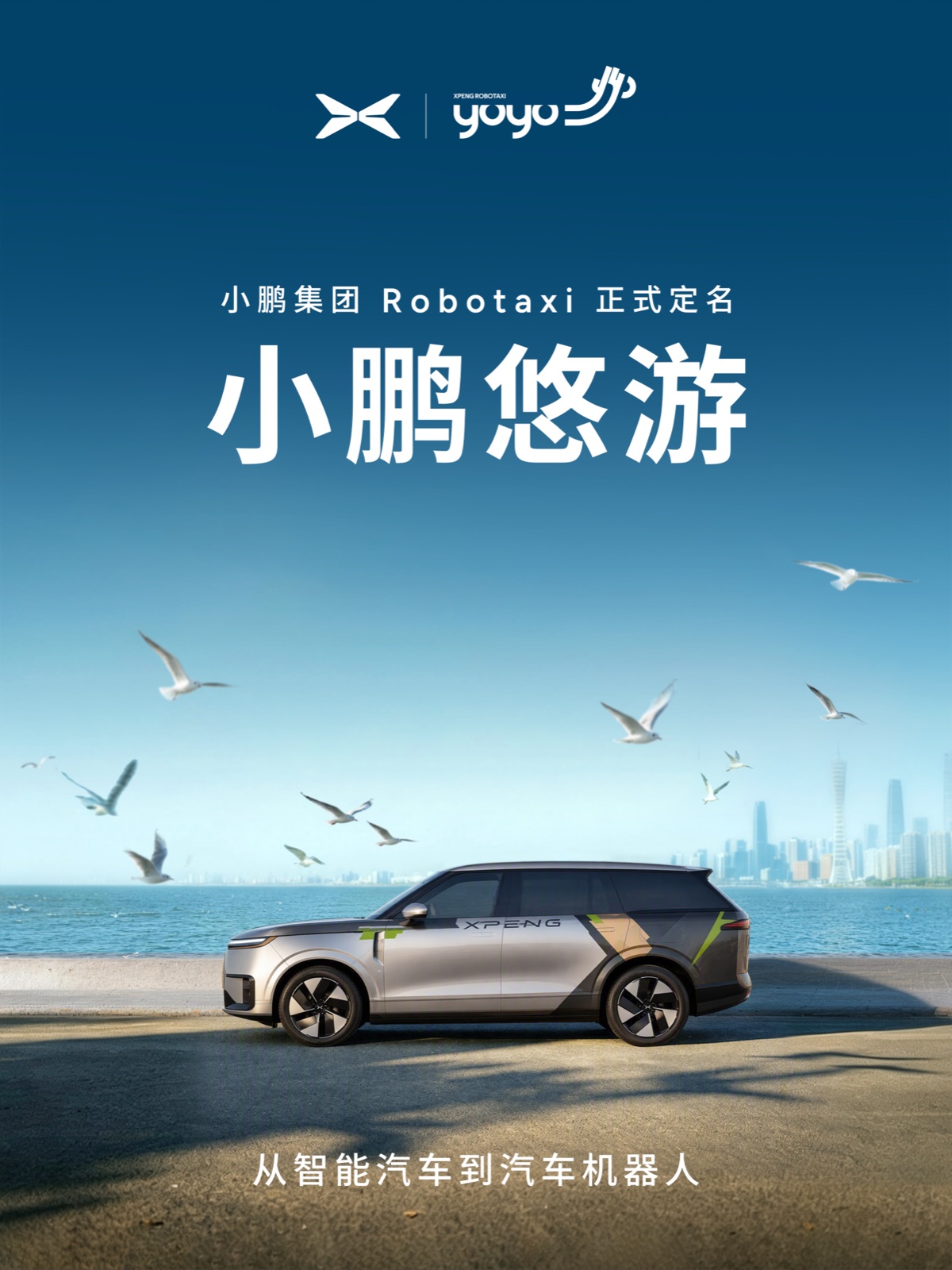
XPeng's official announcement poster. The tagline is more interesting than the name: "from smart car to car robot." Image: XPeng.
What is actually underneath
The hardware is not new, but this is the fullest official specification yet: a GX-platform vehicle with four self-developed Turing chips and about 3,000 TOPS of effective system compute, running the second-generation VLA model, and relying on neither HD maps nor lidar.
That last point is the strategy in one line. XPeng is not building a geofenced, sensor-heavy robotaxi the way the first generation of this industry did. It is betting that a generalising model plus a data loop from its own cars can absorb a new city faster than a mapping programme can — the same argument it makes about assisted driving, moved up a level.
What the CEO says
He Xiaopeng's own post, published the same afternoon, is the short version of the roadmap:
"From last year's Tech Day, when we launched the Robotaxi, to the production car coming off the line, employee beta testing, driver's-seat-unmanned road testing, and now opening the experience to more users today — we are accelerating the Robotaxi from technical validation to the real world."
He repeats the line that has organised all of this — "from smart car to car robot: the same physical-AI capability is moving into more real scenarios" — and adds the part with no date on it: "in the future we will work with global partners to drive Robotaxi's scaled, global deployment."
What the roadmap already said
Most of the deployment language dates from 5 November 2025, when the Robotaxi was first shown at the Tech Day and XPeng said:
- it would launch three Robotaxi models in 2026 and begin trial operations;
- it named Amap (高德) as the Robotaxi's first global ecosystem partner, the two to provide Robotaxi services worldwide;
- the Robotaxi would open an SDK so partners can build on it;
- the hardware was dual-redundant, two sets able to back each other up;
- a private-owner sibling called Robo would arrive in 2026, sharing the Robotaxi's hardware, safety redundancy and driving capability, with two driving modes.
None of that was restated or updated on 8 October. The name, the website page and the mini-program are today's news; the partners and the scaling talk are a year old.
The timeline matters more than the name
- November 2025 — the Robotaxi was unveiled at XPeng's Tech Day in Guangzhou, one of four physical-AI products presented alongside the second-generation VLA, the next-generation IRON robot and the flying-car programme. XPeng said then that it would launch three Robotaxi models in 2026 and begin trial operations.
- May 2026 — Robotaxi production vehicles came off the line.
- July 2026 — the full chain was validated end to end: order in the mini-program, automatic pickup, drop-off. Employee beta testing began, and XPeng says it has passed 2,200 orders.
- August 2026 — the Robotaxi received Guangzhou's intelligent connected vehicle remote testing qualification, permitting testing with no safety officer in the driver's seat on designated tier-1, tier-2 and tier-3 roads. XPeng described this as entering the "critical road validation" phase for driverless operation, and said the second-generation VLA now bridges L2 through L4 on one base.
- 8 October 2026 — the name, the website page and the mini-program, with invitation codes to open it to the public.
Put that sequence next to the marketing and the story inverts. The expensive, slow, regulated work happened in May, July and August. October is the part you can design.
What a ride is meant to feel like
XPeng is selling the passenger experience as a differentiator, which is what you do when the driving is not yet the product. Before pickup, the mini-program lets a passenger pre-set the cabin temperature and switch the fragrance on. Inside there are zero-gravity seats, massage, a large entertainment screen and integration with mainstream music and video services. For a service whose only users so far are XPeng employees, that is a pitch aimed squarely at the paying public.
Why this is the proof point for "physical AI"
It is worth reading alongside the DBC ranking we covered this week, which put XPeng first among Chinese physical-AI driving companies largely on the completeness of its story. A Robotaxi is where that story gets audited: the same chips, the same model, the same data loop — but with a regulator, a passenger and an incident report attached. The GX-based robotaxi is the cleanest available test of whether "one model, three bodies" survives contact with a service obligation.
Caveats
- The deployment language is aspirational. "Scaled, global deployment" and "with global partners" come with no named partner in today's announcement, no markets and no dates; Amap and the three-model 2026 plan were announced in November 2025 and have not been updated since.
- An invitation-code beta is not a public service. No launch date, no city list beyond Guangzhou, no service area, no pricing and no fleet size have been published.
- The 2,200 orders are employee orders. They validate a chain, not consumer demand, and XPeng's own word for this stage is function validation rather than commercial operation.
- The Guangzhou permit covers designated test roads and driver's-seat-unmanned testing. Permission to test without a safety officer is not a licence to carry paying passengers.
- 3,000 TOPS is XPeng's own "effective compute" figure for four Turing chips — a company metric, not a third-party benchmark.
- "L4" is XPeng's characterisation. Under Chinese regulation the service remains a test programme; nothing announced on 8 October is a regulatory finding of L4 capability.
- There is no independent account of it yet. We have seen no third-party description of the mini-program flow, the ride experience or the vehicle's behaviour, and we have not ridden in it.
- This is a brand launch, not a technical report. It was carried by Chinese business media — 人民财讯/证券时报 and 中关村在线 among them — rather than by a published engineering disclosure.
The bottom line
The name is the least important thing announced on 8 October, and the invitation code is the most honest part of it. XPeng has a validated chain, a permit to drive without anyone in the driver's seat on designated Guangzhou roads, and now a brand to hang it on — and it is still asking the public to wait for a code. That is roughly what a serious robotaxi programme looks like at this stage, and it is a better signal than a launch date would have been.
Source: XPeng's announcement and He Xiaopeng's statement on Weibo, as reported by 人民财讯/证券时报 and 中关村在线, with XPeng's own 2025 Tech Day release for the roadmap detail and the Weibo post by 我有播音腔 — translated & adapted for XPENGTech.
Amended 8 October 2026 to add He Xiaopeng's statement and the November 2025 roadmap detail.
Get the next one direct.
New articles, or a daily / weekly digest — the same list EVConduit keeps.