
14 October 2026
XPeng Opens Its Technology Stack to Global Partners
At the Paris Automotive Summit, where he was the only Chinese automaker CEO on the schedule, He Xiaopeng launched XPENG AI ENGINEERING: the vehicle platform, E/E architecture, assisted driving, AI BOX, chips, battery, e-drive and toolchain, plus the physical AI ecosystem of robots, Robotaxi, flying cars and Turing chips, offered to global partners. He also said Robotaxi talks with leading European mobility platforms are far advanced. We set out what is for sale, and what is missing.
At the Paris Automotive Summit on 13 October, He Xiaopeng announced XPENG AI ENGINEERING — a business that sells XPeng's smart-car technology to other companies, described as one-stop capability "from vehicle R&D through production to after-sales". He also said XPeng's Robotaxi business is in deep talks with several leading European mobility platforms, with progress expected to be public soon.
He was the only Chinese automaker chief executive on the summit's published schedule, speaking between Volkswagen's Oliver Blume and Renault's François Provost, on a list that also included Stellantis, Valeo, the French industry minister and a European Commission vice-president.
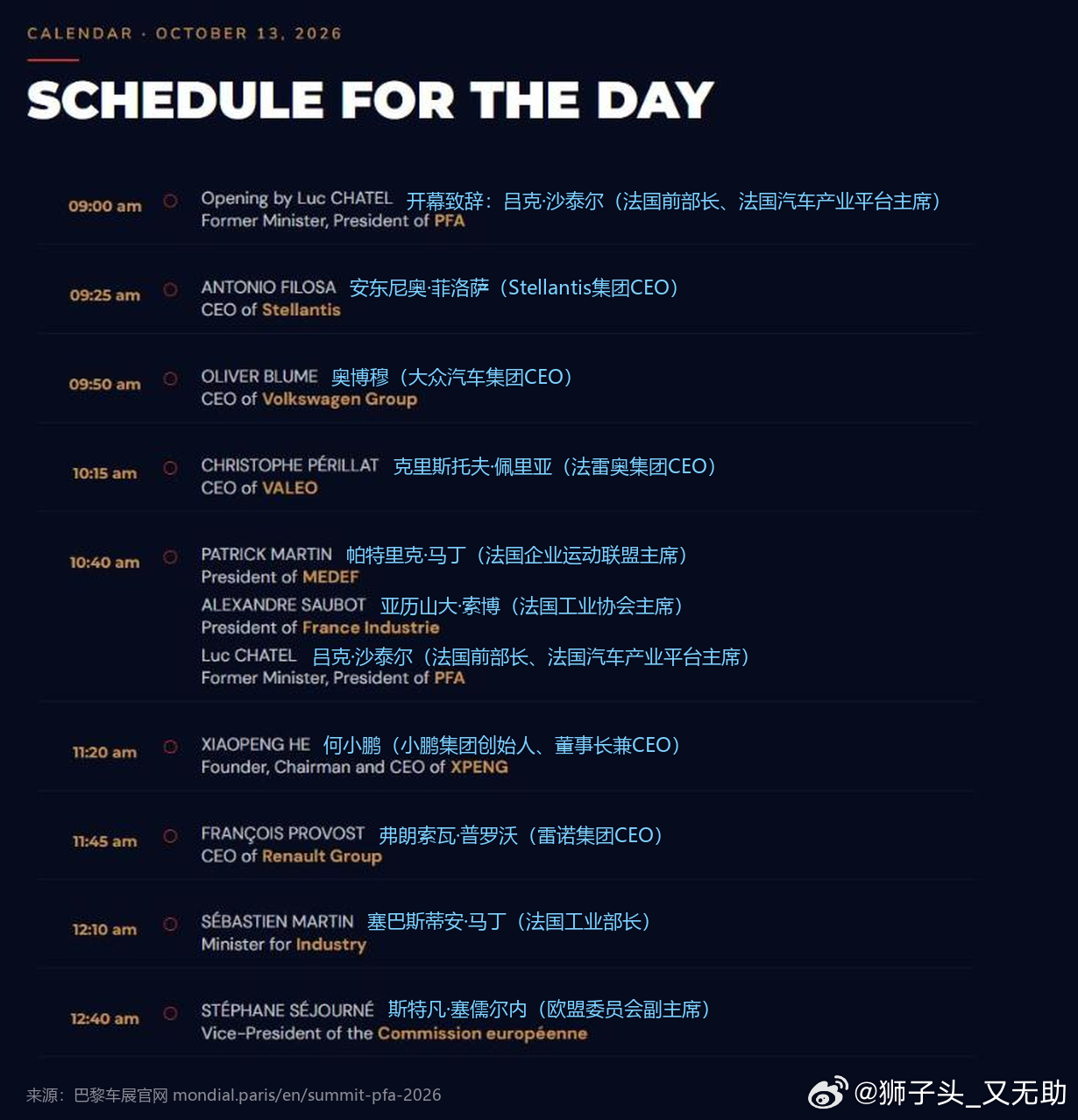
The summit schedule, published by the Paris show: Blume, then He, then Provost. Image: Mondial de l'Auto, via 狮子头_又无助 on Weibo.
What is actually for sale
XPeng's own slide breaks it into three blocks:
Vehicle platform. Platform architecture and electrical/electronic architecture — pitched as a bandwidth running from compact to large vehicles, with a 10-gigabit E/E architecture that XPeng says is 33× faster in transmission.
Modular technology. Assisted driving, AI BOX, chips, battery, e-drive. The slide cites 479 million cumulative complex-scenario ADAS processing events and 8-minute 10–80% SOC fast charging.
Toolchain. Remote XCP calibration, vehicle end-of-line testing and AI diagnostics, with claimed reductions of 95% in the annual operating cost of production-line electrical inspection and 41 minutes saved per vehicle in cumulative inspection time.
Separately, XPeng is opening what it calls its physical AI ecosystem: humanoid robots, Robotaxi, flying cars, Turing AI chips and physical-world foundation models, offered as commercialisation solutions rather than products.
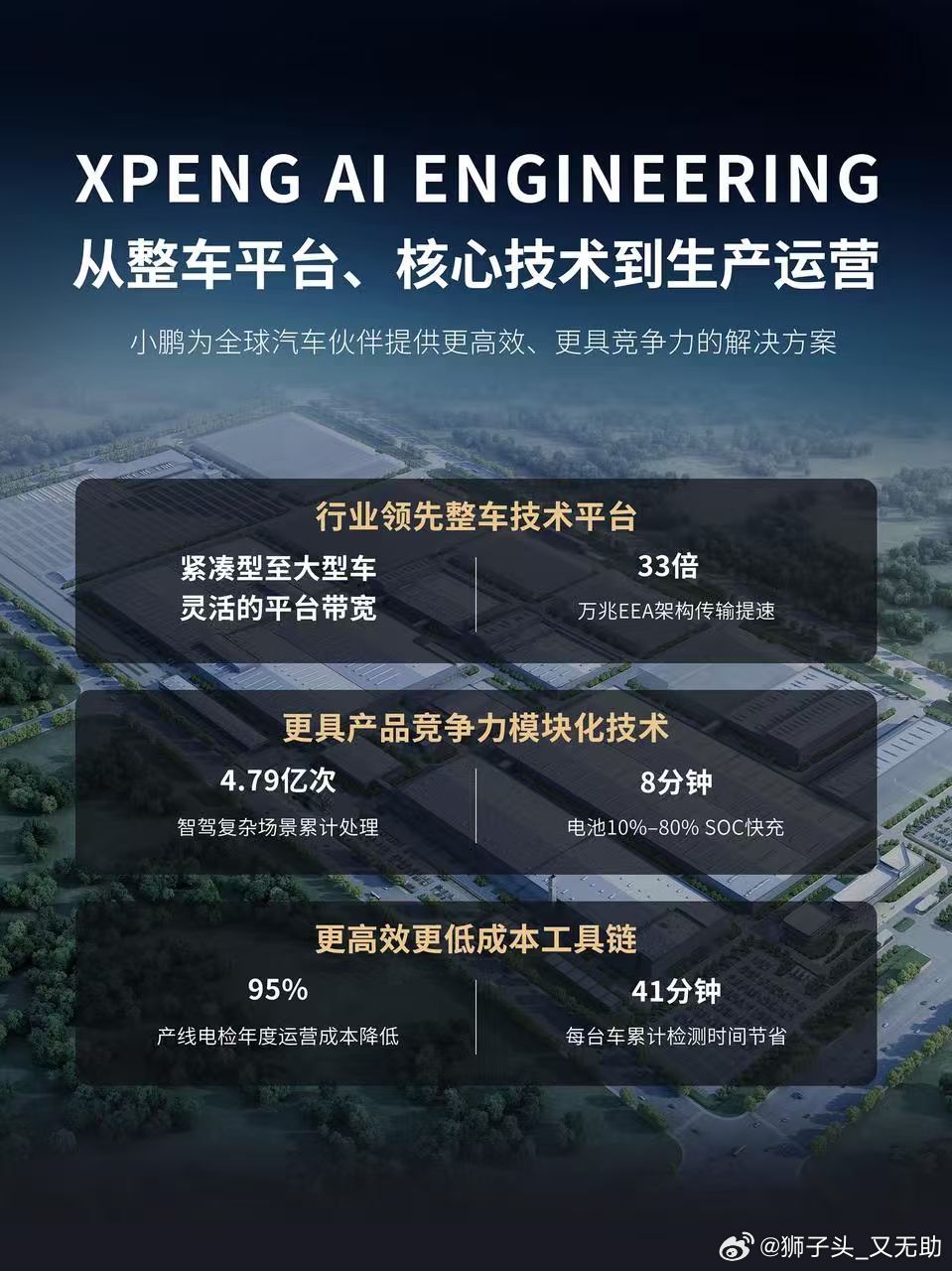
XPeng's announcement slide, with the three blocks and their headline numbers. Image: XPeng, via 狮子头_又无助 on Weibo.
"We not only share technology with partners, but grow together with them, fully supporting partners to master the technology and carry out independent innovation," He Xiaopeng said, adding that openness "has become the keyword" for XPeng's partner strategy.
How XPeng's own side framed the room
The most candid description of the moment came from an XPeng Group vice president, posting from the show:
"This is a historic moment — a rising Chinese car company, facing Europe's most central automotive giants… for the first time formally introducing its smart-car solution to the CEOs: if you run into some intelligent-technology difficulties, you can buy mine."
He named the rest of the summit's automaker speakers, and the published schedule confirms them: François Provost of Renault, Oliver Blume of Volkswagen Group, Antonio Filosa of Stellantis and Christophe Périllat of Valeo, alongside French industry bodies, the industry minister and a European Commission vice-president. It is a fair description of the room: the incumbents who have the factories and the distribution, and one company offering to supply what it believes they lack.
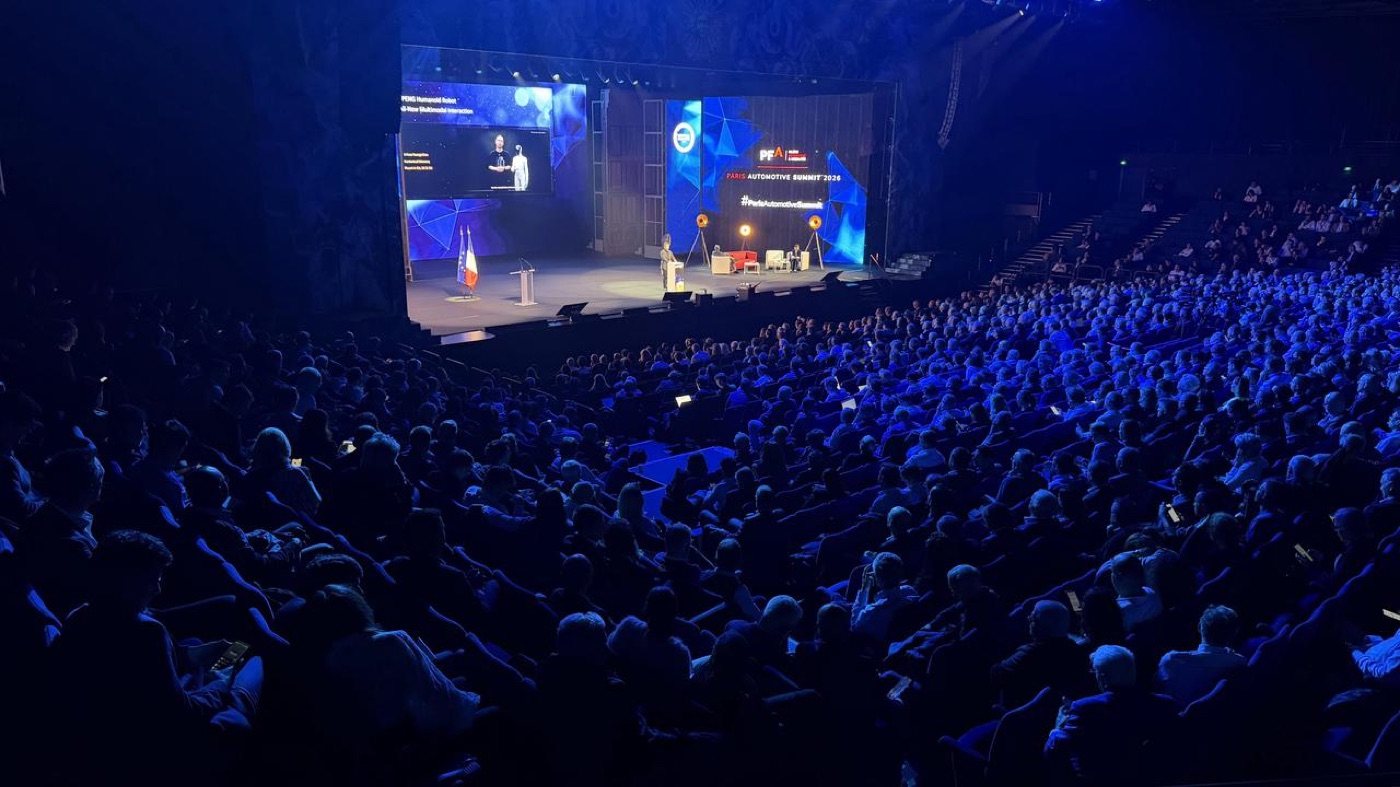
The PFA Automotive Summit hall. Image: 托马斯电火车 on Weibo.
Why this is a strategy shift and not a press release
XPeng has been moving this way for two years, but as a series of deals rather than a business line.
Volkswagen is the proof case. VW was named the first customer for XPeng's second-generation VLA model, and the partnership has since produced a Volkswagen that runs XPeng's Turing chip. He Xiaopeng has said publicly that XPeng is in talks with more automakers on technology and chips.
The economics are the point. Licensing a platform or an E/E architecture carries no tariffs, no factory, no dealer network and no inventory. In a market where Chinese car margins are thin and Europe is adding local-content requirements, selling the stack to somebody else's production line is the highest-margin version of going global — which is also why it fits the company's own framing of itself as a "physical AI company" rather than a carmaker.
The physical AI offer is the same logic extended. Robots, robotaxis, flying cars, chips and foundation models are expensive to build and hard to monetise directly at low volume. Offering them as licensable technology to partners turns cost centres into revenue lines before the volumes arrive — and it is a way to get other companies' data and deployment experience without owning the operations.
The Robotaxi thread
The Robotaxi line is the most concrete thing in the announcement: deep talks with several leading European mobility platforms, with an announcement expected "soon".
That sits on top of what XPeng has already built: the business is named YOYO, with a booking mini-program and invitation codes, more than 2,200 employee test orders, and a Guangzhou permit for testing with nobody in the driver's seat on designated roads. At its 2025 Tech Day it named Amap as its first global ecosystem partner and planned trial operations for 2026.
Two things are worth keeping straight. A deal with a "mobility platform" is distribution and operations, not necessarily XPeng running robotaxis abroad — the Amap arrangement in China is the template. And "soon" is not a date: no platform, market or timing has been named.
Caveats
- No commercial terms, no named customers and no pricing for any of the three engineering blocks. Nobody has been announced as buying XPENG AI ENGINEERING.
- "Open" is undefined. It could mean licensing, joint development, a joint venture or something narrower; XPeng's own language is "cooperation".
- The slide numbers are XPeng's and are unexplained. The "8-minute 10–80%" charging claim differs from the 11.7 minutes the company quotes for the G9L, and the "33×" E/E figure arrives without a baseline.
- The Robotaxi talks are talks. No platform is named, no market and no date. The Weibo poster's aside that the deal is "80–90% certain" is the poster's characterisation, not XPeng's.
- "The only Chinese automaker CEO" is an observation of the published schedule, which we checked; it is not an XPeng-selected comparison.
- Selling a stack is much harder than announcing one. Each market brings homologation, integration, support and liability questions, and a stack built for XPeng's own cars does not necessarily travel — VW's project is the test of that, and it is still early.
- This is an announcement of intent made at the show where XPeng is also selling cars and software, and the coverage is based on XPeng's own material plus Chinese business media.
The bottom line
Every Chinese EV company says it is a technology company. XPENG AI ENGINEERING is the first attempt by one of them to price that claim — to sell the platform, the architecture, the chips and the toolchain as a product, to companies that will keep their own badges. If it works, the car business becomes the demonstration project for the software business, which is the opposite of how the industry has always run. The proof is not the slide. It is a named customer, and there isn't one yet.
Source: He Xiaopeng's remarks at the Paris Automotive Summit as reported by 南方网·粤学习 and 每日经济新闻, with XPeng's announcement materials, the Paris show's published summit schedule and the account of an XPeng Group vice president on Weibo — translated & adapted for XPENGTech.
Updated 15 October 2026 with the company's own framing of the summit and the hall photograph.
Get the next one direct.
New articles, or a daily / weekly digest — the same list EVConduit keeps.