
6 November 2026
XPeng Registered 6,832 Cars Abroad in October. Germany Was a Fifth of Them.
A Weibo registration digest puts XPeng's October overseas volume at 6,832 cars across 26 of the 44 markets it tracks: Germany 1,380, Norway 932, France 741, Australia 620. The mix matters more than the total - XPeng takes 5.9% of Norway's new-car market and 0.5% of Germany's - and the figure is a different instrument from the 13,326 overseas deliveries reported a week earlier.
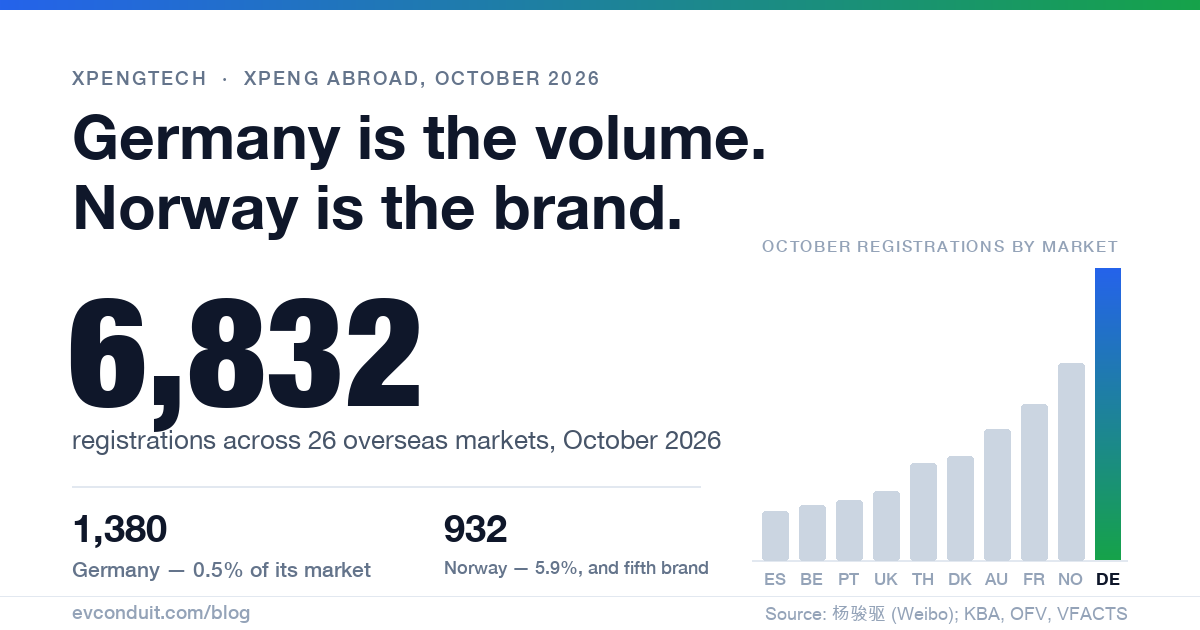
Every month the same gap opens between what XPeng says it shipped and what the registration offices of the world say arrived. October's numbers landed this week from a Weibo account that tracks exactly that, and the country breakdown is more interesting than the total.
The post is from 杨骏驱, a 4,595-follower account verified as 科技博主 and a moderator of the XPeng 超话, whose bio is the right one for this: "smart EVs, robotics, physical AI — I like to judge trends from the market and supply chain side." He posts under the tag #小鹏出海情报# (XPeng overseas intelligence), and this instalment is a registration digest for October: 6,832 cars across 26 markets, with a promise of a fuller analysis in mid-November and an expectation that November deliveries abroad set another record.
At the time of capture the post had 10 likes, 6 comments and no reposts. Its second image is the data card — the country-by-country table — and the first is an unrelated GX advertisement, which tells you something about where corporate marketing ends and enthusiast data work begins.
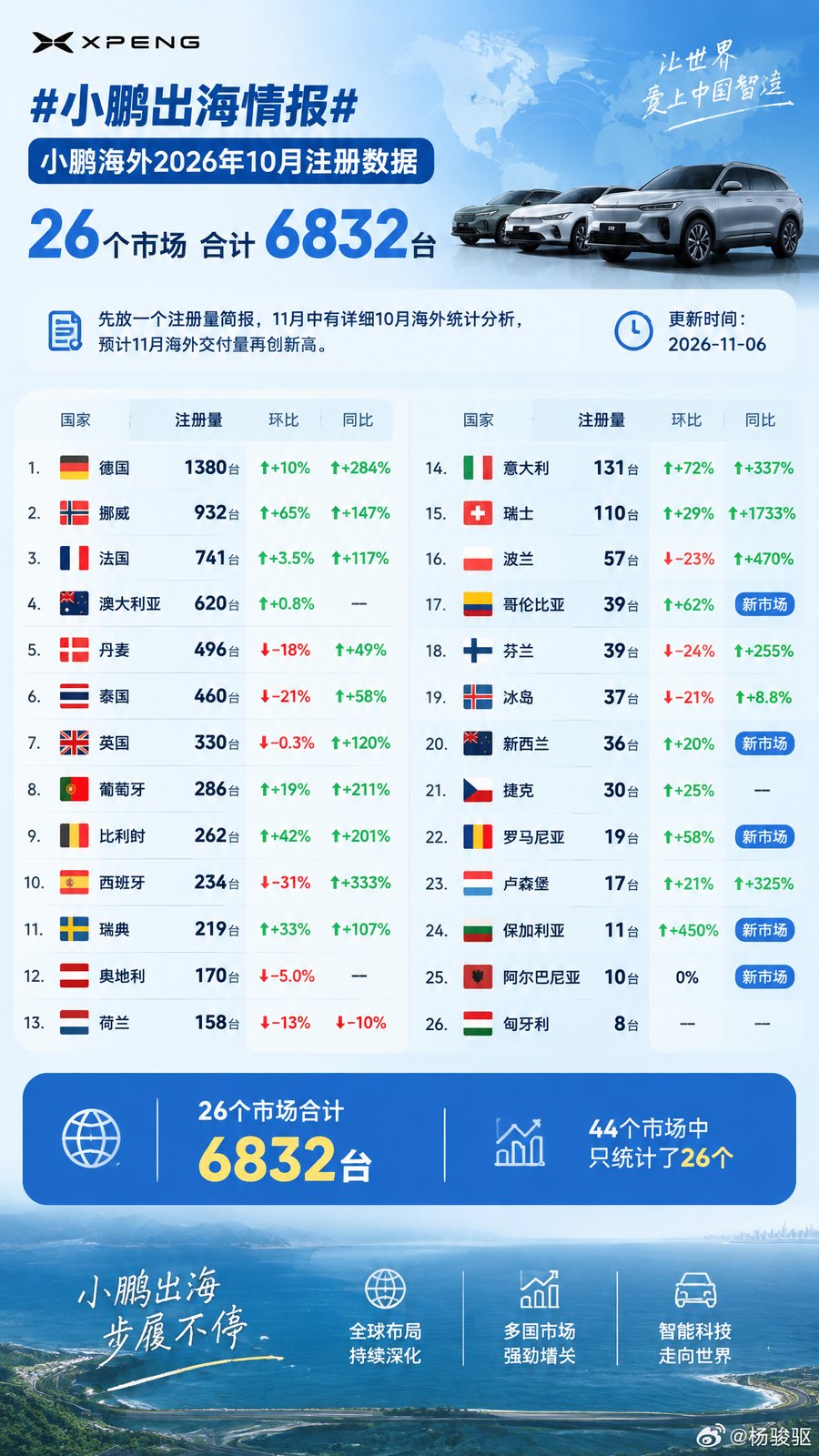
The data card as published, with the 26-market table, month-on-month and year-on-year changes. Image: 杨骏驱 (Weibo).
The table, as published
| Market | Oct 2026 | MoM | YoY |
|---|---|---|---|
| Germany | 1,380 | +10% | +284% |
| Norway | 932 | +65% | +147% |
| France | 741 | +3.5% | +117% |
| Australia | 620 | +0.8% | — |
| Denmark | 496 | −18% | +49% |
| Thailand | 460 | −21% | +58% |
| United Kingdom | 330 | −0.3% | +120% |
| Portugal | 286 | +19% | +211% |
| Belgium | 262 | +42% | +201% |
| Spain | 234 | −31% | +333% |
| Sweden | 219 | +33% | +107% |
| Austria | 170 | −5.0% | — |
| Netherlands | 158 | −13% | −10% |
| Italy | 131 | +72% | +337% |
| Switzerland | 110 | +29% | +1733% |
| Poland | 57 | −23% | +470% |
| Colombia | 39 | +62% | new |
| Finland | 39 | −24% | +255% |
| Iceland | 37 | −21% | +8.8% |
| New Zealand | 36 | +20% | new |
| Czechia | 30 | +25% | — |
| Romania | 19 | +58% | new |
| Luxembourg | 17 | +21% | +325% |
| Bulgaria | 11 | +450% | new |
| Albania | 10 | 0% | new |
| Hungary | 8 | — | — |
| 26 markets | 6,832 |
Two footnotes come with it: Austria is preliminary and Hungary counts battery-electric cars only. The 6,832 is drawn from 26 of the 44 markets the tracker covers, so it is a floor rather than a total.
The map is not the market
Laid out like that, the concentration is stark. Three countries — Germany, Norway, France — are 44.7% of everything. Five are 61%. Europe as a whole (22 of the 26 markets, excluding Australia, Thailand, Colombia and New Zealand) is 5,677 cars, 83.1% of the total.
At the other end, 19 of the 26 markets are below 300 cars a month, and they are only 27.4% of the volume between them. Ten markets registered fewer than 50 cars. Hungary registered eight.
That distribution matters more than the headline, because it tells you where XPeng's overseas business actually lives: not in the "83 countries" of the corporate press release, but in a handful of European markets plus Australia, where the brand has been through a full model cycle and has a dealer network that can absorb cars.
Two countries, two completely different businesses
The most useful comparison in the table is the top two, because they have almost the same number of cars and almost nothing else in common.
Germany: 1,380 cars, 20.2% of XPeng's overseas volume. The German market registered 254,492 passenger cars in October (VDIK). That makes XPeng's share 0.54 per cent — a small player in Europe's biggest market, growing fast off a small base: the +284% implies about 359 cars a year earlier. Chinese brands collectively took 6.7% of the German market, up from 3.4%.
Norway: 932 cars, 13.6% of the volume. Norway registered 15,725 new passenger cars in October, so XPeng's share is 5.9 per cent — ten times its German penetration — and it ranked fifth among all brands, with the G6 contributing 542 units in a single month and 5,813 cars year-to-date. Chinese brands took 22.5% of the Norwegian market overall.
Same order of magnitude in cars. Completely different standing. Germany is where XPeng sells a lot of cars because Germany is enormous; Norway is where XPeng is, by any reasonable measure, a mainstream brand. If you want to know whether the product is competitive in a mature market, the Norwegian number is the one with information in it.
Australia sits closer to the German pattern: 620 cars, +0.8% month-on-month, against a total market of 103,325 — a 0.6 per cent share. Australian VFACTS data for the same month puts the G6 at 577 registrations, which leaves 43 cars across the rest of the range; the two datasets are consistent, though a handful of cars either way would not be visible here. There is no year-on-year figure, which is sensible — the comparison would not be like-for-like.
And this is the point where the percentage column becomes a trap. Switzerland's +1,733% is 110 cars. Bulgaria's +450% is 11. Poland's +470% is 57. These are not growth stories in any sense a reader should act on; they are the arithmetic of starting from single digits.
The new markets are a rounding error
Five markets are marked new: Colombia (39), New Zealand (36), Romania (19), Bulgaria (11) and Albania (10). Together they are 115 cars — 1.7% of the month.
That is not a criticism of opening them. It is a corrective to the way market entries get announced: a new country is a press release, a dealer agreement and a homologation file long before it is volume. The growth in this table is coming from countries where XPeng already had a network and added models, not from the flags on the map.
Why this number is roughly half of last week's number
At the start of November, XPeng reported 13,326 overseas deliveries for October, up 166% year-on-year and 26.5% of a record 50,237 total. We wrote about that here.
This digest says 6,832 registrations. The difference is 6,494 cars, or 48.7% of the reported overseas volume, and none of the explanations involve anyone being wrong:
- The two numbers are measured on different clocks. XPeng's figure is a delivery/shipment number — the moment a car leaves the factory gate for a distributor or a subsidiary. A registration happens weeks later, after a sea voyage, port clearance, a dealer's preparation and a customer's paperwork. A car shipped in October is registered in November or December.
- Dealer stock is invisible here. Cars sitting in a showroom or a compound have been delivered to the network but not registered by anyone.
- The tracker covers 26 of 44 markets, and XPeng claims to sell in 83 countries. Whatever happens in the other 18 tracked markets and the other 39 claimed ones is not in this number.
The author makes the same warning himself, unprompted: registrations are not official deliveries, there is a time lag, and comparisons must respect the measurement basis. That is more discipline than most of the desk-thumping around monthly numbers.
So: is October's overseas business half as big as the delivery figure suggests? No. Is the retail side visibly lagging the shipping side? Yes, by construction, and the size of the gap is the thing to watch — it is the pipeline, and pipelines are what turn into discounting when they get too full.
What could be wrong with this data
- The source is not stated. The card is styled with XPeng's branding and the hashtag is an XPeng one, but the account is a personal one, marked 自主创作 (self-created) by Weibo. Whether the numbers come from national registration authorities compiled by hand, a commercial dataset, or XPeng itself, is not said.
- It covers 26 of 44 markets, and the 44 is itself a tracker boundary, not a company one.
- Austria is preliminary; Hungary is battery-electric only. Both are flagged by the author, which is to his credit, but they mean the total is a mix of definitions.
- Month-on-month is noisy. Nine of the 26 markets fell, and the biggest declines — Spain −31%, Finland −24%, Poland −23%, Thailand −21% — are all small-base markets where one vessel's arrival timing moves the whole month. Neither direction should be read as demand.
- The post sits in an XPeng 超话 and was served with a paid MONA L05 tag. It reads as an independent enthusiast digest rather than brand content, and the numbers mostly check out against national sources, but it is not a primary document.
- One month is not a trend. The author says a fuller October analysis is coming mid-November; the numbers may be revised then.
The bottom line
XPeng's overseas business in October was 6,832 visible registrations in 26 markets, four-fifths of it in Europe, nearly half of it in three countries, and one country — Norway — where it is genuinely a top-five brand. That is a much more useful description of the business than "83 countries", and it is the version you can check against a national registration office.
The number to watch next is not the total. It is whether Germany holds above a thousand as the model range widens, and whether the gap between what XPeng ships and what the world registers narrows — because a gap that persists is stock, and stock is a price problem waiting to happen.
Source: 杨骏驱 (Weibo) — translated & adapted for XPENGTech.
Get the next one direct.
New articles, or a daily / weekly digest — the same list EVConduit keeps.