
4 September 2026
XPeng's 2nd-Gen VLA Upgrade: It Now Understands Time (4D Spatiotemporal)
The first major VLA 2.0 upgrade is about time — remembering the past 30s, predicting the next 6s, and acting in a streaming loop.
Today XPeng's second-gen VLA got its first major upgrade. Many past smart-driving models solved a spatial problem: where's the car, where's the person, how does the road go. But real driving isn't a static image.
A car next to you edges toward the lane line several times; a pedestrian hesitates at the curb then suddenly turns; the car ahead taps the brakes then slams them. Any single frame might look harmless — what matters is what happened before, and what might happen next.
That's exactly where this change is concentrated:
- Infini-VLA long-sequence architecture remembers the previous 30 seconds of the world.
- X-Foresight prediction world-model projects 6 seconds forward.
- Streaming inference turns the discrete see→compute→output process into seeing, thinking, and acting continuously — end-to-end response speed up 300%.
30s of past + the live present + 6s of future — together, that's the so-called 4D spatiotemporal understanding.
It also explains why model parameters grew 3.5×: longer context, more complex motion relationships, and more future possibilities all need more capacity. Per XPeng's numbers, the new on-device model is now 15× mainstream VLA in parameters, with multi-dimensional safety capability up 20×.
Parameters still have to be validated on real roads. For ordinary users, the question is whether it handles continuous events that are hard to write into rules: the probe before a lane-cut, a pedestrian's changing intent, the car ahead decelerating abnormally, complex negotiation. If those judgments become clearly earlier and more coherent, then "understanding time" is real.
Another easily overlooked change is the Master Agent. XPeng has unified VLA and VLM, so smart driving, cockpit, chassis, and body control are now scheduled by one agent. Voice pull-over and voice park-in already show the idea: the human expresses intent, the AI breaks the task down, and calls on different vehicle systems to complete it. The car is moving from executing commands to understanding intent.
This also ties into XPeng's robotics moves: the 2nd-gen VLA spans L2 to L4 and enters Robotaxi; IRON carries 3 Turing AI chips (2250 TOPS) with the physical-world foundation model on-device. On Aug 24 the robotics business closed over $900M at a $6.3B+ valuation.
So the physical-AI story is getting clearer: the car is the biggest data entry point and first scaled training ground; Robotaxi validates higher capability; robots migrate the model to a new body.
What's worth watching long-term isn't one VLA version's strength, but the AI infra behind it: a million-car fleet, billion-scale data assets, 100M clips per training run, 10× data throughput growth in half a year, plus training/simulation/evaluation/deployment.
The new version launches first on the G9L; the Lite distilled version pushes in September; Europe targets regulatory approval in H1 next year.
If the past few years were about whether the car could understand space, the next phase is: can the AI remember the past, understand the present, and think ahead into the future?
Figures




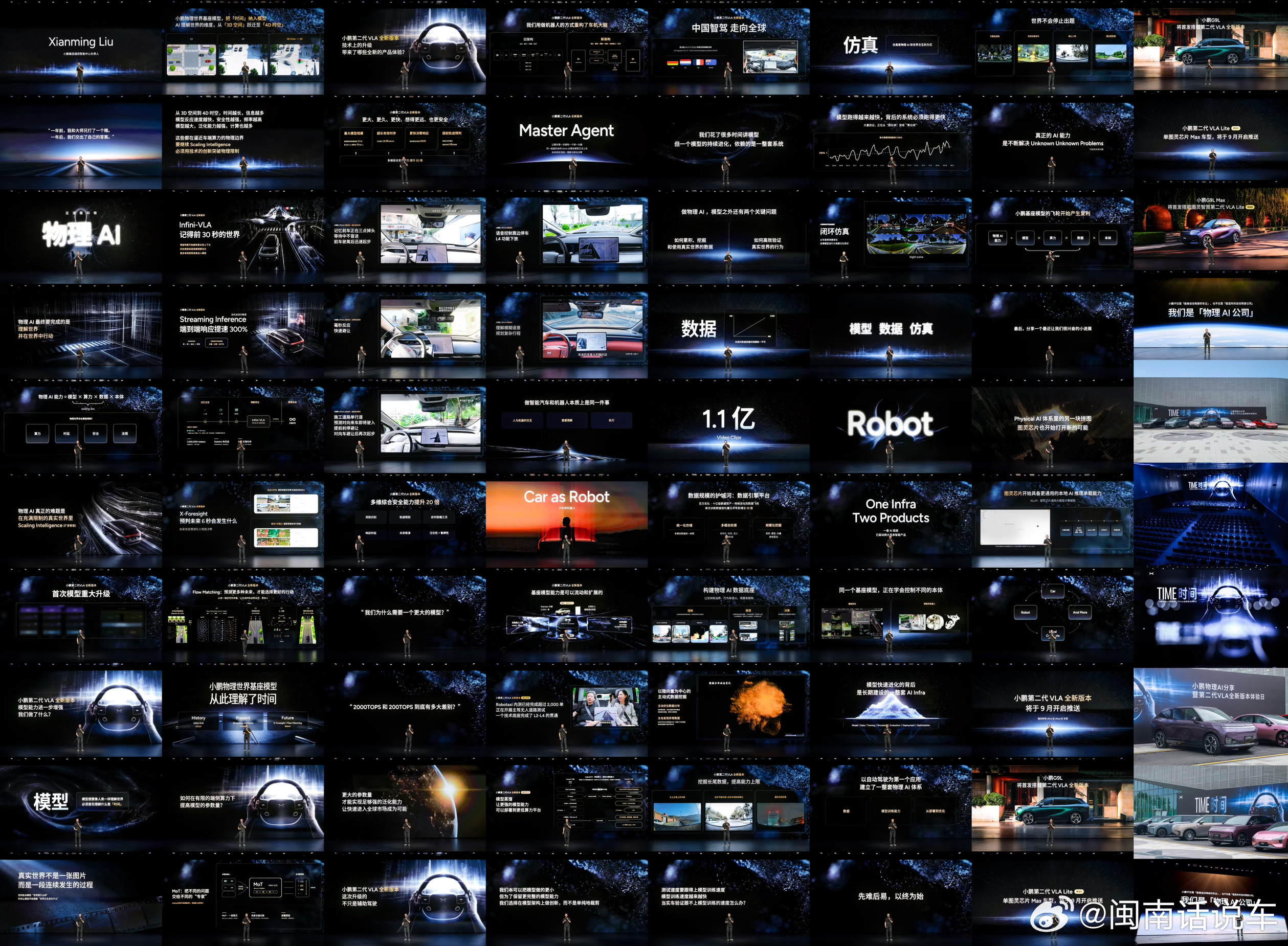




Source: 闽南话说车 (Weibo) — translated & adapted for XPENGTech.
Get the next one direct.
New articles, or a daily / weekly digest — the same list EVConduit keeps.