
7 October 2026
XPeng's Dual-Orin Distilled VLA Takes On Its Weakest Scene
A Weibo reviewer has posted a 3.5-minute one-take clip of XPeng's VLA 2.0 distilled build on narrow market streets, the scene where dual-Orin hardware has been weakest, and says it is now almost indistinguishable from the three-Turing VLA 2.0. He describes creeping past oncoming traffic instead of stopping dead, and smooth yielding to e-bikes and pedestrians. We look at what the clip shows, what remains the driver's judgement, and the side-by-side comparison he has promised next.

The scene XPeng's dual-Orin owners have been most nervous about is the one a Weibo reviewer has just put on camera. 隔壁老王爱智驾 has posted a three-and-a-half-minute clip of the VLA 2.0 distilled build on narrow streets — the tangle of shopfronts, scooters, parked cars and pedestrians where the older Orin hardware has been least convincing, and where, as he puts it, the system has been "especially sensitive" around vulnerable road users.
His verdict is blunt: one continuous take, no speed-up, and "I can say in all responsibility that there is almost no difference from VLA 2.0."
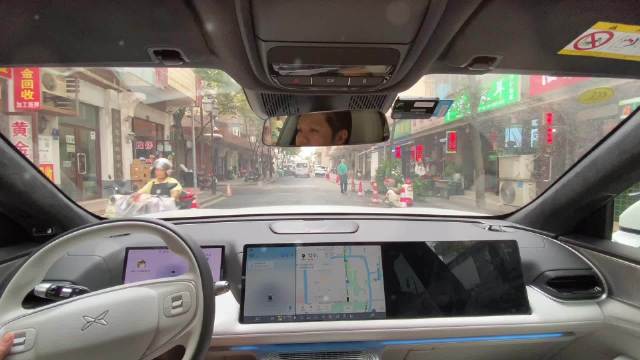
▶ Play the 3½-minute narrow-street clip — the poster's own recording, with his Chinese title overlay burned in.
What the clip shows
The route is a market street, not a test track: a single carriageway with shops on both sides, e-bikes emerging between parked cars, a cyclist drifting across the lane, pedestrians at the edge of the road, and oncoming traffic that has to be negotiated rather than waited out.
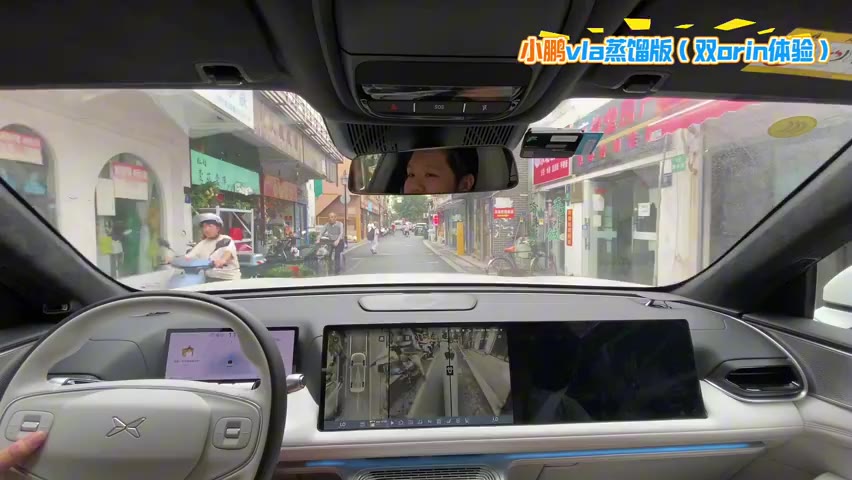
Frame from the clip (t≈1:20): the narrow shop street, and the SR view of what the car is tracking.
The behaviour the poster singles out is what the car does when it is blocked:
"The current handling is to slow and creep, judge the following distance and the vehicle and road width, and then try to pass the oncoming car, rather than stopping dead with one stamp of the brake pedal. In complex dynamic scenes with e-bikes, illegally parked cars and pedestrians it yields safely, and the speed control is delicate and smooth."
That is the opposite of the complaint that has followed dual-Orin builds — that they stop first and reason afterwards, or hesitate in precisely the places a human driver would keep rolling.
The architecture claim
The poster argues the change is structural rather than a matter of tuning, and describes the second-generation VLA dropping the traditional "language translation" step: perception and decision are connected directly, so the system no longer turns what it sees into a text description before judging. It watches and drives, he says, the way a person does.
That is XPeng's own framing for VLA 2.0, and the hardware picture behind it is one we have covered: the same model distilled onto a pair of Orin-X boards, with capability transfer and token compression rather than simple pruning — our earlier piece on how XPeng says the distillation works. What is new here is not the mechanism. It is the scene it is being demonstrated in.
Why narrow streets are the test that matters
Coverage of the distilled build so far has been positive but general — first impressions from owners invited to try it, including a two-hour MONA M03 drive whose narrow-road moment came when a white car squeezed past a tricycle. A narrow street makes that the whole drive rather than a moment in it, and it is where the two things dual-Orin has struggled with collide: fine distance judgement at walking pace, and predicting cyclists and pedestrians who follow no lane at all.
The poster says the evidence that would settle it is coming: a side-by-side of the standard dual-Orin build and the distilled build on the same stretch of road, promised in a few days. Until that lands, this is one clip from one driver with no baseline to compare it against — and that comparison is what would turn a good impression into a result.
Caveats
- One reviewer, one clip. The claim of near-parity with the three-Turing VLA 2.0 build is the driver's judgement from the driver's seat, not a measurement.
- No A/B has been published yet. Without the standard dual-Orin build on the same road, the improvement cannot be separated from the road, the traffic or the driver's familiarity.
- This is an engineering build, not a shipped one, and no rollout date has been announced; our earlier article records Chinese speculation about November, which is speculation and not XPeng's word.
- Parts of the clip are deliberately silent. A caption burned in near the end says the poster muted commentary he could not publish, so the narration is incomplete by the author's own choice.
- The title overlay and the "no speed-up" claim are the poster's, not XPeng's.
- The clip is hosted here as the source material for this article; it is the poster's recording, reproduced unedited.
The bottom line
If the distilled build really has closed the gap on narrow streets, that is a larger piece of news than any motorway demo: it is the one scenario where owners on the older hardware had most reason to fear being left behind, and it is the scenario that most resembles the streets most of them actually drive. The promised A/B clip is the test to wait for — and it is worth remembering that the last thing dual-Orin owners were promised, they are still waiting for.
Source: 隔壁老王爱智驾 (Weibo) — translated & adapted for XPENGTech.
Get the next one direct.
New articles, or a daily / weekly digest — the same list EVConduit keeps.