
6 November 2026
XPeng's EIS Chip Was a Safety Feature. It Turned Out to Be a Charging One.
XPeng's powertrain chief finally explained what the EIS battery chip does, and the answer was a stopwatch: a MONA L05 charged 10% to 80% in 15 minutes 44 seconds at -6 C, about a minute off its own laboratory figure. Behind it is a cell-core temperature estimate accurate to 2 C across the full state of charge - a sensor built to catch failing packs, now being used to charge a cold one faster.
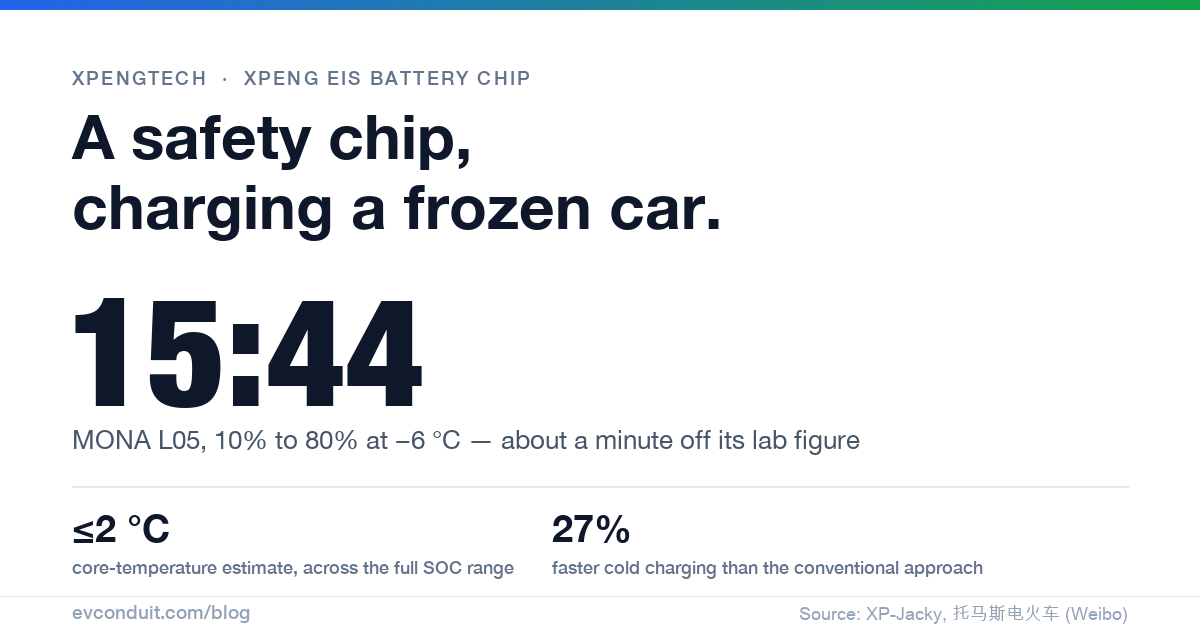
XPeng has spent six months telling people its cars contain an EIS battery safety chip, and roughly none of that time explaining what the chip does. On 4 November the head of its powertrain centre tried to fix the second half of that, and the explanation turns out to be less about safety than about speed.
The post is from XP-Jacky, whose Weibo profile describes him as an XPeng vice president and the head of its powertrain centre. It opens with a confession: the company has taken a lot of feedback — including from colleagues inside its own team — asking what this EIS chip actually does. (Chinese tech outlet CNMO, reporting the same post the day it appeared, names the author as Gu Jie (顾捷); we will use that name below, with the caveat that the Weibo account itself does not carry it.)
Two days later XPeng group vice president 托马斯电火车 quote-posted it with a single line — "'小鹏EIS安全芯片'的作用", "what the EIS safety chip does" — which is how it reached a wider audience. That quote-post, from 6 November, is what we are working from; the underlying explanation and its numbers are Gu's.
The claim, stripped down
Gu's explanation has three parts, and only the last of them arrives with a number attached.
- The chip measures the impedance spectrum of the cell itself — how it responds to small signals across many frequencies. His framing is that this gives "a more microscopic view" of a pack. We have covered what that means physically before, in the piece on ADI's battery 'ECG'.
- On top of that data XPeng built an internal-temperature estimation model. Current accuracy, per Gu: within 2 °C, across a wide temperature range and the full state of charge.
- In cold fast charging, knowing the core temperature lets the battery management system spend the pack's chargeable margin — and shorten the session "without breaking through the safety boundary". XPeng's engineering figure here: 27% less charging time at −10 °C than the conventional approach.
Then the demonstration. A MONA L05, on a snow night, at −6 °C, charged from 10% to 80% in 15 minutes 44 seconds. Gu's verdict: "very good, and in line with our expectations."
What the screenshot actually shows
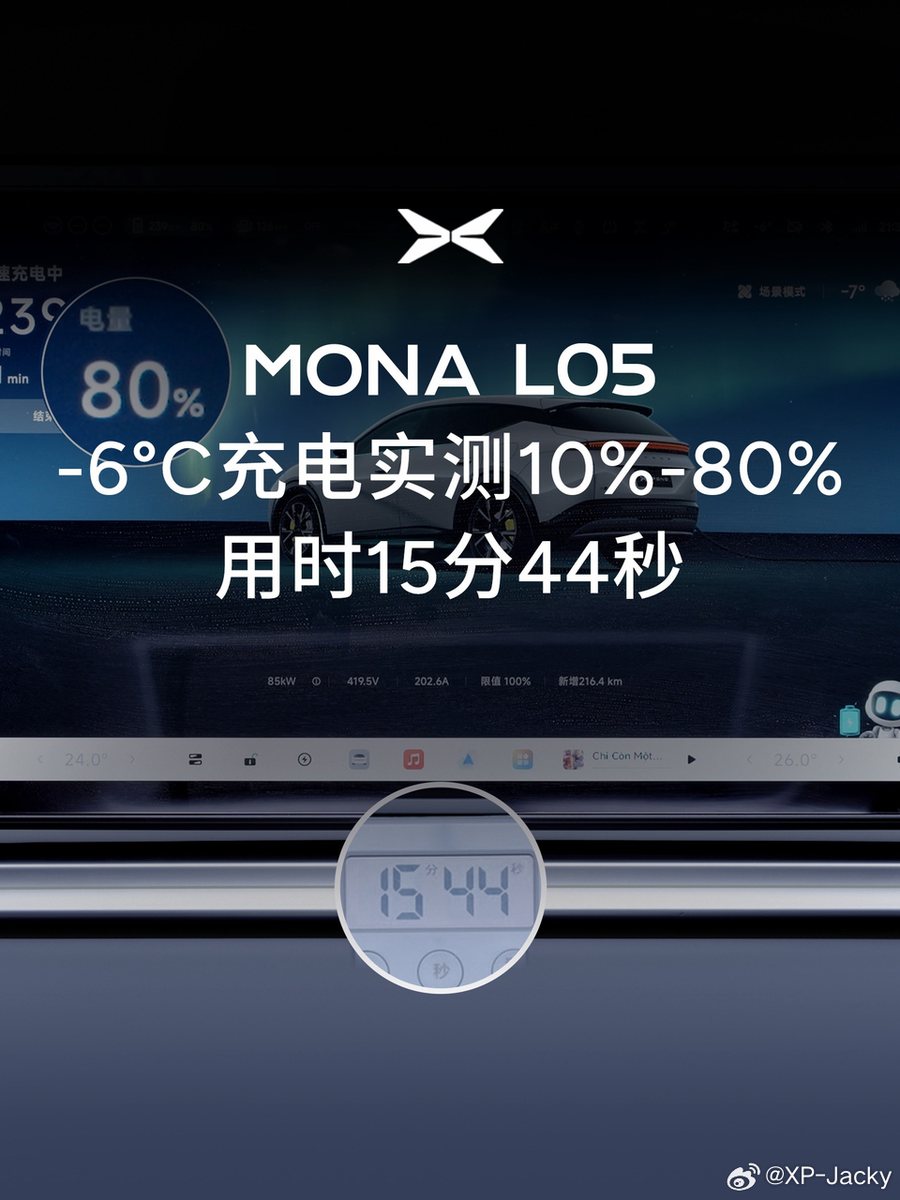
The car's own screen at the moment charging reached 80%, with a physical stopwatch held up to it. Image: XP-Jacky (Weibo).
It is worth reading the numbers on that screen rather than the caption, because they are the part that is hard to stage:
- 85 kW still going in at 80% state of charge;
- 419.5 V and 202.6 A, which multiplies to 85 kW — the display is internally consistent;
- −7 °C ambient, according to the car (the post says −6 °C; the screen rounds differently, which is the least of this story's rounding quirks);
- 216.4 km of range added in the session;
- and a separate stopwatch, physically held to the screen, reading 15:44.
For a 37.2 kWh LFP pack, 85 kW at four-fifths full is about 2.3C — a taper that has not tapered much. That is the visual claim: not that it charged quickly at the start, but that it was still charging quickly at the end, in the cold.
The arithmetic behind the number
The test car was a MONA L05 1310 Ultra SE — the range-extender version, with the 37.2 kWh pack, on optional 20-inch wheels.
Ten to eighty per cent of 37.2 kWh is 26.0 kWh. Delivered in 15.73 minutes, that is an average of about 99 kW at the charger — roughly 2.7C on a pack whose spec sheet says 3C. Some of that is charging loss rather than energy into the cells, so the pack average is a little lower; the order of magnitude holds.
Now the comparison that matters, from XPeng's own configuration table for that trim: 10–80% DC fast charging, ≥14.7 minutes. That is a laboratory number, at an unspecified temperature, stated as a floor. The car did 15:44 at −6 °C, outdoors, at night, which is 62 seconds — about 7% — off the laboratory figure.
That, not the raw 15:44, is the claim worth testing. Everyone's car charges fast on a warm afternoon. The interesting assertion is that the cold penalty has been compressed into about a minute.
Why the chip's job has changed
A conventional battery management system watches three things: voltage, current and temperature. The temperature comes from sensors on the outside of the modules — the surface of the pack, not the middle of a cell.
That creates a permanent worst-case problem. Heat moves slowly through a cell, so under load the core is hotter than the skin, and after a cold night it can be colder. A controller that can only see the skin has to assume the core is at least as extreme as what it can measure, and it derates accordingly. In a cold pack, that means throttling the current — because plating lithium onto the anode instead of intercalating it is the failure mode that quietly destroys fast-charged batteries.
Estimating the core instead of the skin changes the shape of that problem. If the model says the cell interior is warmer than the surface, the BMS can hold current longer without crossing the limit; the "chargeable margin" Gu talks about is exactly the gap between what the surface allows and what the interior actually permits. It is the difference between a thermometer on the outside of an oven and a probe in the middle of the meat.
There is a second reason EIS suits this car in particular. The L05 uses LFP cells, whose voltage curve is famously flat through the middle of the state-of-charge range — which is why estimating LFP state of charge from voltage alone is hard, and why the pack's own behaviour is a better signal. XPeng has claimed a 50% improvement in SOC accuracy from this technology since May. That claim has not been demonstrated publicly; the charging number now has at least one data point behind it.
Where the chip came from, and how far down the range it goes
The EIS silicon is Analog Devices', and XPeng announced it as an industry first at the GX launch in May 2026, with three numbers attached: 27% faster low-temperature charging, 50% better SOC accuracy, and twice the lead time on cell-defect warnings. The chip itself is the ADBMS family with ADI's BLISS software and algorithms co-developed with XPeng — the supplier's side of that is in our earlier piece.
The part worth registering now is where it has ended up. XPeng's configurator lists "EIS电池安全芯片" as standard on all six L05 trims — including the base 560 Plus, at a suggested ¥144,800 (a limited-time ¥139,800 since launch). A technology introduced on the flagship has become a line item on the cheapest car in the range within six months. That is the actual story under the stopwatch: not that the chip works, but that it is no longer a premium feature.
The challenge this was bolted onto
The 15:44 came out of a marketing exercise — the "China Golden Outer Ring" run, organised by Yiche, with journalists relaying the car from Guangzhou to Heihe: more than 8,000 km, from 35 °C to −6 °C, a spread of over 45 °C. XPeng published six results and declared all of them full marks:
- 1,194.2 km on a full tank and charge, about 95% of the 1,260 km the car displayed;
- 968.8 km in −6 to 2 °C conditions, 76.8% of the displayed figure;
- 6.8 L/100 km running on the engine at highway speed with five people aboard, against an official 5.26 L/100 km;
- ¥198 of combined fuel and electricity for the three-province Shanghai–Qingdao leg;
- 587 km of continuous assistance with zero takeovers;
- and the 10–80% charge at −6 °C.
One small tell about how these numbers travel: XPeng's own summary graphic rounds the charge to "15 minutes", while the video it published alongside it is captioned "15 minutes 44 seconds". Nobody is lying; rounding is just what happens on the way to a headline.
What is still unanswered
- One car, one night, one charger. No charger power, no pack state, no statement of how long the car had been cold-soaked, no repeat.
- The 27% has no baseline. "Compared with the conventional approach" — which conventional approach, at what temperature, on what cell, is not stated.
- The ≤2 °C accuracy has no method. No reference sensor, no test conditions, no distribution of error. An accuracy claim without a measurement protocol is a specification, not a result.
- The SOC figure is still just a figure. 50% better than what, measured how, is not public.
- This is XPeng explaining itself to itself. By Gu's own account the post exists because people inside and outside the company could not tell what the chip did — and it went out during an active L05 sales campaign, served in some feeds with a commercial "get to know the L05" tag. It is a good explainer; it is not an independent test.
- Cold charging is where vendor claims and owner experience diverge most. Public chargers derate, packs are cold-soaked overnight, and the car rarely gets the ideal session. The number to watch is not this one — it is what owners report in Heilongjiang in January.
The bottom line
The industry pitch on impedance sensing has mostly been safety: catch the pack that is about to fail. XPeng has now shown the same sensor being used the other way round — as a performance enabler, letting the car charge harder in conditions where it would otherwise have to protect itself. That is a more interesting claim than the safety one, because it is measurable, repeatable and immediately noticeable to the person standing at the charger in a cold wind.
Whether it holds up is straightforward to test: the same car, the same charger, a colder night. XPeng says its technology "does not fear any test". It has just published the first number that can be argued with.
Source: 托马斯电火车 and XP-Jacky (Weibo) — translated & adapted for XPENGTech.
Get the next one direct.
New articles, or a daily / weekly digest — the same list EVConduit keeps.