
13 October 2026
XPeng's European Bottleneck Is Capacity, Not Demand
At the Paris show He Xiaopeng said XPeng targets 1 million global sales a year by end-2030, half in Europe, and that the key is finding ways to build more cars there. XPeng is weighing more capacity with Magna in Graz or a plant elsewhere in Europe - new build or a local partner - with a decision in the coming months and no country confirmed. We set out the numbers behind it, the G9L's new European prices, and why local content rules are driving the move.
XPeng is preparing to build more cars in Europe, and for once the constraint it names is not demand. At the Paris Motor Show on 12 October, chairman He Xiaopeng set the target that explains why: 1 million vehicles a year globally by the end of 2030, half of them in Europe — around 500,000 a year in Europe — and said the key to getting there is finding ways to produce more cars in Europe.
The summary circulating on Weibo the next morning adds the operational detail: XPeng is considering a new plant, or operating a production base with a local manufacturer, a decision is expected within the next few months, and no country has been confirmed.
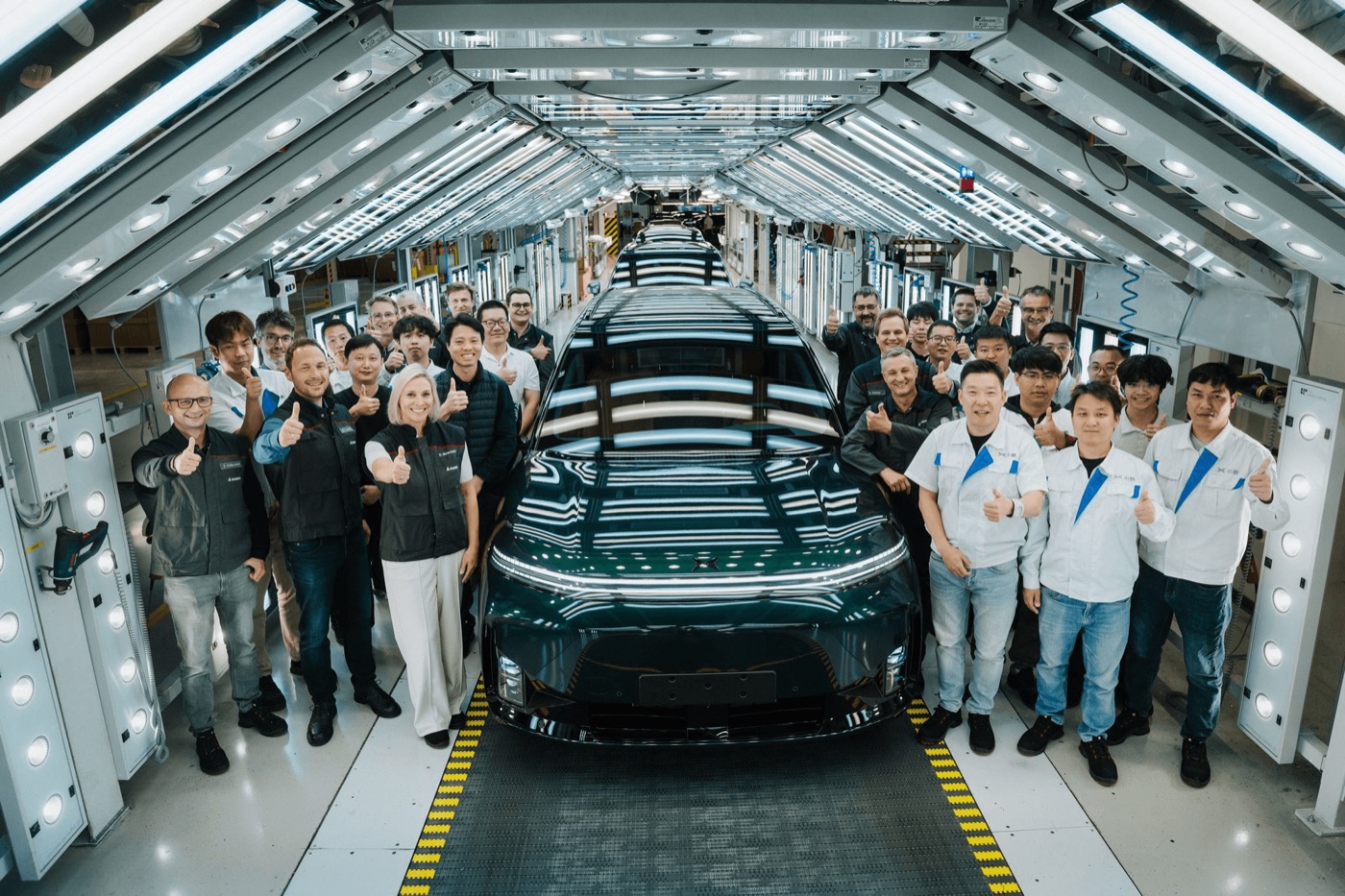
XPeng's European production today: one contract line at Magna in Graz, where the G9L has just completed trial production. Image: XPeng.
What XPeng has actually said
- The constraint is production capacity, in He Xiaopeng's words at the show. Chinese coverage of the same briefing frames it plainly: Austria's capacity is considered insufficient for the plan.
- The options are more capacity with Magna in Graz, where XPeng already builds cars, or production elsewhere in Europe — either a new plant or a site operated with a local partner.
- Nothing has been published about scale, candidate countries or investment. XPeng has confirmed it is evaluating; it has not announced a decision.
- Today that one line at Graz builds the G6, the G9 and the P7+, and the G9L completed its first European trial production there this month — we covered that milestone here. XPeng describes the flagship as now being built in parallel in Guangzhou and Graz.
Why the arithmetic points outward
The European business XPeng has today is real but small relative to the target:
- More than 60,000 vehicles delivered in Europe since entering through Norway in 2020, most of them in the last two years.
- Overseas deliveries passed 20,000 in a quarter for the first time in Q2 2026, up 81% year on year, with overseas markets contributing more than 25% of revenue at an average selling price above €40,000.
- The 500,000-a-year European target is larger than Ford's European volume last year (over 426,000) and Opel's registrations (about 400,000).
And the commercial case for local production got sharper on the same day the target was restated. The G9L launched in Europe at the Paris show with prices that put it squarely in premium territory:
| Market | G9L from |
|---|---|
| Germany | €74,600 |
| France | €74,990 |
| Belgium | €74,990 |
| Austria | €75,600 |
| Netherlands | €76,990 |
| Norway | NOK 749,900 |
| Denmark | DKK 639,995 |
| Sweden | SEK 849,900 |
At the exchange rate Chinese outlets used, the German starting price is about 558,000 RMB — close to twice the top-trim Chinese price for a car that, in Europe, is sold with the battery-electric powertrain only. The European G9L comes from Graz; the Chinese one comes from Guangzhou. European pricing at that level, on a car assembled in Austria, is the strategy in one table: local production is what makes a premium European price defensible rather than an arbitrage.
The rule that is driving this
The coverage frames the expansion as preparation for EU local-content rules — requirements that are pushing Chinese manufacturers to build production and supply chains inside Europe rather than import finished cars. BYD is the loudest example, with reporting suggesting it needs several European plants and a battery factory to support its goals. Countervailing duties on Chinese-built EVs are the blunter version of the same pressure.
XPeng has been exploring this for a while. In May 2026 it was reported to be in talks to buy a Volkswagen plant in Europe as exports surged 62% — Volkswagen is also a shareholder and technology partner, and the two have jointly developed electronics and driver-assistance technology in China. Chinese coverage of this week's briefing says XPeng sees VW's own playbook in China as the model for localisation: invest locally, partner locally, build a long-term base.
What it would take
Three things are worth separating, because "expand production" covers all of them.
Assembly capacity. Going from one contract line to 500,000 cars a year is not an incremental step. Contract manufacturing with a single partner is unlikely to carry it, which is why the option set includes a site of XPeng's own or a larger partnership.
Local content, not just local assembly. Rules framed around local content reach into the supply chain — cells, packs, electronics. XPeng has no announced battery plan for Europe, and that is the expensive half.
Demand at a premium price. A €74,600 starting price puts the G9L against established German metal. The 500,000 target assumes XPeng can sell at those prices, in volume, in markets where it is still building brand recognition — which is a different bet from the one the capacity plan addresses.
Caveats
- This is a plan under consideration, not an announcement. XPeng has confirmed it is evaluating options; the "new plant or local partner, decision within months, no country confirmed" detail comes from the Weibo summary and the Chinese and English coverage of the same briefing. No capacity figure, site or investment has been published.
- The 1 million and 500,000 figures are targets stated by the chairman at a motor show, not guidance with a plan attached.
- "Austria's capacity is insufficient" is XPeng's assessment. Neither XPeng nor Magna has published Graz's capacity or its limits.
- The G9L prices are launch prices for the markets listed and vary by trim and equipment; the European range is battery-electric only.
- The Volkswagen plant talks were reported in May 2026 and have not been confirmed as ongoing.
- The EU local-content framing is the coverage's. We have not verified the specific instrument or its timing in a primary document.
- The Weibo post is a third-party summary by an account that reposts Chinese industry news; we have cross-checked it against CNMO, 观点网, Yahoo Finance Hong Kong and English-language coverage of the same briefing.
The bottom line
A company that has delivered about 60,000 cars in Europe over five years is now saying it wants 500,000 a year by 2030, and that what stands in the way is not customers but factories. The number is aspirational; the diagnosis is the news. XPeng has concluded that exporting from Guangzhou will not get it there — and the G9L's price list, roughly double China's for a car built in Austria, is the argument for why the next decision matters more than the last one.
Source: He Xiaopeng's remarks at the Paris Motor Show as reported by 观点网, CNMO and Yahoo Finance Hong Kong; the G9L's European pricing as reported by 快科技; and the Weibo summary by 姬永锋, cross-checked against CNMO, 观点网 and English-language reporting of the same briefing — translated & adapted for XPENGTech.
Get the next one direct.
New articles, or a daily / weekly digest — the same list EVConduit keeps.