
15 October 2026
XPeng's Export Target for 2027: Close to 300,000 Cars
Wang Fengying, XPeng's president, gave a rare interview at the Paris show: an export target of 200,000 to close to 300,000 vehicles in 2027, globalisation as the second growth curve with Europe as the first battlefield, all future models developed as global cars, overseas profitability better than domestic, and possible standalone MONA stores. She also argues Europe will be where assisted driving lands fastest. We set out the plan and the tension inside it.
Wang Fengying, XPeng's president, gave an interview at the Paris Motor Show — her first with media in years, according to the Chinese outlet that conducted it — and the strategic content was denser than most of the company's launch material. The headline number: XPeng is targeting an export volume of 200,000 to close to 300,000 vehicles in 2027, nearly double this year.
The interview was reported by the automotive journalist 吴佩 on Weibo, and independently by 虎嗅 in a longer piece on Chinese brands in Europe. Both quote her directly, and the two accounts agree on the substance.
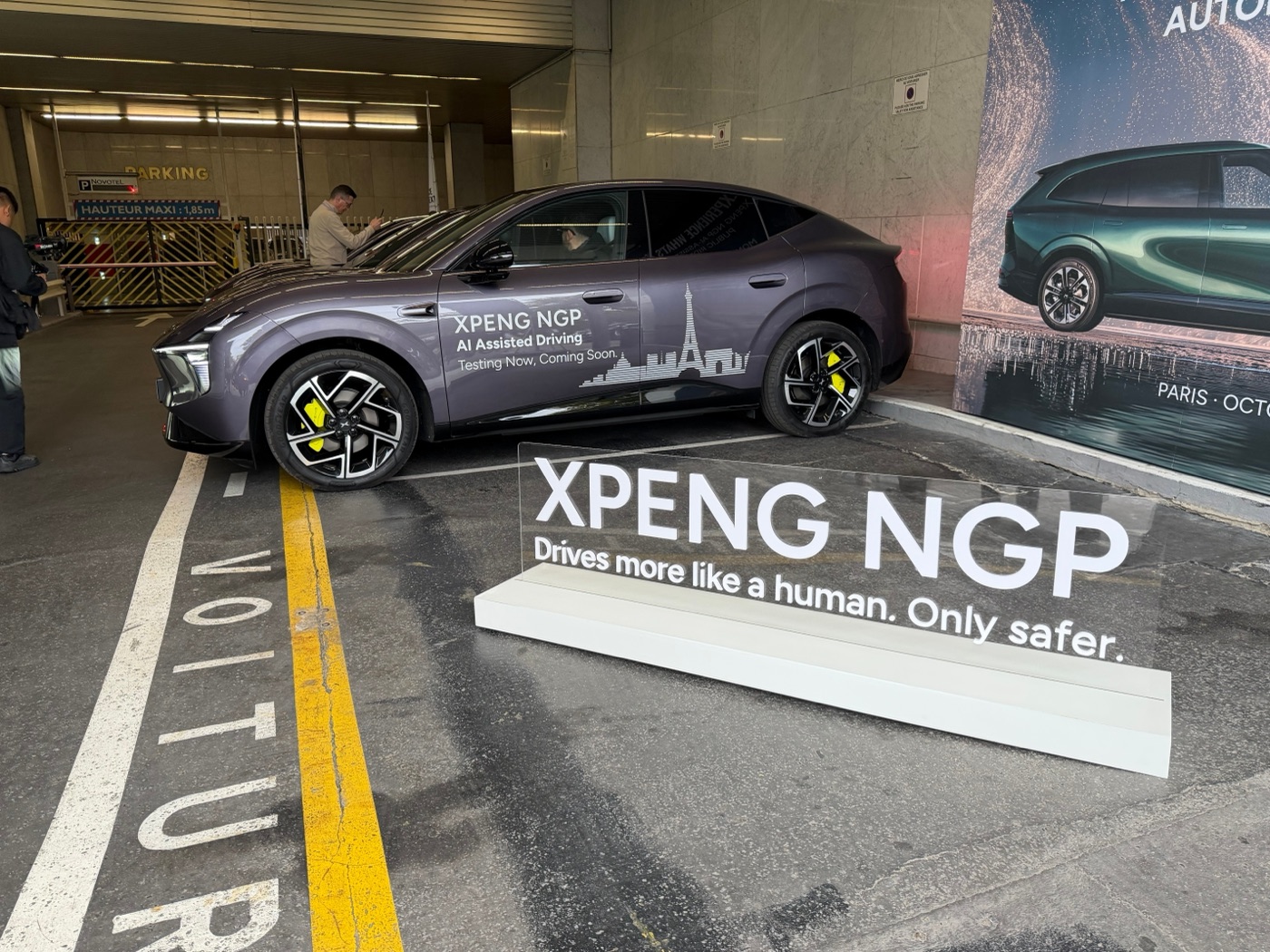
"Drives more like a human. Only safer." — XPeng's NGP campaign at the Paris venue. Image: 吴佩 on Weibo.
The five things she said
1. The 2027 export target is 200,000 to nearly 300,000 vehicles, with globalisation framed as XPeng's "second growth curve" and Europe as the first battlefield. More important than the volume, she said, is that global consumers remember XPeng as an AI car brand — the company's own three tasks are "brand rooting, products that survive global aesthetics, and service that has surprise".
2. Europe first, precisely because it is hard. Germany is the home market of Mercedes, BMW and Volkswagen, with demanding buyers. Her reasoning: standing firm in the toughest market is the best brand endorsement for everywhere else. The goal is not only to sell cars abroad but to build a brand abroad.
3. All future XPeng models will be developed as global cars — the "sell well at home, then think about exports" sequence is over. The G9L has already been trial-produced in Europe, validation covers multiple countries, and "global big-selling models" are the stated direction.
4. Overseas profitability is "generally better" than in China, she said, and XPeng wants to hold a high-end technology brand position rather than compete abroad on price. The public numbers support the direction if not the margin claim: XPeng's first-half 2026 overseas revenue was RMB 8.23 billion, up 62.2% year on year and more than 25% of total revenue, with overseas quarterly deliveries passing 20,000 for the first time in Q2.
5. MONA may get its own stores in China — not for brand reasons, she said, but logistics: the model line-up has grown to the point where existing showrooms may not fit everything. That is a small line with a large implication, given the L05's pre-sales opened this week.
Why she thinks Europe is where assisted driving lands first
The most interesting passage is about timing. Wang Fengying argued that Europe, not China, will be the fastest place for assisted driving to arrive — because European regulators pay close attention to vehicle intelligence, grant more permissive testing conditions, and move rules into place faster than other markets. She said XPeng's investment in assisted driving is first in China and that the company expects an "explosion" on that track soon.
XPeng is not a bystander in that rule-making: it holds the secretary role in a UNECE working group on automated driving, the first Chinese company to do so. And its public demonstration programme in Paris — the only two brands in the show's Autonomous Lab were XPeng and Tesla — was described by the company as the first large-scale public NGP experience in Europe.
That is the commercial logic behind the export target. The G9L's European prices start at €74,600 in Germany and €76,990 in the Netherlands; the cars are built at Magna's Graz plant; and He Xiaopeng has separately said XPeng needs more European production capacity to reach a 2030 target of one million global sales with half of them in Europe.
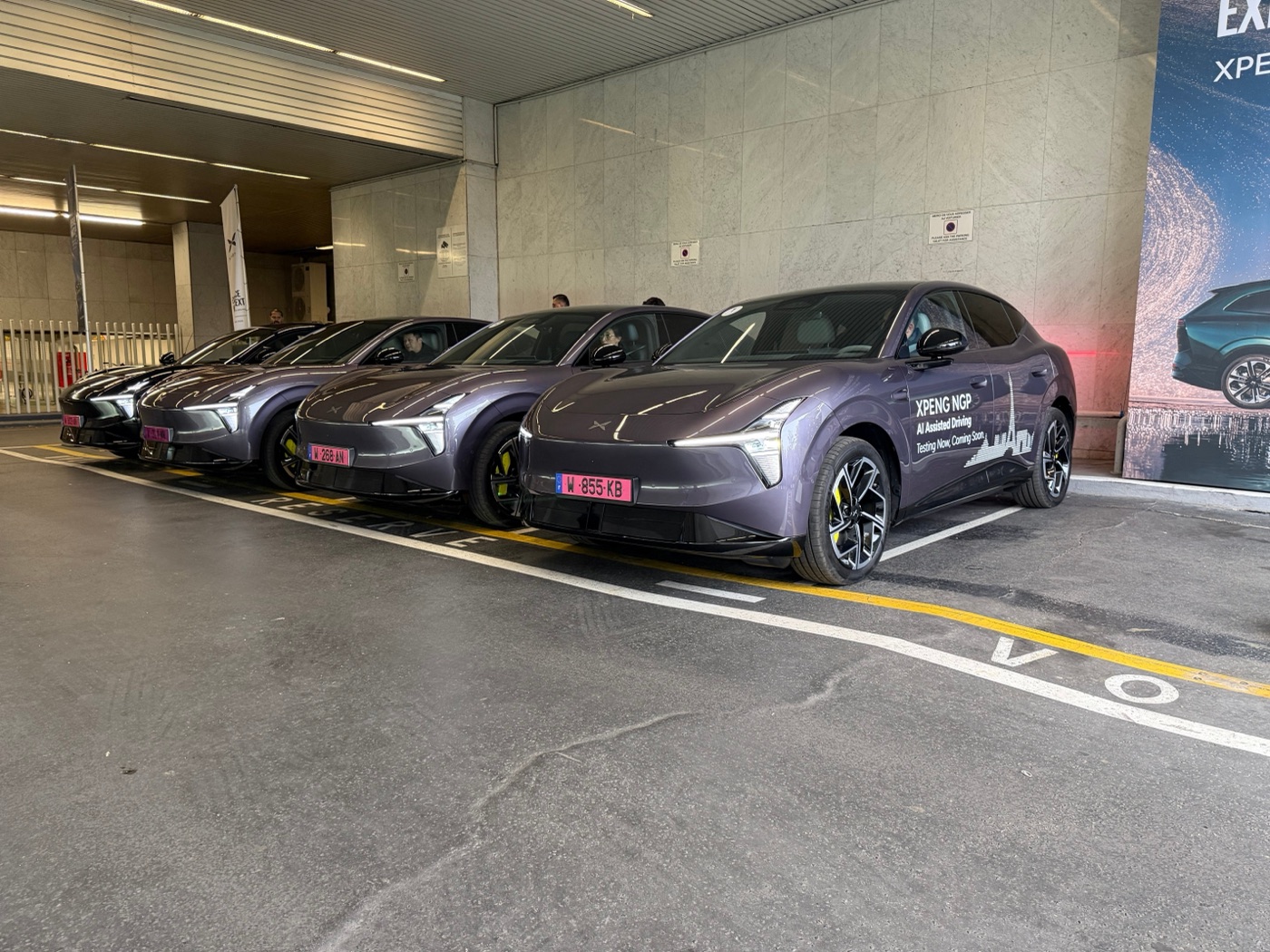
The L03 test fleet in Paris, decalled "Testing Now, Coming Soon". Image: 吴佩 on Weibo.
The tension in the plan
Three things sit awkwardly together, and none of them is hidden by the interview.
Premium positioning against a 300,000-car target. Not competing on price is the right instinct in a market where Chinese brands carry a residual-value discount, but volume targets and premium pricing pull in opposite directions. The L05 — expected under 200,000 RMB at home, with a cabin marketed as "300,000-RMB-class" — is the volume engine that makes the export number plausible; the G9L is what makes the brand credible.
Brand awareness is the real constraint. Third-party polling cited by 虎嗅 found most Chinese brands below 10% unaided awareness in Germany, with newer names around 1%. Building a brand there is measured in years and hundreds of millions of euros, which is a different kind of investment from shipping cars.
The policy environment is tightening, not loosening. The EU's countervailing duties on Chinese-built EVs run up to 35.3% on top of the standard 10%, and the trade conversation has since extended toward plug-in hybrids. Local production — Graz today, more later — is the hedge, which is why the capacity question and the export target are the same question.
Caveats
- The interview is reported through two Chinese accounts — the journalist's Weibo post and 虎嗅's longer piece. There is no published XPeng transcript, and we have not seen the full recording.
- The export target is a target, given verbally, with no breakdown by market or powertrain.
- "Overseas profitability is better than domestic" is her claim. XPeng does not publish segment margins, and the company has been loss-making at group level through its expansion.
- "MONA may get independent stores" is a possibility she raised, not an announced plan.
- The "Europe first for assisted driving" judgement is hers, and it sits alongside a regulatory process that has not approved NGP for European customers yet.
- The brand-awareness and residual-value figures come from third-party research cited by 虎嗅, not from XPeng.
- The G9L's European pricing and the Graz production facts are from XPeng's own announcement, which we covered separately.
The bottom line
The export target is the easy part to report and the least interesting. What Wang Fengying is actually describing is a company reorganising itself around exports — global platforms from the drawing board, premium pricing instead of volume discounts, and a bet that assisted driving is the one feature Chinese makers can charge for in Europe. The hard part is the one no target can fix: being remembered. That is what "brand rooting" means, and it is the only item on her list that money cannot buy quickly.
Source: Wang Fengying's interview at the Paris Motor Show as reported by 吴佩 on Weibo and by 虎嗅, with XPeng's own published figures — translated & adapted for XPENGTech.
Get the next one direct.
New articles, or a daily / weekly digest — the same list EVConduit keeps.