
21 September 2026
XPeng's G9L Press Conference: Paris, Dual-Orin VLA and IRON
Translated highlights from the G9L launch press conference: a global launch at the Paris Motor Show on 12 October with possible partnership announcements, a Q4 batch rollout of distilled VLA 2.0 to dual-Orin-X owners, IRON robot production targeted for end-2026 with China deliveries from Q2 2027, and G9L production starting at Graz - plus one claim about Australian EV buyers that does not survive checking.
XPeng held its G9L launch on 17 September 2026, and the press conference afterwards ran long enough that no single attendee's notes capture all of it. The record below follows the transcript published by Weibo user 肉肉爸比ev, who labels it plainly as an incomplete record (不完整记录), cross-checked against a fuller edited transcript published by BitAuto.
Between them, four things emerged that matter beyond the launch itself: Paris on 12 October, a Q4 handover for dual-Orin owners, a production date for the IRON robot, and a manufacturing plan built around Graz.
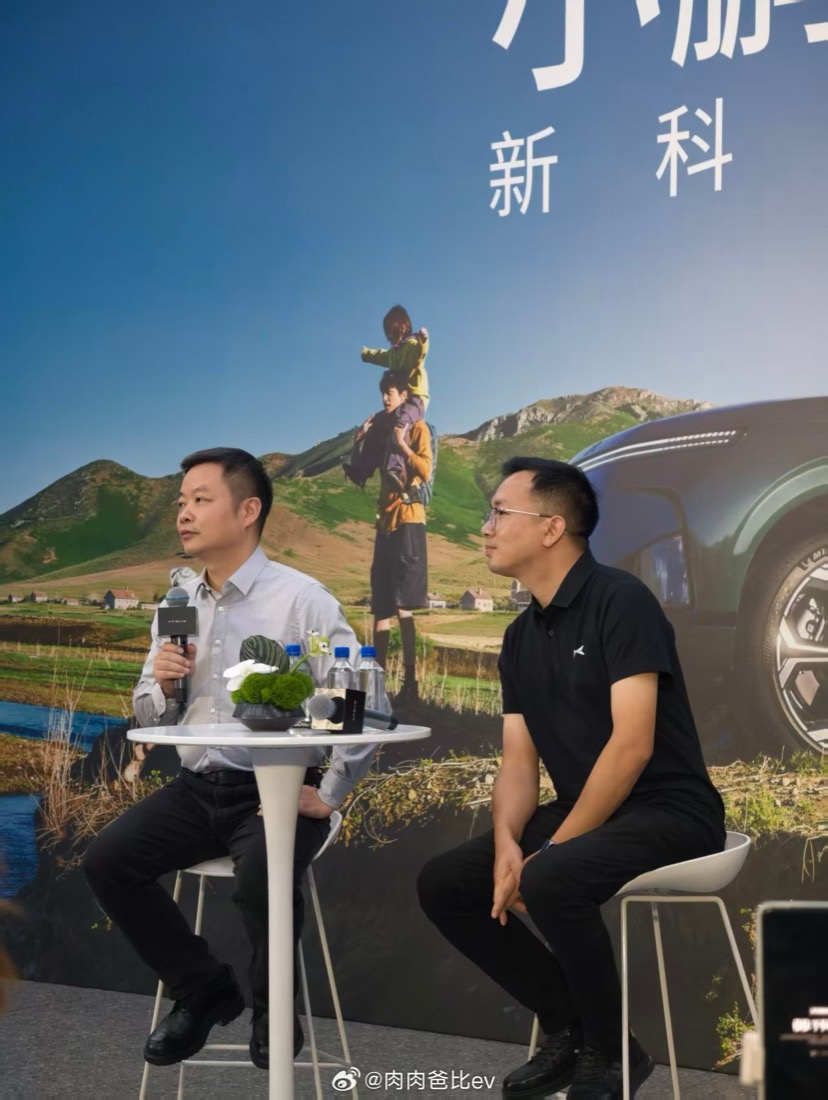
The photograph attached to the original post: a stage segment from the G9L launch, photographed by 肉肉爸比ev.
Paris, 12 October — and possible partnership news
He Xiaopeng was asked what the Volkswagen cooperation has delivered, and whether XPeng will strike more deals across Europe and global markets. His answer tied the two together:
"I think both we and Volkswagen have gained a great deal — among any three people there must be a teacher, and German automakers in particular have much we can learn from. Beyond Volkswagen, we are also in talks with car companies and non-car companies about more cooperation, whether on technology or on chips. And it happens that 12 October is our French motor show — we may officially announce some cooperation cases there."
That is consistent with what he told Yicai on the same evening, where he named the Paris show as the likely venue for "several new examples of XPeng's overseas cooperation" that could land commercially in Q4. (We covered that exchange here.)
On the G9L itself, Wu Anfei — XPeng Group's general manager of product matrix, referred to throughout as 安飞 — confirmed the global timing: the G9L gets its global launch at the Paris Motor Show on 12 October, with deliveries following from then. Asked whether it could reach the United States, He Xiaopeng left the door open: "if the opportunity comes, and it's lawful and reasonable, I hope we can go to America."
The dual-Orin handover moves to Q4
The most consequential answer of the session was about the owners XPeng has been accused of leaving behind.
Reporters noted they had driven the distilled VLA 2.0 build for dual-Orin-X cars the previous week and found it good — so why the silence, and what is the plan?
"We expect to begin in the fourth quarter of this year, progressively pushing to Orin-X owners in batches. It may not be all versions pushed at once. To get every owner onto VLA 2.0 we are doing our utmost — and I want to share one thing: distillation is very expensive. It actually cost far more than I imagined. So you can see that the results really are good."
That confirms the roadmap in the order the community predicted: single-Turing Max first, dual-Orin X Max after. It also corroborates the mechanism behind the whole argument — a full 30B VLA 2.0 does not fit the memory bandwidth of a two-Orin-X car, so XPeng is paying to compress it rather than shipping something unstable. (Our breakdown of that bandwidth argument is here.)
IRON: production target end of 2026, China deliveries from Q2
XPeng's humanoid robot has had an unusually loud year given how little the company used to say about it. He Xiaopeng explained the reversal:
"Robot R&D is extremely difficult — roughly twenty times the difficulty of building a car. So our software, hardware, supply chain and design are largely developed and made in-house, and our capacity pressure isn't large."
He said the earlier reticence was deliberate. "We genuinely weren't sure. In fact, the robot videos circulating out there — we had achieved those over the past two years. After editing them up we felt it was meaningless, because in the end there was no mass production. If it is only research without mass production, it has no value."
His framing of where the programme sits is the striking part:
"The robot today is still in the period cars were in before the first car came off the line. IRON is equivalent to the G3. Sometimes history is a cycle."
The dates: mass production targeted for the end of December 2026, deliveries in China beginning in Q2 2027, then overseas. He added that a capability "jump" should be visible in Q4 2026, and that XPeng is deliberately preheating the product now — "unlike a lot of people, our robot can sell itself. We hope we can do a lot of cool things, and that we can genuinely sell it."
Graz first, three plants, and a right-hand-drive line
Asked about global delivery plans and the right-hand-drive G9L that has now rolled off the line in China, Wu Anfei gave the manufacturing detail:
- G9L will be built first at the Graz plant in Austria — and she said she will travel to Graz herself for the start of production.
- XPeng now has three manufacturing bases worldwide.
- Launches and deliveries roll out progressively through October and November.
- The manufacturing system is unified: domestic supply chain, build processes and inspection processes are "from the same root," with per-market regulatory adaptation. Even the roof rack gets different stiffness for different countries' requirements.
He Xiaopeng then named the three capabilities he expects to show up overseas next year: VLA 2.0 driving globally; offline voice — because "overseas has a great many languages and data traffic is very expensive, in some places ¥4,000" — and ultra-fast charging, with XPeng's energy-storage charging cabinets being built out faster abroad. His conclusion: "you will see XPeng sell well and sell expensive overseas."
An Australian footnote: asked why the car is called G9L rather than being positioned as a five-seat GX, Wu Anfei mentioned an unexpected hurdle — "in Australia, a lot of names are already taken, and we are still discussing small adjustments."
Not a six-into-five conversion
The pricing was the other theme. Reporters put it to the panel as "nine-series specification at a six-series price" and asked what sat behind it.
Wu Anfei's answer was that the GX and G9L were conceived together as two flagships, from genuine customer demand rather than a derivative plan:
"We did not want it to be a simple six-into-five. We redesigned the dimensions and the exterior. Second, from the very beginning we thought of it as a global car, and global requirements are numerous — so from the start there was left-hand drive and right-hand drive, two-wheel drive and four-wheel drive. Third, we thought about multiple energy forms: there is battery-electric, and there is range-extended, so that in parts of the world where charging is not yet complete we can still offer a good range-extender experience. Those three points were the starting point three years ago."
He Xiaopeng's contrast: "What makes it different from a six-into-five is that first, a five-seater has to be good to drive. A golden driving experience is a genuinely enjoyable thing. At this price we have a 702 Max — rear-wheel drive combined with Max — then SE, then the flagship. This is a car that is fun to drive yourself and is also cool."
On supply chain, Wu Anfei put a number on the GX relationship: lower-body sharing above 90%, an all-new upper body, and shared middle/back-office software and models. On volume targets, He Xiaopeng was coy — "internally we haven't discussed it" — before answering anyway: "if you insist on asking, then also top three globally."
The range-extender pitch, and a claim about Australia
Wu Anfei framed XPeng's super range-extender as "a pure EV you can refuel": 435 km of electric range, enough for a week of city commuting without charging, and a 1,600 km combined range. The range-extender battery is 5C as standard, and the system uses both ENC and RNC with what XPeng calls "imperceptible range extension" — the intent being that the car feels the same when the battery is depleted. Her verdict was that on this path XPeng is "invincible."
He Xiaopeng explained the strategic origin, and arrived at Australia:
"I was three minutes late just now because the Mexican ambassador came to see me. The reason we do range-extenders is that we went to Mexico and I found Mexico has no electricity — China's infrastructure really is the best. Many countries are severely short of power; they are roughly where China was in 1990. Why has Australia been buying a lot of electric cars recently? Because there is no petrol, so they can only buy EVs."
That last sentence does not hold up, and it is worth correcting rather than passing on. Australia has no petrol shortage — fuel is abundant and widely distributed. Australian EV uptake has been driven by the New Vehicle Efficiency Standard that took effect on 1 January 2025, state and territory purchase incentives, and running-cost advantages, not by any scarcity of fuel. XPeng's range-extender case for markets with weak charging infrastructure is a real argument; Australia is not an example of it, and it is an unusually poor market to reach for given the G9L's right-hand-drive ambitions here.
On FSD comparisons and where software value goes
Reporters asked about VLA 2.0 versus Tesla's FSD, and about the Silicon Valley operation.
He Xiaopeng's answer separated the user-visible change from the technical one: "This XOS 6.3.0 may not be a huge leap for users, but for the technology layer it is a huge leap. The model's parameter count is larger, and its capability on narrow roads may also exceed V14." (The transcript reads "V15" at one point; the surrounding comparison is to FSD version numbers, so this is most likely a transcription slip for V14. We have not treated the figure as reliable.)
He also made a pointed observation about generalisation: "FSD is very impressive in the United States, but not so impressive in other countries. That is a question of fundamental generalisation ability." His claim is that a VLA plus VLM combination is what lets XPeng take the G9L global, and that L2/L3 definitions now existing in regulation — with XPeng sitting as one of the core committee members — sets up 2027–2028: "I am very confident that among the world's best driver assistance, XPeng will be there."
Asked about the price ceiling for Chinese EVs — the framing being that the internal-combustion era's mainstream ceiling was Porsche — Wu Anfei called the current moment "an era of technology popularisation," noting that a nine-series product used to cost ¥1m. He Xiaopeng went further:
"Today's competition between companies is on features and price — not a very high-dimensional competition. In future the competition will be more high-dimensional: the value of the brand, the value of scale. The value of software has not yet been mined. Software starts as software, then SaaS, then an ant-colony effect — this will form a transformation of the commercial era, and it will happen within ten years. China's car industry will certainly have tiers above ¥500,000, above ¥1m, and from ¥1m to ¥10m — different positioning, different differentiation, different levels."
The human bits
Two anecdotes are worth keeping.
The first is the camouflage film. He Xiaopeng said he proposed tearing the protective film off the G9L test cars, "because the film hides a lot of detail and texture, and it also interferes with wind-noise testing." Wang Fengying and Wu Anfei talked him out of it, for reasons of their own. "There was compromise on the project, and also retreat."
The second is what persuaded whom on the driving stack. He Xiaopeng said Wu Anfei and Wang Fengying were more insistent than he was that a flagship has to ship strong driver assistance — on both VLA 2.0 and XOS 6.3.0. And he noted the turnaround in Wang Fengying's own position: when he recruited her at the end of 2022, "she thought driver assistance was more of a PR concept. Now her thinking has completely changed."
On the internal arguments over price, he was asked directly whether he coaxes her or she coaxes him: "Definitely me coaxing her — where would you find a girl coaxing a guy?"
Caveats
This article is based on an attendee's own Weibo record, explicitly labelled by its author as incomplete, cross-checked against BitAuto's edited transcript of the same session. Group-interview transcripts are paraphrased in the retelling; quotes here are translated from Chinese and should be treated as faithful in substance rather than word-for-word official statements.
Two specific items deserve caution. The "V15" reference in the VLA 2.0 answer appears to be a transcription error and is flagged as such above. And He Xiaopeng's claim that Australians buy EVs "because there is no petrol" is incorrect, as noted in the text — we have left the quote intact for accuracy of reporting and corrected it immediately alongside.
XPeng's figures — 435 km of electric range, 1,600 km combined, 5C range-extender charging, mass-production dates and global launch timing — are company claims and targets. The IRON production and delivery dates in particular are forward-looking and have not yet occurred.
Source: 肉肉爸比ev, Weibo (with reference to BitAuto's edited transcript) — translated & adapted for XPENGTech.
Get the next one direct.
New articles, or a daily / weekly digest — the same list EVConduit keeps.