
16 September 2026
XPeng's Hybrid Si/SiC Inverter: The IEEE Cover Paper, Explained
XPeng's powertrain head walks through the team's IEEE Power Electronics Magazine cover paper: a hybrid traction inverter mixing Si IGBTs, SiC MOSFETs and SiC Schottky diodes in one module, a four-stage switching scheme, and low-parasitic packaging — taking CLTC e-drive efficiency from 96.3% (all-silicon) to 98.7%, at full-silicon-carbide efficiency but without its cost.
XP-Jacky — XPeng's Vice President and head of the Powertrain Center — has published a plain-language walkthrough of the team's IEEE paper on the hybrid silicon/silicon-carbide traction inverter, and it is a good example of a car company explaining an efficiency number down to the device level.
The paper, "Commercialization and Cost-Optimization of a Hybrid Si/SiC EV Traction Inverter" by Hao Chen, Zhehao Cai, Zeyong Xu, Zhongwen Wu, Xuezhi He, Fei Wang, Chenggong Guo, Hongjian Xia and Jie Gu, appeared in IEEE Power Electronics Magazine (June 2026 issue) and was selected as that issue's cover feature. XPeng announced it on 30 July.
Why the inverter matters more than it sounds
The traction inverter converts DC from the battery or generator into the AC the motor needs. On paper that is "just conversion" — but the post makes the case that the inverter also has to control the rhythm and force of the current, because that is what the driver actually feels: no jerkiness, no surging, no motor whine. It has to be efficient, quiet and smooth and reliable across every operating condition for years. That combination is what makes the choice of power devices a real engineering problem rather than a shopping decision.
The paper's subject is the next step: how the hybrid Si/SiC route went from a lab prototype to something that can be built in volume. A prototype is easy; the same behaviour across a full vehicle's operating envelope, over a long period, with batch-to-batch consistency, is not.
Three devices in one module
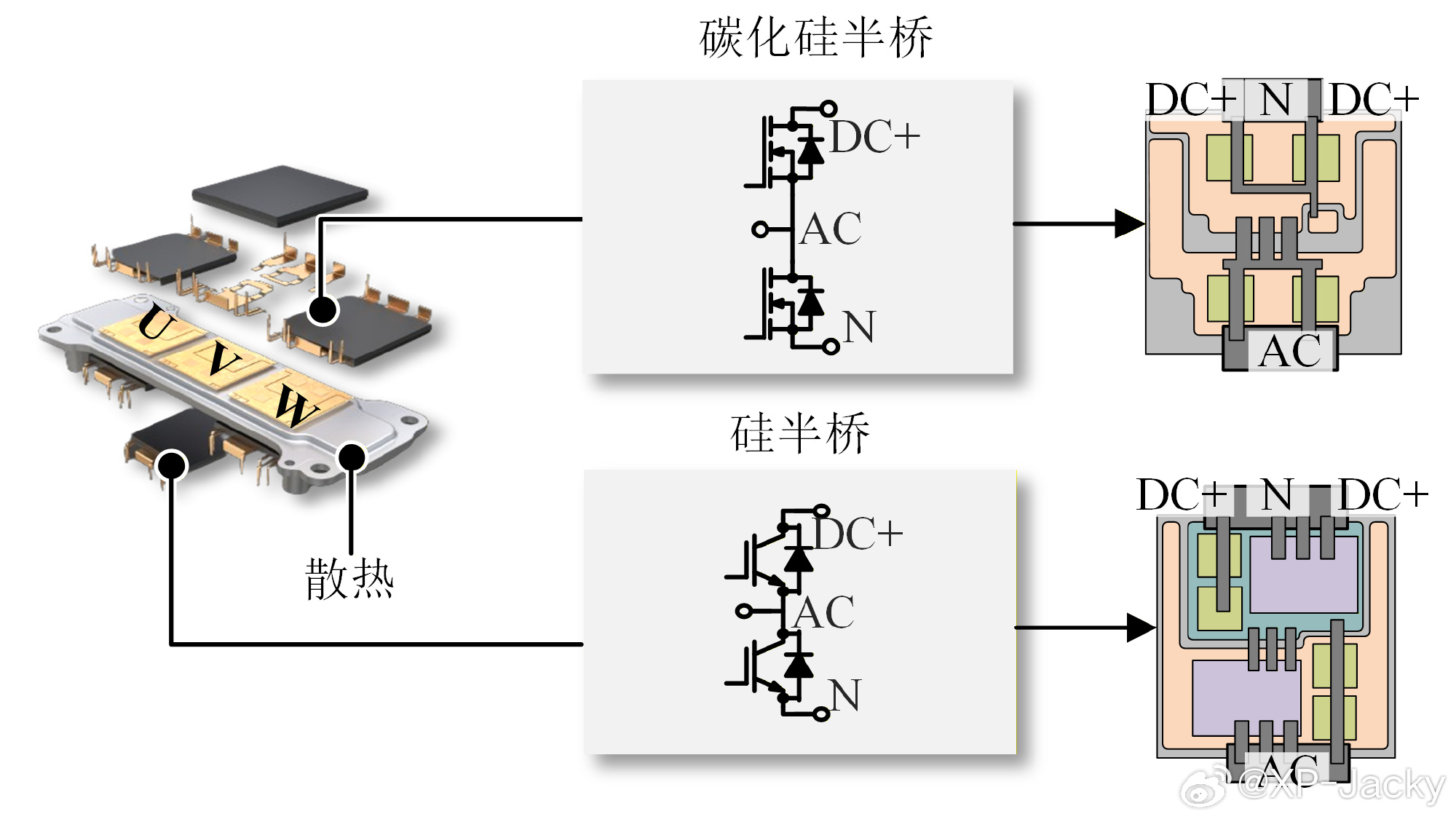
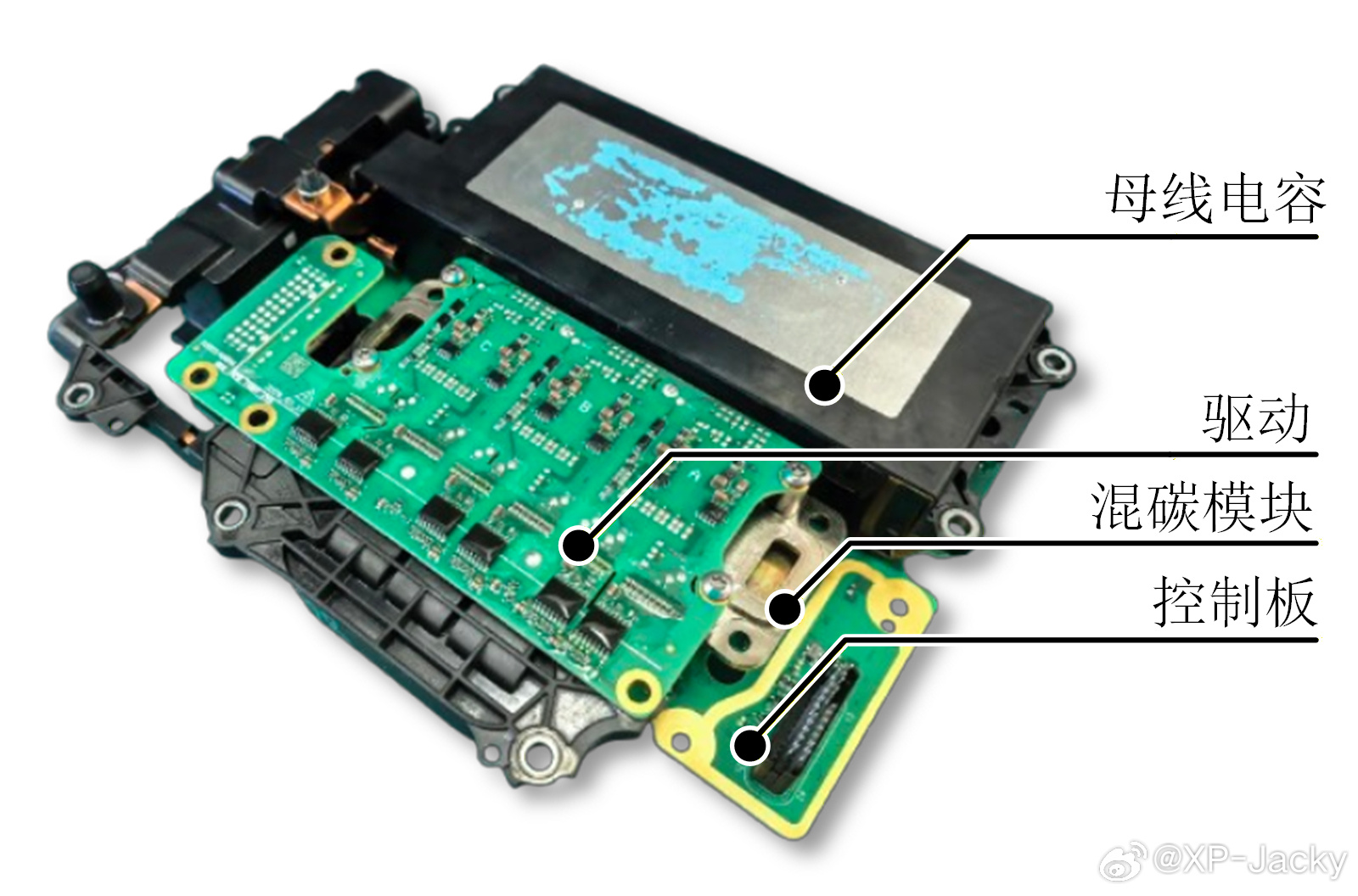
The hybrid module integrates Si IGBTs, SiC MOSFETs and SiC Schottky diodes in the same power module, and the post explains the division of labour with three analogies:
- SiC MOSFET — a "fast, low-effort electronic valve", handling light loads and frequent switching;
- Si IGBT — a "sturdier big gate", handling heavy current under load;
- SiC SBD — a "check valve" that cuts the extra losses from current sloshing back and forth.
The trade-off being managed is explicit. All-silicon is cheaper and more mature but generates more heat under frequent switching and light loads. All-silicon-carbide is more efficient but costs more and is fussier about layout — handle it badly and you get voltage spikes and oscillation. The hybrid lands between them, tuned for efficiency, cost, heat, stability and NVH at once.
Control and packaging
Two further pieces make the device mix work:
- A four-stage switching scheme combined with PWM. At low load it prioritises efficiency; as current rises it reallocates which device does what; in the high-current region it switches modulation method to stop losses spiking — all while keeping NVH in check.
- Low-parasitic packaging. The post's explanation is a plumbing analogy: if the pipework is long and loose, a valve opening and closing quickly produces a shock — in a circuit, that is voltage spikes and oscillation, which show up as interference and noise. Optimising the module's internal layout and reducing parasitic parameters is what buys consistency.
The numbers
On the CLTC cycle, XPeng reports the core e-drive efficiency rising from 96.3% for the all-silicon solution to 98.7% for the hybrid — equivalent to all-silicon-carbide, with engineering validation complete and mass production reached.
The interesting part is why 2.4 percentage points matter. In the post's framing: previously about 3.7 parts in every 100 of energy became heat; now it is about 1.3. Less heat means the system is less likely to trigger power derating — which is what owners actually feel in low-battery, high-speed, climbing and hot-weather conditions, where an over-heating inverter quietly reduces output.
The production claim
From the Chinese coverage of the announcement, the scale-up behind the paper is:
- Nearly 700 engineering vehicles used for validation before production;
- mass production from November 2025;
- more than 15,000 vehicles running the solution on the road at the time of submission;
- and XPeng's claim that this is the first large-scale mass production of a hybrid Si/SiC solution in a commercial traction inverter.
How to read it
These are XPeng's own figures, published in a peer-reviewed magazine and then explained by the executive who owns the programme — which is a stronger footing than a marketing number, but still a manufacturer's framing. The efficiency values are cycle-based lab comparisons, and "equivalent to full silicon carbide" is XPeng's own equivalence claim rather than a third-party measurement. What is not in dispute is the shape of the achievement: the interest here is cost per point of efficiency, not a raw efficiency record — which is exactly what makes it deployable across a mass-market line-up rather than only a flagship.
We covered the same hybrid Si/SiC hardware from a different angle earlier, in XPeng GX's 800V "Hybrid Silicon-Carbide" E-Drive, Explained.
Source: XP-Jacky (XPeng Vice President, Powertrain Center) on Weibo, 3 August 2026 — translated and adapted for XPENGTech. Paper: Chen, Cai, Xu, Wu, He, Wang, Guo, Xia and Gu, "Commercialization and Cost-Optimization of a Hybrid Si/SiC EV Traction Inverter", IEEE Power Electronics Magazine, June 2026. Publication and production details via IEEE PELS and CNMO.
Get the next one direct.
New articles, or a daily / weekly digest — the same list EVConduit keeps.