
22 October 2026
XPeng's IRON Gets the Car's VLA 2.0 Brain and Reads Your Next Move
XPeng's robot lab series shows IRON taking a handshake, a fist bump and a high-five with no voice commands, and switching arms when the person changes the gesture mid-movement. The claim behind it: the same second-generation VLA model as the L05's assisted driving, running on-device on the robot, re-reasoning every 0.2 seconds and predicting six seconds of possible human action - with a probability split across five likely gestures. Company footage, R&D build, one tester.
XPeng's official account published a one-minute-fifty-two episode of its robot lab on 22 October in which IRON shakes hands, takes a fist bump and returns a high-five with no voice command at all — and, when the person changes the gesture mid-movement, changes with them.
The claim in the post is the interesting part, because it is not a new robot. It is the same second-generation VLA model that went into the L05's assisted driving, running on the robot, on-device:
Last month, the second-generation VLA started to understand "time". This month it arrives on XPeng IRON to understand "your next move". Relying on the same Physical AI base, the upgraded model gains stronger temporal understanding and future-behaviour prediction — and that capability has also landed on-device on the IRON humanoid.
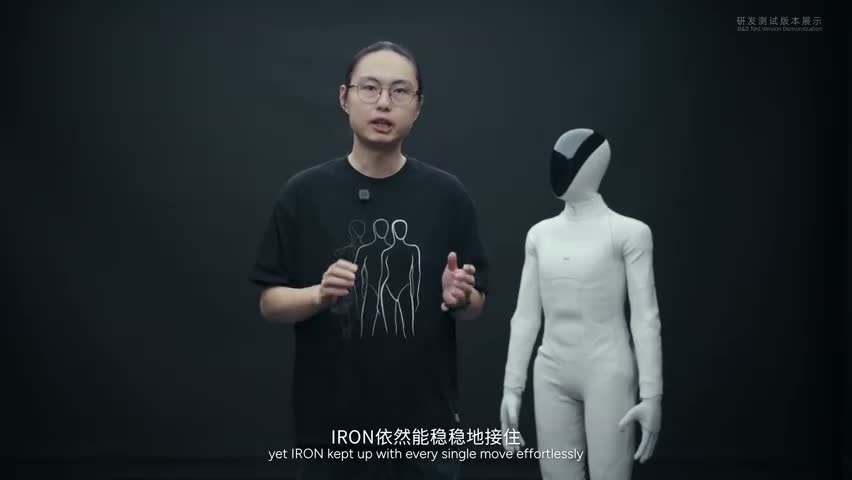
▶ Play the 1:52 episode — XPeng's own footage, bilingual captions burned in, and the on-screen "研发测试版本展示 / R&D Test Version Demonstration" watermark in the corner throughout.
What actually happens in the clip
The demonstration is a handshake that keeps changing. The tester — the presenter in the black shirt, standing beside the robot — offers a hand, then turns it into a fist, then swings it out of reach of the arm IRON had been using. The narration walks through the moment:
I was going to shake his hand, then suddenly switched to a fist bump — it takes the cue at once. Just as the fists meet, I suddenly change to a high-five, and it is outside the range of the arm it was using — it adjusts to the newest change immediately and meets me with the other hand.
The mechanism XPeng describes is a continuous loop rather than a recognise-then-act pipeline. The robot does not identify a gesture, run a routine and wait for the next command; it re-evaluates the frame in front of it every 0.2 seconds and predicts how the movement will change over the next six seconds, so perception and motion are one closed loop.
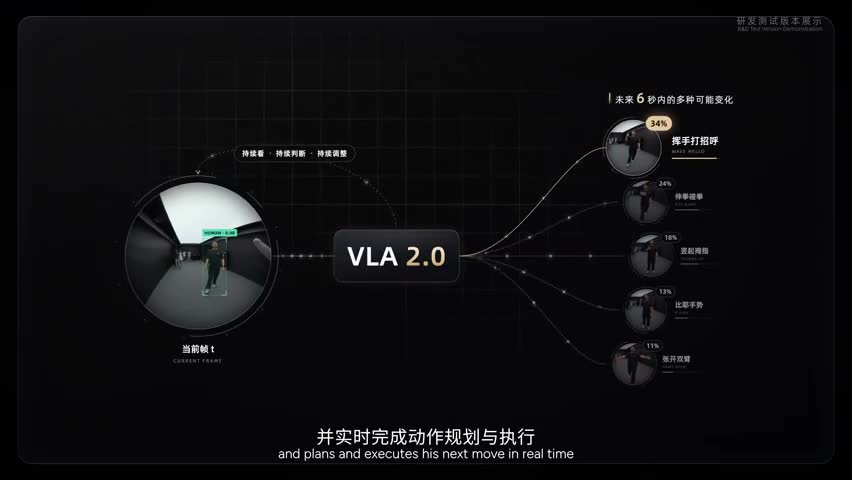
The frame that explains the claim: current frame t → VLA 2.0 → multiple possible next moves within six seconds, with probabilities. Image: via 小鹏汽车 on Weibo.
The diagram in the video is the most informative thing in it. From the current frame, VLA 2.0 branches into the likely next actions with a share attached to each:
| Predicted next action | Share |
|---|---|
| 握手打招呼 — greeting handshake | 24% |
| 伸手握手 — extended hand | 24% |
| 竖起拇指 — thumbs up | 18% |
| 比耶手势 — V-sign | 13% |
| 张开双臂 — open arms | 11% |
That is a distribution over futures, not a single classification, and it is the reason the arm switch is possible: if the model has already priced "high-five, other side" at a plausible share, the body can commit to the other arm without a second decision cycle. The five branches shown account for 90% of the mass; XPeng does not say what the remainder contains.
Why this is a harder problem than the car version
Driving and human interaction stress the same model in opposite directions. A car at 120 km/h needs decisions in milliseconds and a prediction horizon long enough to be useful — which is why XPeng's pre-sale material for VLA 2.0 quotes 30 seconds of temporal context and a six-second look-ahead, and why it spent the autumn arguing that the model "understands time".
A robot meeting a hand needs something different: it has to run fast enough to look synchronous (five inferences a second, here) while committing to a movement that takes a human-visible moment to complete, and it has to recover inside the movement when the human changes the plan. The failure mode is not a crash; it is a robot that freezes, or one that completes a high-five into empty air — both instantly legible as "machine" to anyone standing in front of it.
The narration makes this point directly: 这些互动看似简单,难点却在于人不会按机器人的节奏出招 — the interactions look simple, but the difficulty is that a human will not throw moves on the robot's beat.
One model, two bodies
The strategic message is in the first line of the post. XPeng has been building a single Physical AI stack and pointing it at both products: the car's assisted-driving model and the robot's behaviour model are the same family, trained on the same base and deployed to different bodies.
That argument has been running all autumn. The G9L's cockpit brain is shared with IRON — we wrote that up here — and the L05 shipped the same VLA 2.0 generation, with the same sub-80 ms latency claim attached. What this clip adds is the first demonstration of that model doing physical work on the robot rather than conversation: the previous IRON video, in September, was about orientation, identity memory, three languages and question answering — that write-up is here — and all four of those tests were about the robot's head and voice.
This one is about its arms, and about timing.
The hardware, and the commercial question
IRON runs three of XPeng's own Turing chips on board, up to 2,250 TOPS of effective compute, which is the figure that makes on-device inference plausible in the first place — the same three-chip configuration XPeng quotes for the G9L. Production remains targeted at the end of 2026, with China deliveries from the second quarter of 2027, the dates He Xiaopeng set out at the G9L press conference in Paris.
The job XPeng has been demonstrating for IRON is retail: a sales assistant that answers questions about the cars on the floor, remembers what a customer was interested in, and now shakes their hand. That is a narrow, repetitive, high-footfall task — exactly the setting where a robot that hesitates for a second stops being useful, and where the 0.2-second loop earns its keep.
Caveats
- Company footage, R&D build. The clip carries XPeng's own "R&D Test Version Demonstration" watermark. It is a demonstration, not a test.
- One tester, one studio, one afternoon. The person changing the gesture is the presenter who then explains it. Nothing here shows how IRON copes with a stranger, a crowd, a child, or someone who deliberately tries to break the loop.
- No failure cases and no success rate. We are shown the interactions that worked; the interesting number — how often it misses — is not in the video.
- 0.2 seconds and six seconds are assertions. Neither is instrumented on screen; the 0.2 s figure is stated in narration and the six-second horizon is the same number XPeng quotes for the car's VLA 2.0.
- The diagram is a marketing visual. It shows a probability distribution over five gestures and does not explain how the branches are produced, what the other 10% of mass is, or whether the shares are live output or a composited graphic.
- The robot is the R&D shell. The white body with the black visor is the test build; production IRON, and its hands, may differ.
- No pricing, no specification and no customer commitments for IRON were released with this clip.
- The captions are XPeng's, in Chinese and English, and they are burned in — so everything quoted above is the company's own translation of its own narration.
The bottom line
The interesting sentence in this video is not that a robot can high-five. It is that XPeng is now claiming the same model is doing temporal prediction in a car and in a humanoid, at 5 Hz, with a six-second horizon and a probability distribution over what the human will do next. That is the shortest version of the company's "Physical AI" thesis that it has put on screen — and, like every one of these demonstrations, it is a claim about a capability rather than a measurement of one.
Source: 小鹏汽车 (Weibo), 22 October 2026, with the VLA 2.0 prediction diagram and bilingual captions from XPeng's own edit — translated and adapted for XPENGTech.
Get the next one direct.
New articles, or a daily / weekly digest — the same list EVConduit keeps.