
22 September 2026
XPeng's IRON Moves From Human-Like Motion to Human-Like Interaction
XPeng has published a real-world interaction test of its humanoid robot IRON: following three people around a room, recognising them after they swap places and clothes, switching between Chinese, English and German mid-conversation, and answering car questions as a store sales guide. XPeng names four capabilities, running on three onboard Turing chips rated at 2,250 TOPS.
XPeng's humanoid robot IRON has been shown passing four interaction tests in a studio session: turning to follow three people as they move around it, recognising each of them after they swap places and change clothes, switching between Chinese, English and German mid-conversation, and answering car questions as a store sales guide.
XPeng's official account posted the video on 22 September 2026. Chairman and CEO He Xiaopeng quote-posted it the same afternoon, framing it as a step change rather than an incremental demo:
"From 'human-like motion' further towards 'human-like interaction' — IRON not only looks more and more like a person, it is starting to genuinely understand people."
▶ Play the 5-minute 45-second clip (1080p MP4 — the captions are burned in by XPeng in Chinese and English, with German in the retail segment).
About the clip: this is XPeng's own footage and carries its on-screen "R&D Test Version Demonstration" watermark. It is a company demonstration, not an independent test — the caveats are at the end.
1. Orientation: knowing who is talking
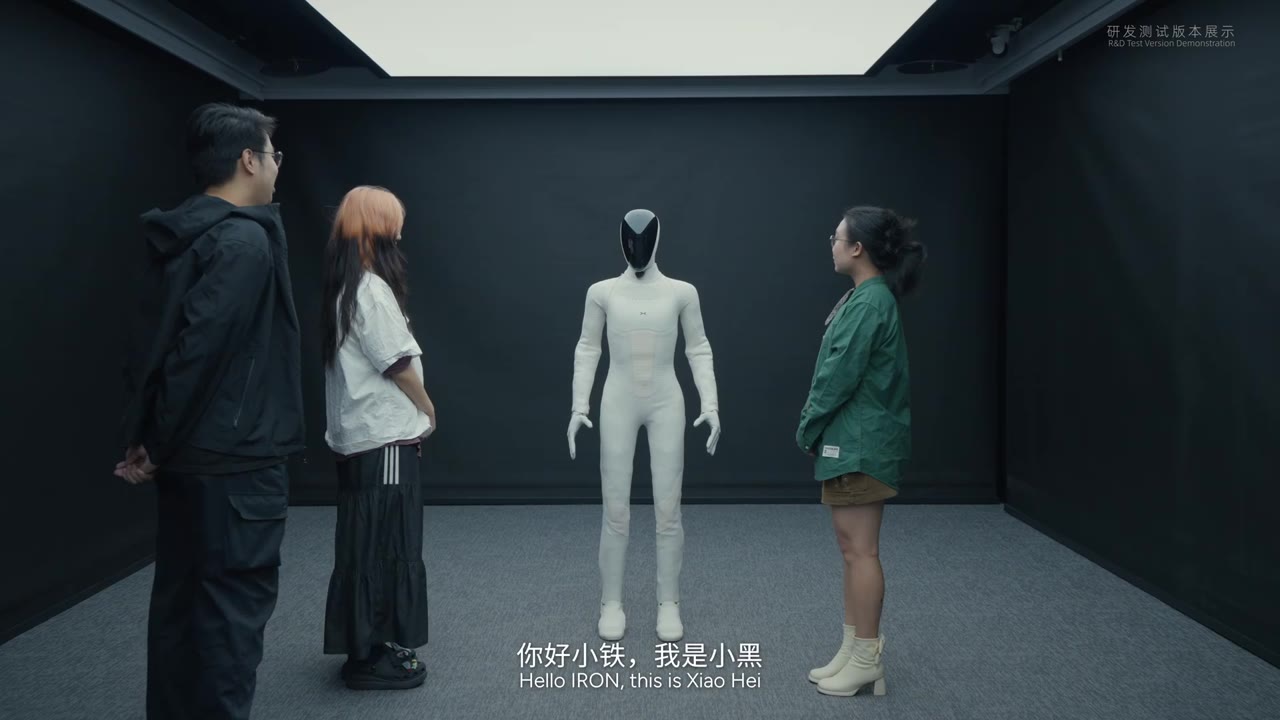
The first test puts IRON in the middle of a room with three people who introduce themselves one at a time — Xiao Hei, Xiao Lü and Xiao Bai, in black, green and white — each with a different car in mind: an SUV under 300,000 yuan for weekend camping (the G9L), the GX, and something good-looking and easy to park for a newly qualified driver (the MONA L03).
As the three move around the room, IRON turns to face whoever is speaking. XPeng describes the pipeline in three stages: a nine-microphone array locates the sound, a multimodal fusion mechanism reads lip movement to lock onto the actual speaker, and an anthropomorphic dynamic tracking strategy then decides how to move — a small turn of the head, a medium turn at the waist, or a full-body turn for a large angle, rather than rotating on the spot.
The narration's argument is that humans adjust their posture face to face without thinking, whereas for a robot "every one of those unconscious behaviours is the result of a large AI model working in precise coordination with hardware."
2. Memory: recognising people after they swap places
For the second test the three testers swap positions and change clothes. IRON still greets them correctly — in one exchange it answers an English question about the GX, then addresses Xiao Hei by name and recalls that he is the one interested in the G9L.
XPeng says IRON captures facial and voiceprint features at a first meeting, combines them with what was said, and builds a dedicated digital memory file for that person, updated at every subsequent meeting. The video frames this as breaking two natural limits of human social memory: memories fade with time, and they blur when there are many people.
3. Language: Chinese, English and German in one sitting
IRON answers an English question in English ("Hey IRON, do you remember which car I like?" — "The GX, Xiao Lü. Big, bold and totally your style"), a Chinese question about fitting a family of five plus filming gear into the G9L, and then a German-speaking customer who says he can barely lift anything and hopes to buy IRON in Germany. IRON replies in German — recommending the MONA L03 and its parking assist — and signs off with "Deal, we'll see each other in Germany."
XPeng's explanation is a three-step recipe: a base model that is multilingual by nature, scientific post-training to make the expression natural, and balanced multilingual training data "so it never skews to one language." The claim is that no extra commands are needed — you simply start talking.
4. Questions: the store sales guide
The last section names IRON's first jobs, and the one it demonstrates is retail sales: answering questions about the cars on the floor. XPeng says the robot runs three of its own Turing chips onboard, with up to 2,250 TOPS of effective compute, so it can query a local knowledge base or search online with low latency, and use its continuous memory to make proactive recommendations.
That is the same three-chip, 2,250 TOPS figure XPeng quotes for the G9L — we broke down the full Turing ladder and the launch pricing here — and one number in the video lines up with the published car: IRON says the G9L's boot still swallows the family's kit with "more than 1,100 litres," where XPeng quoted 1,152 litres of luggage space at launch.
What the tests actually show
- Orientation following is the most verifiable. Three people move independently in a fixed studio, and the video annotates which of them IRON is tracking at each moment. It is still a demonstration, but the behaviour is visible rather than asserted.
- The identity test is the strongest claim. Position and clothing change, and recognition survives both — the classic failure mode for face-only systems.
- The multilingual claim is real but narrow. English and German are both demonstrated, and the German segment is the interesting one, because it points at European retail rather than a Chinese showroom.
- The Q&A test is the weakest as evidence. The questions are soft and the answers short; nothing here shows how IRON handles an uncooperative customer or a question outside its knowledge base.
Caveats
- Company footage, R&D build. The video carries XPeng's own "R&D Test Version Demonstration" watermark, and the prompts are scripted.
- One studio, one afternoon. Nothing here is evidence about performance in a real store, with noise, crowds or poor acoustics.
- No failure cases are shown. A four-for-four demo video is a marketing artefact; the useful question is how often it does not work.
- A naming slip in XPeng's own caption. The English caption reads "XPENG L03" where the Chinese says MONA L03 — the same car, two names, and a reminder that the English captions are XPeng's, not ours.
- IRON's dates have not changed. Production is targeted for the end of 2026 with China deliveries from Q2 2027, as He Xiaopeng set out at the G9L press conference — our write-up of that session is here. Nothing in this video moves those targets.
Source: 小鹏汽车 and XP-何小鹏 (Weibo) — translated & adapted for XPENGTech. Update, 22 October: XPeng has since shown the same VLA 2.0 generation running on the robot for physical interaction rather than conversation - IRON reading a handshake that turns into a fist bump and then a high-five, re-reasoning every 0.2 seconds and switching arms mid-movement. That episode is written up here.
Get the next one direct.
New articles, or a daily / weekly digest — the same list EVConduit keeps.