
14 October 2026
XPeng's NGP Takes On the Arc de Triomphe Roundabout
He Xiaopeng has published a four-and-a-half-minute video of the G9L driving through the Arc de Triomphe roundabout with NGP engaged - no lane markings, no signals, twelve avenues, France's priority-to-the-right rule and pedestrians in the road. He frames it as the third step after Germany and the Netherlands. We look at what the footage shows, why the junction is a fair test, and the attempt and intervention data it does not include.
He Xiaopeng has posted a four-and-a-half-minute video of the G9L taking on the Arc de Triomphe roundabout in Paris with NGP engaged — the junction he calls "the world's hardest roundabout."
His description of why: no lane markings, no traffic lights, twelve avenues converging, traffic that has to be read continuously, France's "priority to the right" rule to observe, and pedestrians standing in the middle of the road taking photographs. "Genuinely very challenging."
The company's read on the result, from the same day's Chinese coverage: the Turing system completed the traffic judgement and route decisions itself and drove through steadily, and He Xiaopeng described the car's behaviour as that of "a European veteran driver."
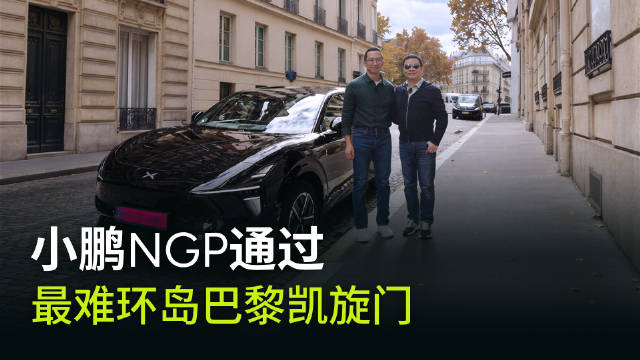
▶ Play the 4½-minute roundabout run
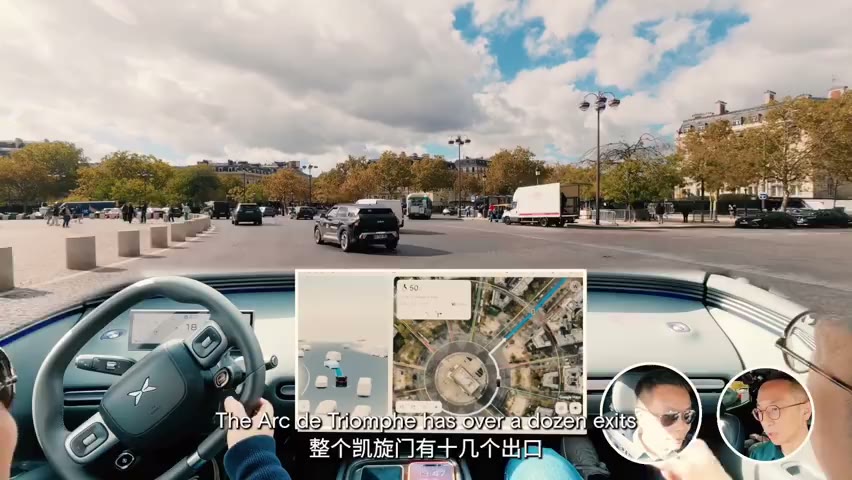
Mid-roundabout: the car's own visualisation on the centre screen, traffic on all sides, the Arc behind. Image: He Xiaopeng on Weibo.
What the video shows
It is a produced piece rather than raw dashcam: the view is from inside the car looking forward, with the centre screen's visualisation inset, bilingual Chinese and English commentary subtitles ("The Arc de Triomphe has over a dozen exits"), and two commentators in picture-in-picture. The sequence runs from the approach — the monument filling the windscreen, traffic crossing in front — into the circulating carriageway, where the screen shows the roundabout and the vehicles around it.
The hands are off the wheel in the footage. There is no visible intervention and no cut to a driver grabbing the wheel.
Why this roundabout is a fair test
The Arc de Triomphe is not a stunt location. Twelve avenues empty into it, there are no lane markings to follow, there is no signal control, and the normal French roundabout convention — entering traffic yields — is famously replaced here by priorité à droite, where vehicles coming from the right have priority. Add the density, the buses and scooters, and the tourists who walk into the carriageway to photograph the arch, and it is about as hard as European urban driving gets inside one 200-metre circle.
That is the argument for the demonstration: if the stack handles this, most of what a European city can throw at it is downstream. It is also a junction XPeng did not choose for convenience, because there is no way to make it easy.
He Xiaopeng frames it as the third step in a deliberate sequence: Germany in July for localisation acceptance testing, the Netherlands with its waterway-laced narrow roads, and now the Arc de Triomphe — with the model's generalisation "continuously improving and getting stronger in real combat."
What the video does not show
This is where the published evidence stops short of the claim, and it is worth being precise about what is missing:
- How many attempts it took. A successful pass is shown; the number of runs, and whether earlier ones needed intervention, is not stated.
- Any measurement. No intervention count, no time spent circulating, no number of laps, no disengagement rate.
- Whether the run is continuous. The piece is edited with commentary; it is not presented as one unbroken take, and there is no timecode to check it against.
- What the driver did. The post says he drove it; the coverage says he "personally sat in" the G9L. Neither describes the driver's role during the roundabout itself, beyond footage of hands off the wheel.
None of that makes the run unimpressive. It makes it a demonstration rather than a result — the same distinction that applies to every assisted-driving clip a manufacturer publishes.
Where this fits
It lands in the same week as three other NGP claims, all from the same company with different degrees of independence. The Paris show's Autonomous Lab put XPeng and Tesla alone in front of the public on real streets, and the overseas reviewers' verdicts from that programme were compiled by XPeng-side accounts. He Xiaopeng posted his own verdict after riding in a Tesla with FSD engaged. And XPeng's engineers told Bloomberg that NGP is about two weeks' work per new European country, using a ten-thousandth of the training data.
The Arc de Triomphe run is the visual argument for that two-week claim — and the one piece of it a sceptic could, in principle, falsify, by going to the same roundabout with the same car and counting.
Caveats
- One published pass, edited. No attempt count, no intervention data, no duration, no unbroken take.
- Published by the CEO, on his own account, in the week his company is selling both the car and the software in Europe. Chinese coverage of the run is based on the same material.
- The bilingual subtitles and picture-in-picture commentary indicate a produced video, so the sequence is a selection rather than a recording.
- "World's hardest roundabout" is XPeng's phrasing. It is a genuinely difficult junction; the superlative is marketing.
- The French "yield to the right" rule is how the post describes priority at this roundabout; French priority law is more nuanced than one line, and the system's compliance with it has not been independently verified.
- NGP remains a Level 2 system. Every run described here had a driver present and responsible.
- The comparison context is all company material. The Amsterdam test, the Paris reviewer quotes and this video share one constraint: none is an independent, measured comparison.
The bottom line
On the merits of the location, this is the right way to demonstrate a driving stack: pick the junction everyone in the city avoids, drive it in daylight with the cameras running, and let people judge. What is missing is the part that would turn it into evidence — how many tries, and how many times a human had to take over. Until a manufacturer publishes that, a clean run through the Arc de Triomphe is a strong suggestion and not yet a number.
Update, 19 October 2026
The clip circulated again on 19 October, reposted by the financial blogger 姬永锋 with a one-line joke about the Paris horizon, and the video now shows around 146,000 views on Weibo. Two details in that wave of coverage are worth recording.
The first is a claim about who was watching. XPeng says officials from the French Ministry of Transport rode in an NGP car at the Paris show and "repeatedly praised its comprehensive capabilities and road compliance performance." We have not found independent confirmation of the visit or the wording, so read it as a company statement — and note what it is a statement about. For the regulator of the market XPeng wants to enter next, a favourable description is precisely the sort of thing a company reports about itself.
The second is the regulatory counterpart. The same week, XPeng was elected secretary of a newly created UNECE working group on exchanging autonomous-driving scenario information (TF-ESRI) under the GRVA framework — we covered that separately. A demonstration run through the world's most awkward roundabout and a seat at the table where the rules are drafted are two halves of the same argument.
What has not changed is the evidentiary position. Neither NGP nor Tesla's FSD is authorised for use in France today, and XPeng is targeting 2027 for its European rollout. A clean lap of the Arc de Triomphe, however many people watch it, is still not a published rate of intervention.
Source: He Xiaopeng's Weibo post and video of 14 October 2026, with 大河报's report of the same run, 姬永锋's 19 October repost and our earlier Paris coverage — translated & adapted for XPENGTech.
Get the next one direct.
New articles, or a daily / weekly digest — the same list EVConduit keeps.