
21 October 2026
XPeng's Own Test: MONA L05 vs a Mercedes GLC on Six Dynamic Conditions
XPeng's media test drive leaked a 3:20 proving-ground comparison: the MONA L05 against a 300,000-RMB-class luxury SUV (its dimensions and badge identify a Mercedes-Benz GLC) over three items and six conditions - ride comfort, steering agility, anti-motion-sickness. The L05 is ticked on all six, turns in 5.4 m against 5.68 m, and does a one-shot U-turn at a 4.3 m lane width. The video carries XPeng's own disclaimer: its test facility, non-standard conditions, comparison only.
A second leak from the same media test drive, this one a 3:20 video, sets the MONA L05 against a 300,000-RMB-class luxury SUV on a proving ground and marks it the winner on six of six conditions. The poster is 烟隐烟隐, the account that published the L05 pre-sale price slide ten days ago, and it puts the comparisons at three items, six conditions.
The video names the rival nowhere: the badge is blurred and it is captioned 某30万级豪华车, "a certain 300,000-RMB-class luxury car". Its dimensions, 4,826 mm long and 1,890 mm wide, and its front-end graphics identify it as a Mercedes-Benz GLC — which is also the car the post names outright, alongside an American model that does not appear in the footage.
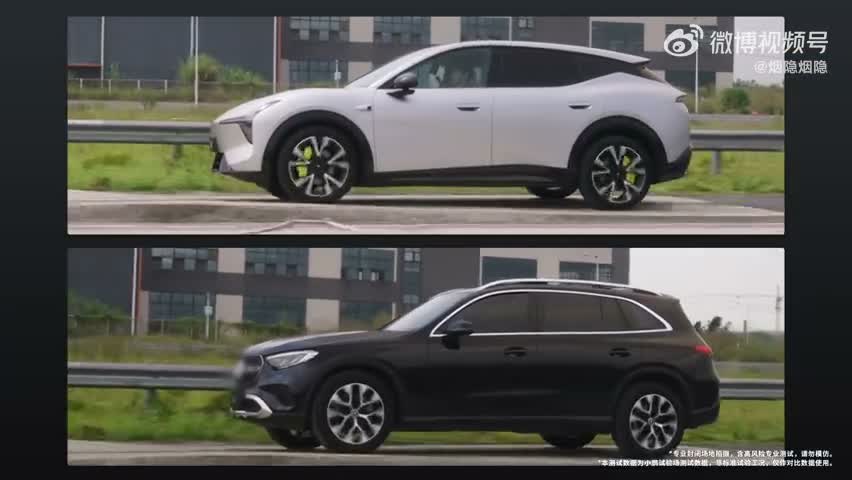
▶ Play the 3:20 test (Chinese captions; English subtitles on the YouTube version) — no narration, so the subtitles translate the on-screen cards. The same cut is on YouTube, unlisted, with an English caption track: youtu.be/S79IEH30u5c.
The test as it is run
The video opens on XPeng's proving ground and the same two cars run each exercise back to back, marked on screen as 同一条件, 同一测试标准 — same conditions, same test standard. The three items and their two conditions each:
| Item | Condition A | Condition B |
|---|---|---|
| 1. Ride comfort | Continuous undulating road | Continuous speed bumps |
| 2. Steering agility | Fixed-radius turn | Narrow-corner lane |
| 3. Anti-motion-sickness | "Accordion foot" stop-start | Continuous corners |
A disclaimer in the bottom-right corner of every frame states the terms: the data comes from XPeng's own test facility, the conditions are not a standard test cycle, and the figures are for comparison only. That is the honest framing of a manufacturer's internal benchmark, and it is worth holding on to, because everything else in the video is a verdict rather than a measurement.
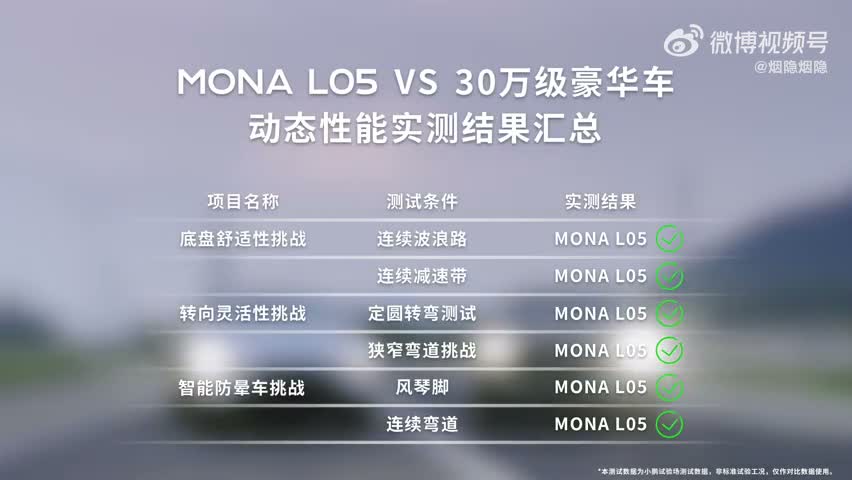
The summary card: six conditions, the L05 ticked on every one. Image: via 烟隐烟隐 on Weibo.
Where the numbers are
Four numbers appear on screen, and three of them are comparable between the two cars:
- Turning radius: 5.4 m for the L05, 5.68 m for the comparison car. The L05's 5.4 m is XPeng's published figure; 5.68 m is what the video measured for the GLC.
- A U-turn at a 4.3 m lane width. On an overhead diagram of the same manoeuvre the L05 is marked at 5.4 m and 5.6 m of radius, the GLC at 5.8 m and 6.0 m. The caption's claim is 窄路掉头一把过 — a one-shot U-turn on a narrow road; the diagram is what supports it, and the geometry is checkable in the frames.
- Dimensions: 4,870 × 1,930 mm against 4,826 × 1,890 mm, with the two cars photographed nose-on under measurement lines. The L05 is 44 mm longer and 40 mm wider, so the tighter turning circle is being achieved with the larger footprint, not a smaller one.
The rest of the claims come from the post rather than from the footage. XPeng's figures for the car, restated there, are 0-100 km/h in 6.8 s, 100-0 km/h in 34.22 m and the 5.4 m turning radius — and the post's quietness claim is a list of hardware rather than a dB figure: double-glazed front side glass, acoustic material over 90% of the body, 24 cavity baffles, a low-wind-noise body shape and an RNC active noise-cancellation system, with the assertion that the L05 beat both comparison cars on every measured item.
The anti-sickness mode is the interesting part
The third item is not a chassis metric borrowed from a spec sheet; it is a feature, and the video shows its menu screen. Turning on 防晕车模式, motion-sickness mode, produces a confirmation dialog that explains what it does:
It applies to situations that easily cause car sickness, such as hard acceleration and braking. By adjusting power output, brake response and body attitude it lowers the probability of passengers feeling unwell and eases discomfort. In this mode power and braking are softened, smooth braking is applied, energy recovery is switched off, and stop mode and the AI chassis are disabled. After switching it off the car must be stationary and stop mode must be restored manually.
That last sentence matters to an owner: this is not a drive mode you flip in traffic and forget, and it trades efficiency (no regen) and one-pedal behaviour for passenger comfort. The demonstration itself uses a glass of butterfly-pea flower water in the cupholder as a mechanical readout of motion — front-to-back slosh for pitch under acceleration and braking, side-to-side slosh for roll through the slalom — with the L05 in one column and the GLC in the other. The captions state the intent: 制动不点头, less squat and less dive, and 过弯不摇摆, lateral movement and roll building more slowly.
As a visual method it is honest in one respect and weak in another. The water does move differently between the two cars, which is visible without instrumentation; but two glasses, two runs and one camera angle cannot separate suspension tuning from tyre choice, load, or the anti-sickness mode itself being active on only one car — which the video never states.
What this adds to the L05 story
The car's positioning has been about price and equipment: 169,800 to 191,800 RMB at pre-sale, a 2,940 mm wheelbase, a 17.3-inch centre screen and a 17.3-inch roof screen, 14-point massage in front. This is the first material that argues about how it drives — and it does so against a car the video classes as 300,000 RMB — the bracket XPeng has aimed the L05 at since it started calling it a big five-seat SUV for young people with 30万-level equipment. The GLC is a dearer car than that label suggests at list price; the video uses the segment, not the transaction price.
There is a second, quieter claim in the numbers: 5.4 m turning radius and a one-shot U-turn at a 4.3 m lane width in a 4,870 mm car is a manoeuvrability result, and manoeuvrability is what Chinese urban buyers actually notice. The GLC's 5.68 m is not a bad figure for its class; it is simply larger than the L05's, and the video's own diagram shows the gap at the tightest radius.
Caveats
- XPeng's own ground, XPeng's own conditions. The on-screen disclaimer says the data comes from the company's test facility and is not a standard test cycle. There is no third-party timing gear, no acceleration trace and no published protocol.
- The competitor is anonymised in the video. We identify the car as a Mercedes-Benz GLC from its dimensions (4,826 × 1,890 mm) and front-end design, and from the post, which names the GLC. XPeng's video deliberately does not, and we have not seen the GLC's specification, tyres, load or tyre pressures.
- The American car the post mentions is not in the footage. The post says the comparison covered a German luxury SUV and an American model; only one rival appears on screen.
- Six ticks are verdicts, not scores. No metric is shown for items 1 and 3 — only the caption and the green tick — and the anti-sickness mode's state in the comparison car is not stated.
- Three published numbers are XPeng's (6.8 s, 34.22 m, 5.4 m) and appear in the post, not as measured overlays in the video. The 5.68 m GLC radius is the only figure in the video that is unambiguously a measurement of the rival.
- This is leaked media-drive material, not a press release: it was shot at a media test event and published by a third-party account, with the disclaimer intact.
- The launch is 29 October, so the car being tested is not yet in customer specification.
The bottom line
A manufacturer comparing its own car to a rival on its own track and winning is not news; a manufacturer publishing the disclaimer that says so, and a turning-radius diagram precise enough to argue with, is more useful than most of what passes for handling coverage. Take the six ticks as XPeng's opinion, take 5.4 m against 5.68 m and the 4.3 m U-turn as the checkable part, and treat the anti-sickness mode as the genuinely new product information here — one that costs the owner regeneration and one-pedal driving to buy a calmer passenger.
Source: the Weibo post and video by 烟隐烟隐 (21 October 2026), shot at an XPeng media test drive, with XPeng's own test-facility disclaimer and the pre-sale material published on 15 October — translated and adapted for XPENGTech.
Get the next one direct.
New articles, or a daily / weekly digest — the same list EVConduit keeps.