
7 October 2026
XPeng Tops a Chinese Ranking of Physical AI Driving Companies
A Chinese consultancy, DBC, has ranked the country's ten leading "physical AI" driving companies and put XPeng first, on a bar of mass production plus a data loop plus new scenarios. The table runs from XPeng through Momenta, Huawei, Horizon, WeRide, ZYT, DeepRoute, QCraft, MINIEYE and Qianli Technology. We set out what is verifiable in XPeng's case, what is self-reported, and why a list built on XPeng's own three growth curves is a narrative judgement rather than a measurement.
A Chinese consultancy has published its ranking of the country's ten leading "physical AI" driving companies, and put XPeng first.
The list — 2026 China Physical AI Driving Companies Top 10, from DBC (德本咨询) and republished on Weibo by the account 姬永锋 — is not a sales table or a benchmark. It is a judgement about narrative and shipping. The selection bar is stated up front: an explicit physical-AI strategy plus all three of a mass-production base, a data closed loop and an extension into new scenarios. The table also says the quiet part out loud — next to each company it prints a Chinese idiom or line of poetry expressing its approval. XPeng's is "the peng journeys ten thousand li, soaring straight up," for a company the ranking describes as the only one pushing physical AI across passenger cars, flying cars and humanoid robots at the same time.
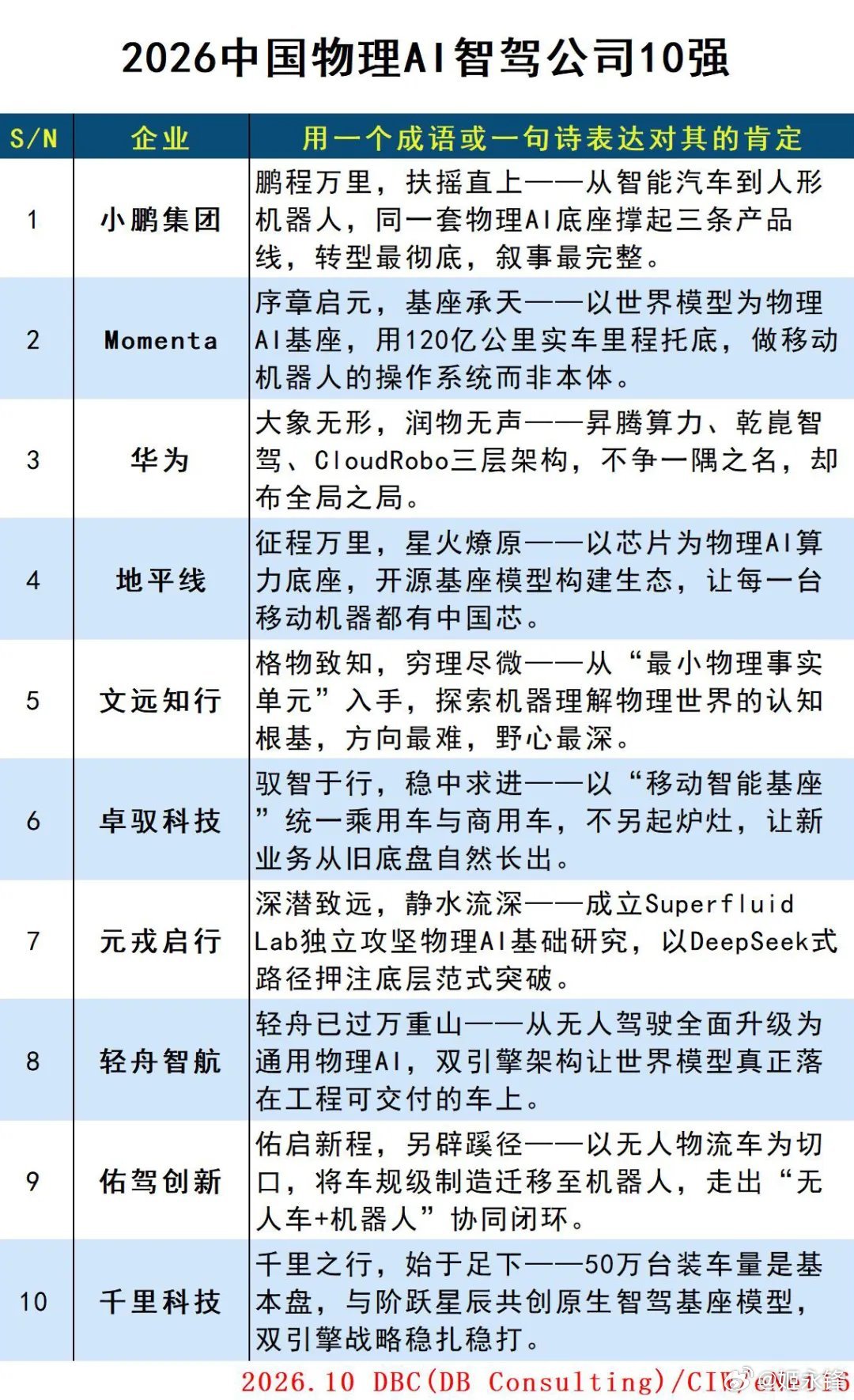
The DBC table as published with the post. Image: DBC (DB Consulting).
Why XPeng is at the top
Most of the case rests on things XPeng has said itself, and which can be checked against its own releases.
- VLA in production. The second-generation VLA stack began rolling out to customers on 19 March, and XPeng reported that assisted-driving mileage passed 50% of total mileage in the first month, with one model covering both L2 assistance and L4 capability. We have followed that rollout and what it looks like from the driver's seat in this piece on the 6.3.0 release.
- One model, three bodies. He Xiaopeng's internal letter of 10 June took the unusual step of naming the group CEO as CEO of the robot business as well, calling it "not a simple business upgrade, but an important step in XPeng Group's transformation from a 'smart car company' to a 'physical AI' company."
- A robot line, not a demo. On 9 September XPeng started up its humanoid production line and showed a robot completing automated final assembly and walking off it — we covered the IRON programme — with more than 80% of core processes automated. IRON carries three Turing chips at 2,250 TOPS and 76 degrees of freedom; XPeng's target is scaled production by the end of 2026, commercial deployment starting in its own stores and campuses, and customer deliveries in 2027.
- Money following the story. On 24 August the robot business raised more than US$900 million at a post-money valuation above US$6.3 billion, which XPeng describes as a record single private-equity round for China's embodied-AI sector. Tesla is not the only company whose robotics plans are being priced separately from its cars — we looked at that comparison here.
The other nine
These summaries are the ranking's, not ours — we have not independently verified each company's figures.
- Momenta — the clearest capital-markets version of the story: the R7 world model entered mass production in April, built on more than 12 billion kilometres of real-world mileage, and the company has passed its Hong Kong listing hearing. Its positioning, in the ranking's words, is to be the "operating system" of physical AI rather than a body.
- Huawei — a platform play: the CloudRobo embodied-AI platform in public beta, Ascend compute and Qiankun ADS beneath it, and a RMB 200 million sanitation-autonomy development agreement with Fulongma that takes driving intelligence out of passenger cars. The listed risk is organisational: the capability sits across three business units.
- Horizon Robotics — the silicon route. Its fourth-generation BPU, "Riemann", is described as designed for physical AI; it open-sourced the HoloBrain VLA base model in February 2026, and says Journey-series chips have shipped more than 15 million units to over 40 car brands.
- WeRide — the cognitive layer: WITT, a "physical AI cognitive foundation model" built around decomposing scenes into verifiable physical facts, plus the GENESIS simulator. A partnership with Lenovo targets 200,000 autonomous vehicles over five years.
- ZYT (卓驭科技) — "mobile physical AI": one base for passenger cars, commercial vehicles and unmanned logistics, a deep strategic partnership with FAW, and a plant already producing in Changzhou. The ranking notes it did not start a robot programme, preferring to extend the existing chassis of the business.
- DeepRoute.ai (元戎启行) — basic research as an organisational unit: the Superfluid Lab, led by a former DeepSeek core member, works on VLA, world models and multimodality. The ranking credits it with China's first map-free ADAS (2023), first mass-produced end-to-end model (2024) and first VLA supplier launch (2025).
- QCraft (轻舟智航) — the most complete repositioning, from "driverless" to "general physical AI" in April, with a dual-engine architecture (cloud world model for generating rare and dangerous scenarios, on-car world behaviour model) and a 500+ TOPS city NOA system.
- MINIEYE (佑驾创新) — the most decisive move off the car: a mobile-robotics arm seeded with a RMB 240 million angel round, quadruped robots, and a tie-up with Honor on unmanned logistics from warehouse sorting to last-mile delivery.
- Qianli Technology (千里科技) — "AI plus car": 19 models across Zeekr, Lynk & Co, Geely Galaxy and smart, more than 500,000 units installed and a 92% assistance activation rate, with a native driving base model built alongside StepFun. The ranking calls its physical-AI case early but structurally different.
The argument underneath the list
The closing section of the post is more interesting than the ranking. Its claim is that physical AI is "not a collective upgrade of the industry but a stratification," and that three kinds of company will not make the crossing: those with an L4 story but no volume, revenue or durable asset structure; those with volume but no technical route into world models or VLA; and those with algorithm demos but neither a car nor a scenario. Its line for the gap between them: "models can be migrated in part; engineering capability cannot be copied automatically."
Read coldly, that paragraph is a description of the Chinese assisted-driving field in 2026, where a long list of suppliers is trying to re-label itself as embodied AI. And the three conditions the ranking selects on — mass production, data loop, scenario extension — are close to word for word the three growth curves XPeng has been presenting to investors: cars, robots and globalisation. A list that selects on a company's own criteria and then ranks that company first tells you the story has landed with Chinese analysts. That is worth knowing. It is not the same as a measurement.
What the list does not tell you
- There is no published methodology. DBC has not set out its scoring, weightings or data sources, and the ranking is an editorial judgement rather than an index.
- The inputs are largely self-reported. The mileage share, the chip shipment totals and the activation rates come from the companies themselves.
- The idiom column is a flourish, not a metric — the table is explicitly rhetorical in form.
- It is China-only by construction. It excludes the suppliers winning European contracts, and it excludes Tesla, the most valuable physical-AI story of all, for no reason other than nationality.
- Order is not capability. Almost everything separating number one from number five here is the completeness of a narrative, which is exactly what the list says it is measuring.
The bottom line
The practical value of a list like this is that it puts XPeng at the top of a category its rivals are all claiming — and it is the category, not the car, that is being valued right now. The checks that will actually settle it are smaller and further out: whether the robot line produces at the end of the year, whether the assistance mileage share holds, and whether "physical AI" turns into revenue rather than a slide.
Source: DBC (德本咨询) ranking, republished by 姬永锋 on Weibo, with XPeng's own releases for the company facts — translated & adapted for XPENGTech.
Get the next one direct.
New articles, or a daily / weekly digest — the same list EVConduit keeps.