
20 September 2026
XPeng Will Build Its Own Battery Packs From 2026 — But Not the Cells
Asked about self-developed batteries after the G9L launch, He Xiaopeng said XPeng now does its batteries itself — 'not the cells'. From 2026 XPeng leads pack design, the BMS and thermal management, with stakes in three cell makers (CALB, Sunwoda, SVOLT) and cells still bought in. Here is what pack-level control actually buys, how it differs from Li Auto's deeper cell-level approach, and what the 'escaping CATL' commentary does and does not establish.
Asked about self-developed batteries after the G9L launch on 17 September, XPeng Group chairman and CEO He Xiaopeng gave an answer that is worth reading carefully, because the headline and the substance are not the same thing:
"From this year, XPeng does all its batteries itself. Not the cells — investing in cells ultimately means they belong to someone else. We have also invested in three cell companies, but from this year we do the batteries ourselves."
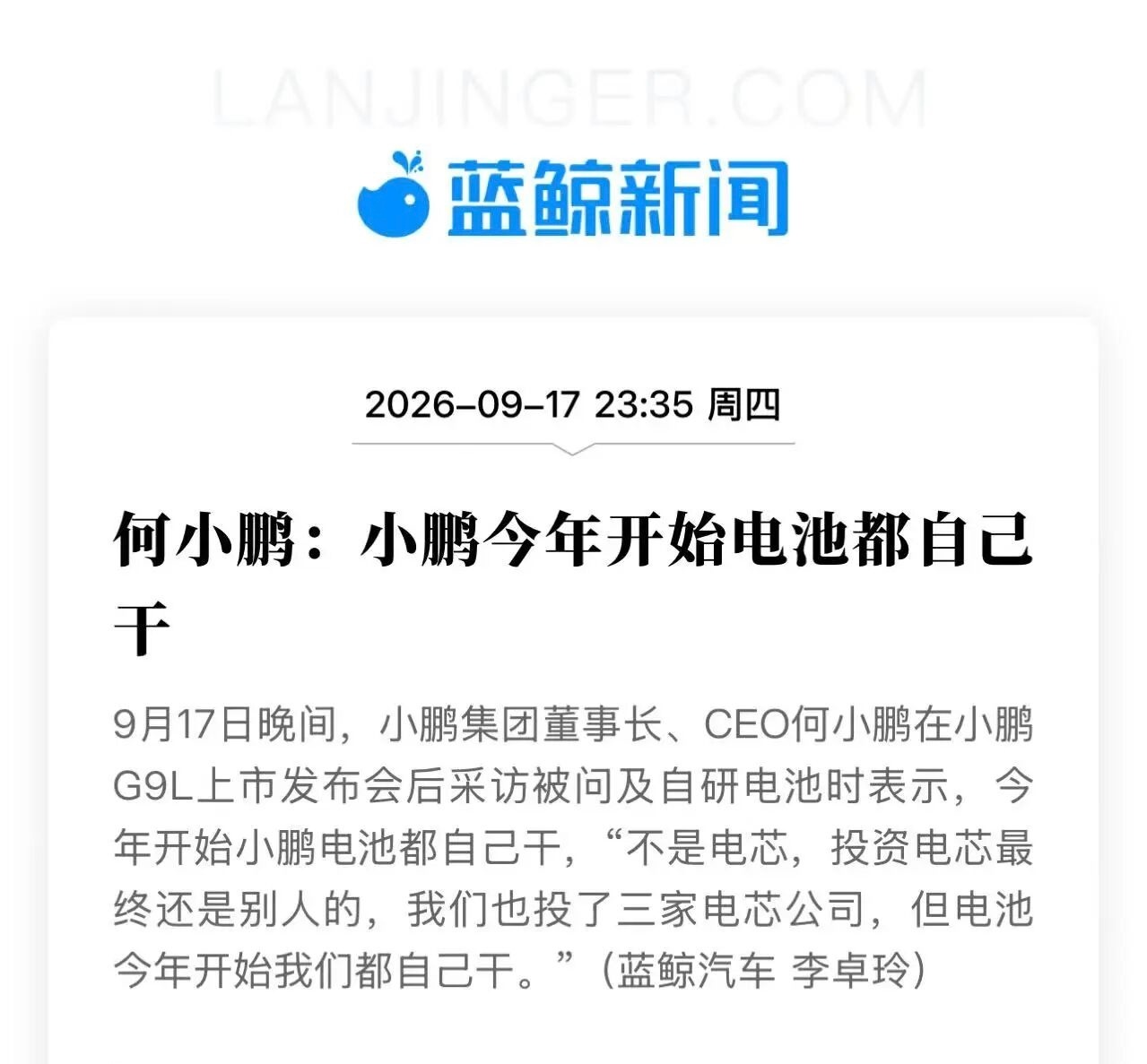
The quote was reported by Blue Whale Auto (蓝鲸汽车) and CLS, and the Chinese commentary account 一顶思考帽 used it to make a blunter point: whichever approach a carmaker takes, the important part is that the industry is no longer dependent on a single battery supplier — in his framing, CATL.
What "doing batteries ourselves" actually means
XPeng's move is at the pack (整包) level, not the cell level. From 2026 the company leads pack design, the BMS (battery management system) and thermal management — the three areas where a carmaker can still differentiate even when buying identical cells from the same suppliers.
What that buys, concretely:
- Pack architecture. Deep customisation of the physical structure improves volume utilisation — how much cell capacity fits into a given space — which raises pack-level energy density (Wh/kg) without changing cell chemistry.
- BMS strategy. A carmaker-developed BMS can align charge and discharge rate strategy with how the vehicle is actually driven, produce more accurate state-of-charge estimation, and extend cycle life. This is the part that decides whether a 5C claim holds up in year five.
- Thermal management. Liquid or direct-cooling plate design determines how much heat can be pulled out during high-rate charging. Paired with an 800V platform, in-house thermal design is what keeps peak charging power sustained rather than momentary — the difference between a fast-charging demo and repeatable fast charging.
In other words, XPeng is taking the definition rights over its three-electric system without taking on heavy cell manufacturing. The cells remain external; the integration, software and thermal behaviour become in-house.
The three cell investments
The quote names three cell companies without listing them; public reporting identifies CALB (中创新航), Sunwoda (欣旺达) and SVOLT (蜂巢能源) — all three of which have progressively entered XPeng's battery supply system. Holding stakes is not the same as making cells, and He Xiaopeng's phrasing is unusually direct about why: investing in cells still leaves the cells belonging to someone else.
That distinction matters because Chinese cell supply is no longer scarce. NCM811 and LFP capacity is abundant, which shifts the competitive question from "can we get cells?" to "how well is the pack integrated?" — and pack integration is exactly where a carmaker can still out-engineer a competitor using the same supplier.
"Escaping CATL" — the commentary, and the evidence
The Weibo post's central argument is that carmakers can and will break away from CATL, and that arguments about which chemistry is better or safer are secondary to that. That is commentary rather than a company statement, but it is not baseless: XPeng's current supply mix already has CALB as its lead supplier across the G6, G7, GX, X9, G9L and MONA L03, with no CATL batteries in the GX at all — a picture we covered in our earlier article on XPeng's battery supply landscape.
The wider trend is real too. Chinese EV makers including XPeng, Li Auto and Xiaomi are all moving away from single-sourcing cells and towards greater control of the pack.
Where XPeng differs from Li Auto
The post notes that Li Auto intervenes more deeply, technically — and that is supported by the reporting:
- Li Auto recently took a ¥2.65 billion strategic stake in Sunwoda Power, and the new-generation Li L8 switches entirely to Sunwoda cells. Its i9 uses a self-developed battery, with Li Xiang framing it as keeping the decisions about the product in-house.
- Xiaomi's new model uses its own designed "Dragon Armour" battery system, with cells supplied jointly by CALB and Sunwoda.
- XPeng, by contrast, is explicit that it is not making cells — it is leading the pack, the BMS and the thermal system.
So the industry is converging on the same conclusion — the carmaker should own the pack — while splitting on how far up the chain to go. Li Auto has moved into cell-level partnerships; XPeng is drawing the line at integration.
What to keep in mind
- The quote comes from a post-launch interview as reported by Chinese media, not a formal product announcement; the specific investment names come from public reporting rather than the quote itself.
- Pack self-lead is not cell self-supply. The cells in a 2026 XPeng pack will still come from CALB, Sunwoda or SVOLT.
- The "escaping CATL" framing is the commentary's emphasis. The verifiable version is narrower but still significant: a large Chinese EV maker is taking engineering control of its battery packs and multi-sourcing its cells — and it is not alone in doing so.
Source: 一顶思考帽 on Weibo, 18 September 2026 — translated and adapted for XPENGTech. He Xiaopeng's quote was reported by Blue Whale Auto and CLS (17 September 2026); pack-level detail and the Li Auto/Sunwoda and Xiaomi comparisons via News18a's technical explainer and ITHome.
Get the next one direct.
New articles, or a daily / weekly digest — the same list EVConduit keeps.