
23 October 2026
XPeng Wins Forbes China's 'Most Employee-Favoured Employer' Award
XPeng Group has been named a 2026 Forbes China most employee-favoured employer. It is a sub-list of the Forbes China Best Employers programme, not the main ranking, and the methodology is worth knowing: 40% employer questionnaire, 40% anonymous employee vote, 20% audit. We set out the weighting and the wider results, XPeng's own six-goods care scheme, and the survey finding that workers use AI more but believe in it less - the claim XPeng's AI-heavy pitch has to keep earning.
XPeng's official account announced on 23 October that XPeng Group has been named a "2026 福布斯中国年度最受员工欢迎雇主" — Forbes China's most employee-favoured employer — in the 2026 Forbes China Best Employers programme. The post credits "employee experience, organisational management and AI-era human-machine collaboration", and lists the company's "six goods" care framework, its Explorer Programme and its benefits package.
That is accurate as far as it goes, but the award is worth reading precisely, because the label on the poster is a sub-list, not the main ranking.
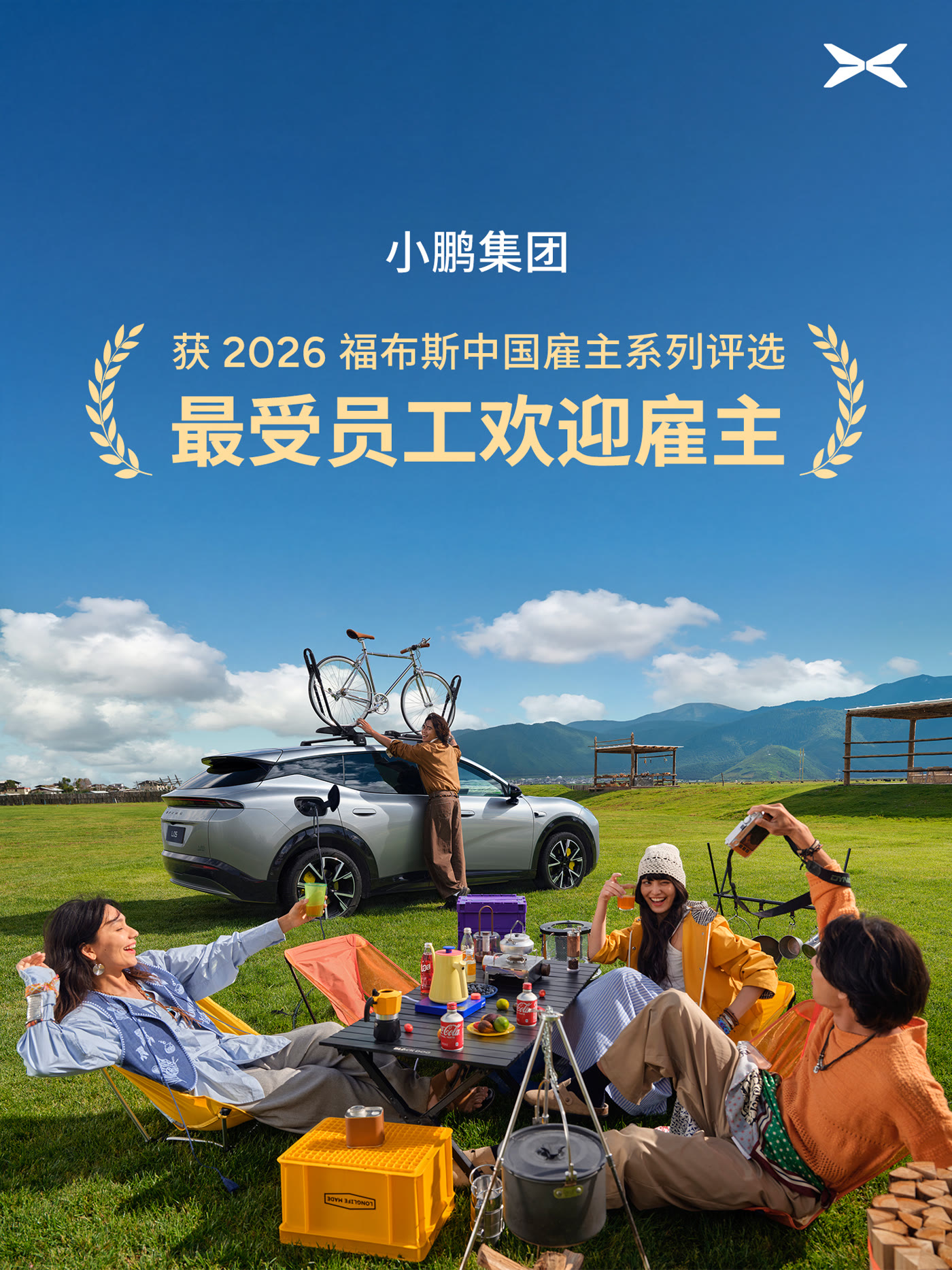
XPeng's own announcement poster. Image: 小鹏汽车 on Weibo.
What was actually awarded
Forbes China's Best Employers programme is in its sixth year, and for 2026 it published one main list and three sub-lists:
| List | 2026 winners (as published) |
|---|---|
| 2026中国年度最佳雇主 — the main ranking | Chery Automobile and Seres among the automotive names |
| 2026中国年度最佳AI实践雇主 — AI practice | separate sub-list |
| 2026中国年度最佳ESG实践雇主 — ESG practice | separate sub-list |
| 2026中国年度最受员工欢迎雇主 — most employee-favoured | XPeng and Xiaomi |
So XPeng took the employee-popularity sub-award, not a place on the main best-employer list. Chinese media covering the results on 20 October put Chery and Seres on the main list and XPeng and Xiaomi on the sub-list; suppliers including CATL, Bosch China and Sailun also appeared across the programme.
That distinction matters less than it might, because of how the score is built.
The methodology, which is the interesting part
Forbes China publishes the weighting, and it is unusually employee-heavy:
- 40% employer questionnaire — strategy and organisational capability, product innovation, operational and process efficiency, collaboration, profit distribution and risk management, and AI practice.
- 40% employee vote — an anonymous survey of the company's own staff, scored across six blocks: employer image, organisation and management, training and development, work environment, pay and benefits, and AI value creation.
- 20% public opinion and qualification audit — no major labour-safety incident and no major labour dispute in the year, or the points are lost.
Entry requires at least 300 employees, three years of stable operation in mainland China, and a clean record; the research partner is the leadership consultancy Russell Reynolds Associates. The 2026 employee sample was 40,537 responses, collected between 1 August and 15 September 2026.
A 40% employee vote is a real constraint on an award like this. It does not make it scientific — the employees surveyed are those of companies that applied — but it means a company cannot win the popularity sub-list purely by submitting a good deck.
What the 2026 survey says, and why it sits oddly beside the award
The same programme published its findings on AI in the workplace, and they are a useful counterweight to the language in XPeng's post. In the 2026 sample:
- 70.2% of respondents use a company AI tool at least once a day, up from 61.3% a year earlier.
- 91.1% say their company has provided AI training.
- But the share agreeing that AI improves work efficiency fell to 86.0% from 91.0% — more use, less conviction.
- Around 31% say AI has increased their workload, and that share is roughly the same among heavy users and light users.
- 37% say AI makes their output harder to evaluate fairly, and that group is far more likely to fear being replaced (71.3% against 9.5%).
XPeng's post leans on "AI-era human-machine collaboration" as one of the three things it was recognised for — and it is a company that has spent the autumn arguing that one Physical AI model runs its cars, its cockpit and its humanoid robot. That makes the award a claim about internal practice as much as external reputation: the survey's central finding is that adoption and felt benefit have come apart, which is exactly the gap a company selling AI has to close inside its own workforce first.
What XPeng says it does
The specifics in the post are the company's own description rather than anything the award publishes:
- A "six goods" care system — 吃好、身体好、学习好、家庭好、福利好、氛围好 — "eat well, health well, learn well, family well, benefits well, atmosphere well".
- The Explorer Programme (探索者计划) and other training channels for staff at different career stages.
- A stated aim of a "simple, efficient, respectful, inclusive and equal" workplace.
None of that is scored publicly; Forbes China does not release company-level results, so there is no way to see which of the 40% employee points XPeng won or lost.
Why a car company is collecting an HR award
The timing is not accidental. XPeng Group in late 2026 is hiring across three fronts at once — vehicles, humanoid robots and the AI stack behind both — in a Chinese labour market where every competitor is chasing the same machine-learning and robotics engineers. An employer-brand award is a recruiting asset, and "most employee-favoured" is the version of it that speaks to candidates rather than to investors.
It also lands in a week when the company's public reputation was being discussed for a different reason entirely: the L05 launch and the apology that followed it. An award post is not a rebuttal — it is a different conversation, published to a different audience, and it attracted 110 likes and 15 comments, against 376 on the apology video.
Caveats
- Self-nominated. Companies apply, submit an employer questionnaire, and their employees are surveyed afterwards. Companies that do not enter cannot win, so the list is a comparison among applicants, not a ranking of the industry.
- A sub-list, not the main ranking. XPeng took "most employee-favoured employer"; the main 2026 best-employer list named other companies, including Chery and Seres.
- No scores are published. We cannot see XPeng's employer-questionnaire result, its employee-survey score or its audit outcome — only the outcome.
- The employee sample is not a random poll of Chinese workers. It covers employees of participating companies, which is why Forbes itself cautions that year-on-year comparisons may be affected by sample composition.
- The "six goods" and Explorer Programme are XPeng's descriptions, not findings of the award.
- Awards programmes are commercial. Forbes China runs the programme with a research partner and an application process; that does not make the result meaningless, but it is not an independent audit of working conditions.
- Coverage of the wider list is second-hand. The main-list names above come from Chinese media reporting on the 20 October announcement, not from a full list we read on Forbes China's site.
The bottom line
XPeng has won a genuine Forbes China employer award, and the part worth taking seriously is that 40% of the score is its own employees' anonymous answers — a harder test than a jury. The part worth keeping in perspective is that it is the popularity sub-list of an application-based programme, that no scores are published, and that the same survey found Chinese workers using AI more and believing in it less, which is the claim XPeng's own AI-heavy pitch will have to keep earning.
Source: 小鹏汽车 (Weibo, 23 October 2026), Forbes China's 2026 Best Employers programme pages (methodology, sub-lists, questionnaire design and the 40,537-response employee survey), and Chinese media reporting of the 20 October results — translated and adapted for XPENGTech.
Get the next one direct.
New articles, or a daily / weekly digest — the same list EVConduit keeps.